
For laboratory research use only. Not for human or veterinary use.Lab research use only. Not for human or animal use.

Same-Day DispatchAustralian StockPremium Research GradePublished CoAsPayID · Clears in Seconds
Same-day dispatch on business-day orders before 12pm Sydney time.Same-day dispatch before 12pm Sydney timeFree standard post $199+Free std post $199+

Buy Tirzepatide Peptide (Tirz) in Australia

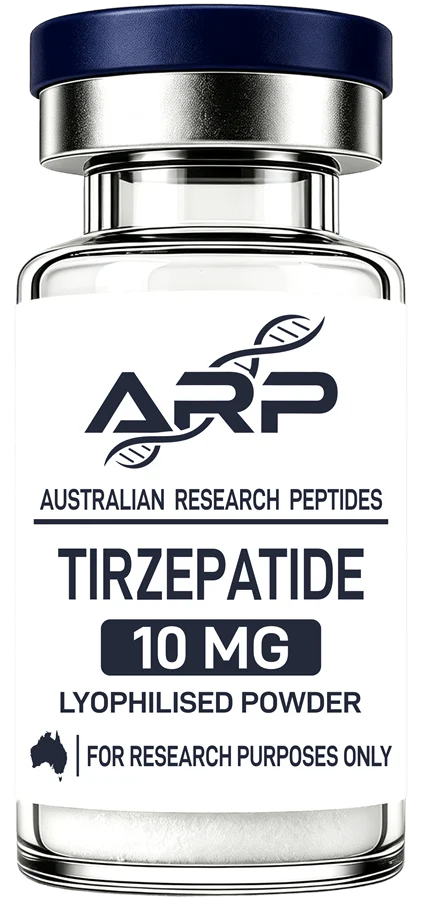
Tirzepatide, the dual GIP and GLP-1 research peptide often shortened to tirz, is sold to laboratories and researchers in Australia by Australian Research Peptides at A$129.99 for the 10 mg vial (out of stock), A$189.99 for the 20 mg (out of stock) and A$269.99 for the 40 mg (out of stock). Each vial holds freeze-dried tirzepatide, one laboratory-made chain of 39 amino acids modelled on the gut hormone GIP, with a 20-carbon fatty chain attached. In vitro research purposes only.

Metabolic Research · Lyophilised Powder · Independently lab-tested · SKU 43056
Out of stock·
$129.99

Tirzepatide 10 mg is sold out for now. Leave your email and ARP will send you one email the day it is back. Nothing else.

Presentation
10 mg per vial
Grade
Research Grade
Form
Lyophilised Powder
Category
Metabolic Research
Currently out of stock — stocked lines dispatch same business day before 12pm Sydney time, Mon–Fri
Tracked shipping Australia-wide · typically 1–2 business days to most areas by Express Post · free post over $199, free Express over $299
For in vitro research purposes only. Not for human consumption. Not for animal consumption. This product is not a drug, food, cosmetic, or dietary supplement. ARP gives no usage, medical or therapeutic guidance of its own.
Tirzepatide · 10 mg
$129.99
Notify Me

In stock at Australian Research Peptides

Tirzepatide is out of stock, and Australian Research Peptides has not put a substitute in its place. These are in stock on the shelf in Australia.

About Tirzepatide

Tirzepatide is a laboratory-made peptide studied in metabolic research that binds two hormone receptors, GIP and GLP-1, which is why it is called a dual agonist, meaning it binds and switches on two receptor types at once. Eli Lilly developed it under the code LY3298176. By receptor count it sits between the two other GLP-1-class peptides Australian Research Peptides lists, semaglutide at one receptor and retatrutide at three.

Its structure is one chain of 39 amino acids that follows the sequence of GIP, a hormone the gut releases. Positions 2 and 13 hold aminoisobutyric acid (Aib), an amino acid the genetic code does not specify, and the last amino acid carries an amide cap, a small chemical end-group. A 20-carbon fatty diacid, meaning a fatty chain with an acid group at each end, is joined through a short linker to the lysine at position 20, which the 2018 discovery paper says lets the molecule bind albumin, a common carrier protein.

In that paper's laboratory binding tests, tirzepatide held the GIP receptor about as tightly as natural GIP and the GLP-1 receptor about five times less tightly than natural GLP-1. Those are measurements made with cells in glassware, not results in any living subject. Australian Research Peptides supplies tirzepatide as freeze-dried reference material for in vitro work, meaning glassware and cell culture.

In Australia, Australian Research Peptides offers tirzepatide to laboratories and researchers as 10 mg, 20 mg and 40 mg vials, and each strength has its own page and stock code. Buyers also search for it as tirz or tirzepatide peptide. Orders are filled from Sydney and posted domestically, so none depends on an overseas shipment clearing customs. The CoA library shows which Tirzepatide strengths, if any, have a published certificate.

BAC water (bacteriostatic water) is also in our range.

The peptide calculator works out the mg/mL concentration of a reconstituted vial.

Tirzepatide vs Retatrutide vs Semaglutide

Tirzepatide binds two hormone receptors, one more than semaglutide and one fewer than retatrutide, and all three are supplied by Australian Research Peptides to laboratories and researchers as freeze-dried research powder. The table compares the molecules and the current listing for each.

Tirzepatide, retatrutide and semaglutide compared by receptor target, structure and Australian Research Peptides listing
ComparedSemaglutideTirzepatideRetatrutide
Receptors it bindsGLP-1GIP and GLP-1GIP, GLP-1 and glucagon
Number of receptorsOneTwoThree
Chain length31 amino acids39 amino acids39 amino acids
Modelled onGLP-1, a gut hormoneGIP, a gut hormoneGIP, a gut hormone
Fatty chain18-carbon fatty diacid20-carbon fatty diacid, at position 2020-carbon fatty diacid, at position 17
Strengths at ARP10 mg10 mg, 20 mg and 40 mg10 mg, 20 mg and 30 mg
Price at ARPA$119.99From A$129.99From A$139.99
StockIn stockOut of stockOut of stock
CertificatePublishedNot yet publishedPublished

Structure from ChEBI, the US FDA substance register and the developers' published papers. Price, stock and certificate are read live from the listings. In vitro research purposes only.

Tirzepatide specifications, storage and shipping

  • Compound: Tirzepatide
  • Also known as: Tirzepatide (LY3298176)
  • Class: Synthetic 39-amino-acid peptide; dual GIP / GLP-1 receptor agonist
  • Appearance: White to off-white lyophilised (freeze-dried) powder
  • Sizes & SKUs: 10 mg (43056), 20 mg (42817), 40 mg (47263)
  • Presentation: sealed glass vial
  • Form: Lyophilised Powder
  • Grade: Research grade
  • Testing: Independently lab-tested before release
  • Identity confirmation: Mass spectrometry
  • Classification: In vitro research purposes only — laboratory reference material

Lyophilised — long term
−20 °C to −80 °C — long-term storage
Lyophilised — short term
2–8 °C — refrigerated, for a few months
Reconstituted
2–8 °C — use within 8–12 weeks
Protect from light and moisture. Handle in accordance with standard laboratory safety practice, including appropriate PPE. This information is provided for laboratory handling only and is not a usage instruction of any kind.

Tirzepatide is independently lab-tested before release. No laboratory report is published for this line yet. The COA library lists every product and strength, and says which reports are available.

This line is currently out of stock. Stocked lines ordered before 12pm Sydney time on a business day are dispatched the same day with tracked shipping. Standard delivery within Australia typically takes 2–5 business days. See Shipping & Delivery for details, and follow your parcel on the Track Order page.

For in vitro research purposes only. Not for human consumption. Not for animal consumption. Not a drug, food, cosmetic, or dietary supplement. No therapeutic or medical claims are made.

Questions about Tirzepatide

This question guide from Australian Research Peptides covers Tirzepatide in Australia: the 10 mg, 20 mg and 40 mg vials, live price and stock, what the compound is, how it compares with Retatrutide and Semaglutide, handling, testing, delivery and the legal and pharmacy questions. Start with the quick answers, then open the topic that matches your search.

Quick answers

Tirzepatide is listed in Australia by Australian Research Peptides, which supplies laboratories and researchers, in three vial strengths: A$129.99 for the 10 mg, A$189.99 for the 20 mg and A$269.99 for the 40 mg, all out of stock. Each strength has its own page and stock code, and every parcel is sent from Sydney to all states and territories, so nothing crosses a border; while a strength is out of stock, the email sign-up on its page sends one message when that vial returns. Searching tirz or LY3298176 finds the same listing.

Tirzepatide is a laboratory-made peptide that binds both the GIP and GLP-1 receptors, which is why it is called a dual agonist, and Eli Lilly created it as LY3298176. It is one chain of 39 amino acids following the sequence of GIP, a hormone the gut releases, with a 20-carbon fatty chain attached (Coskun 2018). Australian Research Peptides sells it as freeze-dried powder to laboratories and researchers for in vitro research.

Tirzepatide costs A$129.99 for the 10 mg vial (out of stock), A$189.99 for the 20 mg (out of stock) and A$269.99 for the 40 mg (out of stock) at Australian Research Peptides. The price per milligram falls as the vial gets larger, and each strength's page works out its own rate from the live price. Every strength has to be restocked before an order can be posted, and the email sign-up on each strength's page says when that happens. Postage is added at checkout and depends on the delivery service chosen.

Tirzepatide and retatrutide differ by one receptor: tirzepatide binds GIP and GLP-1, while retatrutide binds GIP, GLP-1 and glucagon, a hormone made in the pancreas. Both are 39-amino-acid chains built on a GIP backbone with a 20-carbon fatty diacid (a fatty chain with an acid group at each end) attached, joined at position 20 on tirzepatide and at position 17 on retatrutide (Li 2024). Australian Research Peptides lists both, and Retatrutide has its own page.

Tirzepatide and semaglutide differ in how many receptors they bind and which hormone each copies: semaglutide binds GLP-1 alone and is built on GLP-1, while tirzepatide binds GIP and GLP-1 and is built on GIP. Semaglutide is 31 amino acids long with an 18-carbon fatty chain (Knudsen and Lau 2019), and tirzepatide is 39 long with a 20-carbon one. Australian Research Peptides lists both, and Semaglutide has its own page.

Tirzepatide is out of stock in Australia at Australian Research Peptides in all three strengths, 10 mg, 20 mg and 40 mg, so no vial can be ordered or posted today. Every strength has its own buy box, and a strength that is out of stock shows an email sign-up there in place of Add to Cart. One message is sent when that vial returns, and signing up reserves nothing and costs nothing.

Buying Tirzepatide in Australia: price and stock

The 40 mg Tirzepatide vial costs the least per milligram and the 10 mg costs the most, with the 20 mg in between, at Australian Research Peptides' current prices. Each strength's page works out its own rate per milligram from the live price. The trade-off is volume: a larger vial makes more solution once it is mixed, and a mixed peptide solution keeps for a limited time.

Australian Research Peptides does not list Tirzepatide 5 mg, 15 mg, 30 mg or 60 mg, because the strengths it supplies are 10 mg, 20 mg and 40 mg vials, the three shown on this page. Other suppliers choose their own vial sizes, which is why strengths differ from shop to shop. More than 40 mg on one order simply means more than one vial, each in its own sealed glass.

Tirzepatide can be ordered online in Australia from Australian Research Peptides by choosing the 10 mg, 20 mg or 40 mg strength on its listing, adding it to the cart and completing the checkout form. The parcel cannot be sent while every strength is out of stock, and each buy box then shows an email sign-up in place of Add to Cart. The order reference shown after checkout is what a PayID payment or bank transfer quotes.

What Tirzepatide is: names, structure and strengths

Tirz is the common short name for Tirzepatide, the dual GIP and GLP-1 research peptide, so tirz peptide and the full name mean the same compound. People shorten the long name when they search for it or write about it. Tirzep is a second shortening, and both short forms open the same listing in the Australian Research Peptides site search.

In laboratory binding tests, Tirzepatide binds and switches on two hormone receptors, GIP and GLP-1, where a receptor is the protein on a cell's surface that a hormone locks onto. Coskun 2018 measured binding constants of 0.135 nM (nanomolar, a concentration unit) at the GIP receptor, about the same as natural GIP, and 4.23 nM at the GLP-1 receptor, about five times weaker than natural GLP-1; a lower number means a tighter hold. These are measurements in cells in glassware, not effects in any living subject.

A dual agonist is one molecule that binds and switches on two different receptor types, and tirzepatide is called one because it acts at both the GIP and GLP-1 receptors. 'Agonist' is the pharmacology word for a molecule that activates a receptor, and 'dual' counts the receptors. A single-receptor peptide such as semaglutide acts at one, and a triple agonist such as retatrutide acts at three.

Tirzepatide has 39 amino acids in one continuous chain, built on the sequence of GIP, and two of those positions, 2 and 13, hold aminoisobutyric acid (Aib), an amino acid the genetic code does not specify. The last amino acid carries an amide cap (a small chemical end-group), and the 20-carbon fatty chain on the lysine at position 20 is a side chain, not an extra amino acid in the count (Coskun 2018).

A Tirzepatide vial contains only freeze-dried tirzepatide, a white to off-white powder sealed in glass under a tamper-evident cap, with no liquid, carrier or second peptide added. Its 20-carbon fatty chain is part of the molecule itself, joined to the chain by a chemical bond, so the powder is one compound rather than a blend. The 10 mg, 20 mg or 40 mg on the label is the weight of tirzepatide inside.

Eli Lilly developed Tirzepatide, which its scientists described in 2018 under the development code LY3298176 as a dual GIP and GLP-1 receptor agonist built on the GIP sequence (Coskun 2018). The same company holds the United States approvals for the finished medicines that contain it. Australian Research Peptides has no connection with Eli Lilly and supplies research-grade tirzepatide powder for laboratory use.

Tirzepatide goes by Eli Lilly's development code LY3298176 as well as its generic name, and the 2018 paper that first described it uses the code throughout. Chemistry databases list the molecule as ChEBI:194186. In searches it is shortened to tirz or tirzep, which mean the same compound. It is often grouped with GLP-1 peptides, but it acts at the GIP receptor as well, so it is a dual agonist rather than a GLP-1 copy. Australian Research Peptides lists it by the generic name.

No, Tirzepatide from Australian Research Peptides comes only as freeze-dried powder sealed in a glass vial, not as a tablet, capsule, liquid or ready-made solution, in 10 mg, 20 mg and 40 mg strengths. The powder is dissolved in the laboratory before any in vitro work, by whatever method that laboratory uses. No other form of the compound is listed, and nothing else is supplied in the vial.

The Tirzepatide 10 mg, 20 mg and 40 mg vials hold the same freeze-dried peptide in different amounts, so the number on each is simply the milligrams of tirzepatide sealed inside. The 40 mg vial holds four times as much as the 10 mg vial and twice as much as the 20 mg. Each strength has its own page, stock code and price, and the CoA library shows which strengths have a certificate published.

Published Tirzepatide studies include laboratory receptor-binding assays, which measure how tightly it holds each receptor, and registered clinical trials of the finished medicine rather than of research powder. Australian Research Peptides does not reproduce trial results on this page, because those trials tested a manufactured medicine, and it draws no conclusions of its own. The 2018 discovery paper is the main laboratory source cited here (Coskun 2018).

Mixing and storing Tirzepatide

No single volume is correct for reconstituting Tirzepatide, and Australian Research Peptides publishes no fill volume for any of its three vials, because the liquid added changes only how concentrated the solution is. The milligrams of tirzepatide in the glass are the figure on the label whatever volume goes in, so each laboratory sets the volume to suit its own method. Each strength's page also answers this for its own vial.

Tirzepatide is reconstituted, meaning dissolved back into solution, by adding a diluent to the sealed vial and letting the liquid run down the glass wall rather than straight onto the powder. The vial is then rolled or swirled gently, never shaken, until no specks remain. Australian Research Peptides supplies the powder dry and sets no fill volume, because the volume added only decides how concentrated the solution is.

Tirzepatide should be stored as sealed freeze-dried powder, cold and dry, and Bachem's peptide handling guidance puts lyophilised peptide below -15 °C for long-term storage, with 4 °C in a refrigerator acceptable for short periods. Let a cold vial reach room temperature in a closed, dry container before opening it, because the powder pulls moisture from the air. The 10 mg, 20 mg and 40 mg vials all store the same way.

Australian Research Peptides has no tirzepatide-specific stability data for a laboratory-mixed solution, so its storage panel applies: 2 to 8 °C, used within eight to twelve weeks, out of light and never refrozen after thawing. Bachem advises against keeping peptide solutions long term, especially where the chain contains glutamine or tryptophan, and tirzepatide's chain contains both. For longer holds, Bachem prefers single-use portions frozen below -15 °C.

Yes, a Tirzepatide vial can look almost empty, especially the 10 mg, because ten milligrams of freeze-dried peptide is a thin white film or small disc on the base of the glass. The 20 mg and 40 mg vials hold two and four times as much and show a more obvious cake. Holding the vial against a dark background usually makes the powder visible, and an intact seal is the check that matters.

Cloudiness in freshly mixed Tirzepatide is most often trapped air: a stream aimed at the powder, or a shake instead of a swirl, fills the liquid with tiny bubbles that scatter light and rise away within minutes. If a haze is still there after ten minutes at room temperature, some powder has not gone into solution or the peptide has clumped. A properly dissolved vial reads clear and colourless against the light.

No, a Tirzepatide vial comes without a diluent, which is the liquid a dried solid is dissolved into, because each sealed vial holds only freeze-dried tirzepatide. The laboratory supplies its own diluent, glassware and measuring equipment to suit its method, and that choice also sets how concentrated the finished solution is. Australian Research Peptides supplies the vial for in vitro research purposes only.

Testing and certificates

Yes, Tirzepatide from Australian Research Peptides is independently lab-tested before release, and the single-peptide certificates in its library report two results: purity by HPLC, which separates a sample, and identity by mass spectrometry, which weighs the molecule. Identity matters most for tirzepatide, because a batch missing its fatty chain or an Aib position would still look like the same white powder. No matching certificate is currently published for this product at any strength.

The analytical testing behind a Tirzepatide certificate establishes purity by HPLC, a method that separates a sample into its parts, identity by the molecule's measured mass and, where the report states it, the milligrams of peptide in the vial. Purity is the share of the sample under the main peak. The mass check confirms that peak has tirzepatide's weight with the fatty chain attached. Neither test covers sterility or endotoxin (a bacterial contaminant), and neither says anything about use in a living subject.

The certificate that applies to a Tirzepatide vial is the one for its exact strength, because the 10 mg, 20 mg and 40 mg are separate listings, and the CoA library shows which of them has a certificate published. One strength's document never stands in for another's, so a 40 mg vial is matched only against a 40 mg certificate. No matching certificate is currently published for this product at any strength.

Ordering, payment and delivery in Australia

Australian Research Peptides (ARP), a Sydney company, supplies Tirzepatide to laboratories and researchers across Australia and posts each order domestically rather than importing vials once an order arrives. Its listing pairs the generic name with Eli Lilly's development code LY3298176, and the 10 mg, 20 mg and 40 mg each carry their own stock code. It takes PayID or bank transfer, and no buy-now-pay-later, wallet or crypto payment.

Tirzepatide is paid for by PayID or bank transfer at Australian Research Peptides, both sent from the buyer's own banking app, so no card or bank login is entered on the site. Each payment quotes the order reference so it can be matched to the right order, and dispatch follows the match.

Tirzepatide is posted from Sydney by Express Post or Standard tracked post, and the shipping page lists the business days each service takes to every state and territory, with Express Post the faster of the two. Transit is counted from when the parcel is lodged with the carrier, and dispatch follows once payment is matched to the order. The parcel travels within Australia only, so it never waits on customs. Nothing can be posted until a strength is back in stock.

A single 40 mg Tirzepatide vial clears the free Standard tracked post threshold in Australia by itself, while one 10 mg or 20 mg vial does not, and the 20 mg falls just short. Any two Tirzepatide vials together clear it, and a pair that includes a 20 mg or 40 mg also reaches the higher free Express Post threshold. Australian Research Peptides checks both against the goods total before any discount code.

Tirzepatide sent from an overseas seller can be stopped by the Australian Border Force, and a parcel held at the border may never be released, taking the money paid for it with it. Tirzepatide from Australian Research Peptides avoids that risk because it is posted from Sydney to Australian addresses, so the parcel never crosses a border on its way to the buyer. Import rules for therapeutic goods are set by the TGA and fall on the person importing, not on the overseas seller.

Legal and pharmacy questions in Australia

Tirzepatide from Australian Research Peptides is sold in Australia only as a reference compound for in vitro laboratory research, not as a medicine, and never for use in a person or an animal. The registered medicine that contains tirzepatide is a separate, finished product dispensed by pharmacies on prescription, and research powder is not a substitute for it. Each buyer is responsible for the rules that govern its own laboratory work.

Chemist Warehouse is a pharmacy, so the only tirzepatide it can hand over is the registered medicine, dispensed against a prescription, and that is not the product Australian Research Peptides sells. Australian Research Peptides supplies tirzepatide to laboratories and researchers as freeze-dried research powder in sealed glass for in vitro work. The compound name is shared; the product, the way it is supplied and its permitted use are not.

No, Australian compounding pharmacies can no longer make Tirzepatide, because the TGA says that from 1 October 2024 pharmacists may not compound and supply medicines containing GLP-1 receptor agonists, in any form. The TGA's notice names tirzepatide among the medicines that change covers. Australian Research Peptides does not compound or dispense anything: it supplies research powder to laboratories and researchers for in vitro work.

No, the Tirzepatide vial Australian Research Peptides supplies is not a registered medicine, nor a replacement for one: it is plain freeze-dried powder in a sealed vial, supplied for in vitro laboratory research. A registered medicine is a finished, assessed product with its own manufacturer, strength and label. The two share a compound name, and nothing more is claimed for the research vial.

Yes, the US Food and Drug Administration approved tirzepatide in May 2022, but only as the active ingredient of Eli Lilly's finished prescription medicines, and that approval does not extend to research powder (Drugs@FDA). Each approval covers one manufacturer's product with its own label, set strengths and quality controls. Tirzepatide from Australian Research Peptides is unregistered freeze-dried powder for in vitro laboratory work, not an approved medicine.