
Same-Day DispatchAustralian StockDiscreet DeliveryPremium Research GradeVerified CoAs
Same-day dispatch on business-day orders before 12pm AEST.Same-day dispatch before 12pm AESTFree post $199+

Buy BPC-157 + TB-500 Blend in Australia

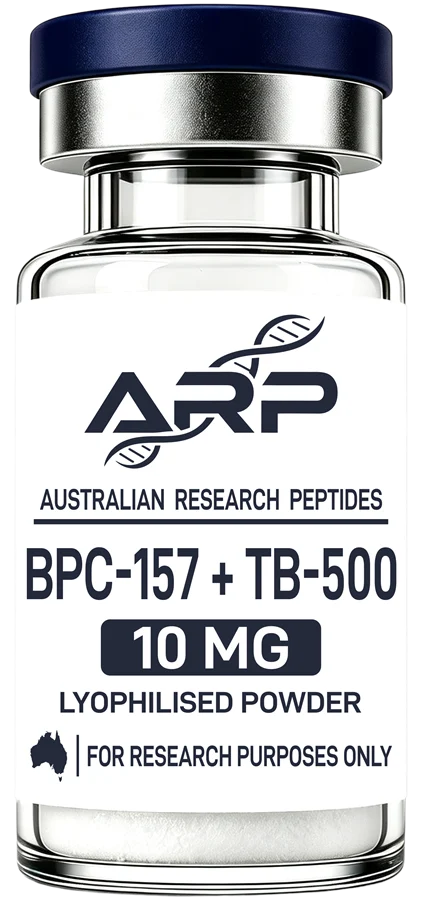
BPC-157 + TB-500, the two-peptide vial nicknamed the Wolverine Stack online, is sold in Australia by Australian Research Peptides as 10 mg of lyophilised powder covering both chains together. BPC-157 drives new blood supply into injured tissue by switching on VEGFR2; TB-500 binds actin, letting a cell rebuild its framework and crawl into a wound. Note the evidence, though: the single rat study pitting the pair against each peptide alone found the combination added nothing extra. Sent to every state and territory. For in vitro research purposes only.

Tissue Repair Research · Lyophilised Powder · Batch-tested · SKU ARP-BPCTB-10
In stock·
$104.99
1

2+ vials: 5% off — applied automatically in the cart

Presentation
10 mg per vial
Grade
High-Purity Research Grade
Form
Lyophilised Powder
Category
Tissue Repair Research
Same-day dispatch on business-day orders placed before 12pm AEST, Mon–Fri
Tracked shipping Australia-wide ·typically 1–2 business days to most areas by Express Post · free post over $199, free Express over $299
Batch certificates — published in the COA library
For in vitro research purposes only. Not for human consumption. Not for animal consumption. This product is not a drug, food, cosmetic, or dietary supplement. Any amounts shown are reported from published studies, with the species or trial population named. ARP gives no dosing, medical or therapeutic guidance of its own.
BPC-157 + TB-500 · 10 mg
$104.99

Frequently Bought Together

About BPC-157 + TB-500

Both halves of this vial come from the preclinical tissue-repair literature. Putting them in one vial is a packaging choice, not a research finding. A 2026 rat Achilles tendon study set the pair against BPC-157 alone and TB-500 alone across four groups. It reported no additional benefit from the combination. The quantity on this listing is the total for the vial, covering both peptides at once.

The powder is freeze-dried and holds two chains of very unequal length. BPC-157 runs to fifteen amino acids, sequence GEPPPGKPADDAGLV. TB-500 is seven, Ac-LKKTETQ, matching residues 17 to 23 of thymosin beta-4 with an acetyl cap on one end. Thymosin beta-4 itself is 43 amino acids long, so TB-500 is a small piece of it rather than the whole protein. ARP lists each peptide on its own as well.

The two are studied down different routes. Laboratory work on BPC-157 links it to VEGFR2, a receptor that drives blood-vessel growth. The LKKTETQ stretch in TB-500 is thymosin beta-4's actin-binding motif, and actin is the protein cells use to build their internal scaffolding. The authors of the 2026 rat study suggested the two may converge on shared downstream pathways, which would explain a combination adding nothing. They called that a hypothesis needing more work.

What is in the vial

BPC-157 + TB-500 composition per vial
ComponentAmount per vial
BPC-157~5 mg
TB-500a fragment corresponding to the actin-binding region of thymosin beta-4 — not the full protein~5 mg
Total10 mg per vial

BPC-157 + TB-500 specifications, storage and shipping

  • Compound: BPC-157 + TB-500
  • Also known as: BPC-157 with TB-500 (thymosin beta-4 fragment)
  • Class: Two-peptide blend: a pentadecapeptide with an actin-binding thymosin beta-4 fragment
  • Appearance: White to off-white lyophilised powder
  • Sizes & SKUs: 10 mg (ARP-BPCTB-10)
  • Presentation: sealed glass vial
  • Form: Lyophilised Powder
  • Grade: High-purity research grade
  • Purity verification: HPLC-assayed on every batch to a minimum of 99% purity — the measured result for your batch is stated on its Certificate of Analysis
  • Identity confirmation: Mass spectrometry
  • Batch traceability: every batch is tested, with its certificate published in the COA library
  • Classification: In vitro research purposes only — laboratory reference material

Lyophilised — long term
−20 °C to −80 °C — long-term storage
Lyophilised — short term
2–8 °C — refrigerated, for a few months
Reconstituted
2–8 °C — use within 8–12 weeks
Protect from light and moisture. Handle in accordance with standard laboratory safety practice, including appropriate PPE. This information is provided for laboratory handling only and is not a usage instruction of any kind.

Every batch undergoes HPLC purity analysis and mass-spectrometry identity confirmation. The full laboratory report is published in the COA library.

Business-day orders before 12pm AEST are dispatched the same day with tracked, discreet shipping. Standard delivery within Australia typically takes 2–5 business days. See Shipping & Delivery for details, and follow your parcel on the Track Order page.

For in vitro research purposes only. Not for human consumption. Not for animal consumption. Not a drug, food, cosmetic, or dietary supplement. No therapeutic or medical claims are made.

Questions about BPC-157 + TB-500

This question guide from Australian Research Peptides covers BPC-157 + TB-500 in Australia: what the listing contains, live buying and delivery questions, research context, handling, testing and comparisons. Start with the quick answers, then open the topic group that matches your search.

Buying, price and availability

BPC-157 + TB-500 comes from Australian Research Peptides, which posts from inside Australia, so an order travels internally and never queues at customs. One vial carries both chains — fifteen residues and seven — under the single product code BPCTB, with no strength to choose. Search terms bpc tb, bpc 157 tb 500 and tb500 bpc all reach the same ARP product record. Express delivery reaches every territory and state.

Australian Research Peptides supplies the BPC-157 + TB-500 blend, dispatching weekday orders the same day when they arrive before 12pm AEST. ARP is an Australian company posting from Sydney, under Tissue Repair Research alongside each peptide sold separately. HPLC testing backs every batch of the blend. Bank transfer and PayID are the accepted payment methods.

Australian Research Peptides charges one Australian-dollar figure for the whole BPC-157 + TB-500 vial, not two amounts for two peptides. The number quoted is read from the live catalogue entry, so it moves when the business reprices rather than going stale in prose. The vial is blended at about 5 mg of each peptide, so the price buys both together rather than either one on its own. A second vial triggers the multi-vial discount automatically, with no code to enter. Delivery is charged on top.

Ordering BPC-157 + TB-500 means dealing with Australian Research Peptides directly, online rather than through a marketplace or a pharmacy. Bacteriostatic water is a separate catalogue line under Lab Supplies and is not inside the blend vial. Two payment methods are accepted, Australian bank transfer and PayID; card details are never requested. Confirmation carries an order reference and the account particulars to pay into.

The BPC-157 + TB-500 blend is stocked by Australian Research Peptides and by no Australian pharmacy, Chemist Warehouse included. Neither peptide is registered as a medicine here, and a combination of two unregistered compounds cannot be dispensed under any authorisation a retailer holds. ARP dries the pair into one 10 mg research vial.

Identity, names and exact format

BPC-157 + TB-500 is two names joined, not one compound's name. BPC abbreviates body protection compound. The 157 marks one particular fifteen-amino-acid sequence. TB stands for thymosin beta, because TB-500 is a fragment of thymosin beta-4. What the number 500 refers to is not established in the sources reviewed, so this answer does not guess at it.

BPC-157 + TB-500 is one vial containing two research peptides, freeze-dried into a single cake. The BPC-157 half runs to fifteen amino acids and was first described in gastric juice. The TB-500 half is a seven-amino-acid piece of thymosin beta-4, a protein involved in how cells organise actin. Both appear in preclinical tissue-repair studies.

BPC-157 + TB-500 holds twenty-two amino acids, split across two separate molecules. BPC-157 contributes fifteen and TB-500 contributes seven. They stay two chains in the vial, so this is not one twenty-two-residue peptide. The acetyl group capping TB-500 counts as a chemical modification, not an extra amino acid. The sequences are GEPPPGKPADDAGLV and Ac-LKKTETQ.

A BPC-157 + TB-500 vial from Australian Research Peptides holds 10 mg in total, blended at the standard 1:1 ratio, so it is about 5 mg of each peptide. Those are nominal formulation figures. When an exact-strength batch document is published, its laboratory-measured amount for each chain takes precedence over the nominal formulation figures. Compare the vial against another blend rather than against a single-compound vial, or you are comparing different things.

BPC-157 + TB-500 has no scientific synonym of its own because it contains two peptides: BPC-157, also recorded as bepecin or PL 14736, and TB-500, the acetylated thymosin beta-4 fragment 17-23. The combination is sometimes nicknamed the "Wolverine Stack"; that is an informal label, not a standardised formula or evidence claim. Australian Research Peptides uses BPCTB as the catalogue code for this blend.

Research context and evidence

BPC-157 + TB-500 has two mechanisms under study, one per compound, and neither is settled. Cell and animal work links BPC-157 to VEGFR2, a receptor that drives new blood-vessel growth. TB-500 carries the LKKTETQ motif, the stretch of thymosin beta-4 that binds actin. Actin is what cells assemble into their internal scaffolding, and what they use to move. One rat study suggested the two may share downstream pathways.

Research on the BPC-157 + TB-500 pairing itself comes down to one published experiment. Biçer and colleagues, publishing in 2026, split 32 rats into four groups of eight: control, BPC-157 alone, TB-500 alone, and both. They measured Achilles tendon load at failure, histology scores, and collagen types I and III. The combination gave no additional benefit over either peptide by itself. Human evidence for either compound remains thin.

The 2026 study of BPC-157 + TB-500, by Biçer and colleagues, dosed male Sprague-Dawley rats daily. BPC-157 was given at 10 µg/kg/day. The TB-500 arm got six times as much, 60 µg/kg/day. The unit is micrograms per kilogram of body weight. Both went in by intraperitoneal injection for four weeks after tendon surgery. Those are rat figures, not a human schedule.

BPC-157 + TB-500 puts two peptides of wildly unlike timescale into one vial. Mateescu's 2026 review puts BPC-157 under thirty minutes in plasma. For the seven-residue thymosin fragment there is no such figure at all; Rahaman's 2024 rat work instead followed metabolites, one of them still measurable three days on. A single elimination time for this blend does not exist in the literature, whatever a competing listing asserts.

Neither compound in this vial has ever had a human timeline published. What exists is rodent work dosing daily across one to four weeks, with repair measured once at the close of the study — so the timescale is documented in animals and simply unknown in people.

Ceasing the BPC-157 + TB-500 blend has never been studied, either as a pair or peptide by peptide. Both literatures consist of laboratory and animal experiments that finish when dosing finishes, with no phase observing subjects later. Putting two compounds in one vial creates no data about either. Anyone describing a specific after-effect is extrapolating from a record that contains nothing to extrapolate from.

There is no published human safety data for either BPC-157 or TB-500, so the blend has no side-effect profile that anyone can honestly quote. Combining two compounds that individually lack human trials does not average out to a known risk — it means two unknowns instead of one. Animal studies reported both as well tolerated at the doses used.

The BPC-157 + TB-500 pairing rests on animal work: both peptides have produced repair-related findings in rodent tendon, muscle and gut models, and studies exist that ran them together. Neither has a controlled human trial. The pairing is widely used and poorly evidenced in people, and those two facts sit together rather than one replacing the other.

BPC-157 + TB-500 has one published test of the pairing itself, and it did not favour the blend. Biçer's 2026 study split 32 rats across four groups and measured Achilles tendon load at failure alongside collagen types I and III; the two peptides together did no better than either one alone. Each compound carries its own rodent literature, and neither has a controlled human trial. On the evidence as it stands the pairing is less established than its parts, not more.

Handling, storage and measurements

Yes, and a BPC-157 + TB-500 vial trips people up for a specific reason: the ten-milligram figure covers both chains together rather than each separately, so combining two peptides does not double what is visible. What dries down is one thin cake of shared solid, frequently hard to tell apart from clean glass. Two compounds in a single container means two chemistries, never twice the bulk.

BPC-157 + TB-500 keeps best as a sealed dry powder in a freezer, below −15 °C. Keep it out of light and moisture. Its TB-500 half ends in glutamine. Bachem names that residue among those that shorten a peptide solution's life, so the dry powder outlasts the made-up liquid. Bring it to room temperature inside a desiccator before you break the seal, because freeze-dried peptide draws moisture from the air.

Reconstitute BPC-157 + TB-500 by running bacteriostatic water gently against the glass, never straight onto the powder. Both peptides dissolve into the same liquid, so one addition serves the whole vial. Swirl rather than shaking. Dissolving can take minutes and occasionally hours. Bachem advises aliquoting peptide solutions and keeping them frozen below −15 °C rather than storing one volume long term.

Dissolved BPC-157 + TB-500 gets the 8–12 week refrigerated life Australian Research Peptides prints against every peptide line it carries, but a blend truly lasts only as long as whichever chain fails first. Bachem lists glutamine among the residues that limit a dissolved peptide, and the TB-500 component finishes on exactly that. Nothing lets a researcher discard one chain and keep the other.

Water added to a BPC-157 + TB-500 vial gives a combined strength, not one per peptide. The vial holds 10 mg in total. One millilitre makes it 10 mg/mL. Double the water and the strength halves to 5 mg/mL. At 5 mL it is 2 mg/mL. Australian Research Peptides blends that 10 mg at about 5 mg of each peptide, so every strength above covers the pair together rather than either one. The calculator in ARP's reconstitution guide handles any volume.

BPC-157 + TB-500 clears more slowly than a single peptide, because its two components do not dissolve at matching speeds, so a brief cloudy phase while one chain is still going in is ordinary. Bubbles raised by over-enthusiastic handling add to the effect. Stand the vial upright and look again ten minutes later. Opacity that lingers, or grit settling out afterwards, signals something has degraded.

Yes — BPC-157 + TB-500 arrives dry, with no liquid in the vial, so laboratory work needs a diluent first, and bacteriostatic water is the usual choice. "Diluent" means the liquid a powder is dissolved in, and one volume of it serves both peptides, since both chains dissolve into that same volume. Australian Research Peptides lists bacteriostatic water under Lab Supplies, apart from the peptides, so it goes into an order separately.

The 10 mg on a BPC-157 + TB-500 vial is the total across both peptides, which is the single most misread figure on any blend listing — it is not 10 mg of each. Twenty draws at 500 mcg of blend, forty at 250 mcg, with the split between the two set out in Australian Research Peptides' blend breakdown.

Testing and batch documents

Yes — Australian Research Peptides tests every batch of BPC-157 + TB-500 two ways, with HPLC measuring how pure the powder is and mass spectrometry confirming identity. This blend gives the mass test two masses to find rather than one, because the vial holds a fifteen-residue chain and a seven-residue chain. Every batch also gets a record in ARP's CoA library, findable by product name. The library shows each product and strength as published or still to come.

Ordering, payment and Australian delivery

The account name, BSB, account number and PayID for a BPC-157 + TB-500 order are issued twice — once when the order is lodged and again in the confirmation email — and by no other channel. Nobody at Australian Research Peptides will phone or text a different set of details, so treat any message that does as fraudulent.

Two vials of the blend clear the free Standard tracked post threshold, though without much room; one alone does not. Express Post is waived only at a higher figure that a two-vial order does not reach, so choosing Express still attracts a fee. Because qualification is judged before the multi-vial discount, earning that discount can never cost you the free post.

A BPC-157 + TB-500 order arrives 1–2 business days after lodgement in Canberra, Sydney, Melbourne and Adelaide by Express Post, 1–3 in Brisbane, 2–4 in Perth, Hobart and Darwin, and 2–5 anywhere by standard tracked post. Because both peptides sit in one vial it travels as a single small parcel rather than two, and adding water or syringes does not split it.

A blend needs less equipment than buying its parts. One BPC-157 + TB-500 vial is one reconstitution, one water volume and one set of draws, where two separate vials would be two of each. A 3 mL bacteriostatic water vial covers it comfortably, and insulin syringes are the other thing not included.

Access, approval and sport questions

BPC-157 + TB-500 contains two compounds that Australia's Poisons Standard regulates. BPC-157 and TB-500 each appear in Schedule 4, meaning prescription only, and each is listed at Appendix D clause 5, which covers poisons a person must not possess without authority. Australian Research Peptides supplies this vial for in vitro laboratory research, not for use in people. Anyone with a different purpose should take their own advice.

Neither half of the BPC-157 + TB-500 blend carries a marketing authorisation, in the United States or anywhere else, so the pairing cannot be approved either. Thymosin beta-4 never produced a licensed product, and no agency has ever reviewed BPC-157 for approval as a medicine. Two unapproved compounds sharing one vial do not inherit approval from somewhere.

BPC-157 + TB-500 is banned in sport on both counts, under different headings. BPC-157 falls in S0 because no regulator has approved it; thymosin beta-4 and TB-500 sit with the growth factors in section S2. Neither heading eases outside the competition season. Sport Integrity Australia tests Australian athletes, and a finding follows from the substance being present.

A blend has no separate legal identity at the Australian border, so BPC-157 + TB-500 is assessed as the two Schedule 4 compounds it contains. Combining them in one vial neither creates a new substance nor lightens how either is treated. Border Force acts on that at the frontier and the TGA sets the rule behind it. Australian Research Peptides' vials are posted domestically and cross nothing.