For laboratory research use only. Not for human or veterinary use.Lab research use only. Not for human or animal use.
Cart is empty
Same-Day DispatchAustralian StockPremium Research GradeVerified CoAsPayID · Clears in MinutesSame-Day DispatchAustralian StockPremium Research GradeVerified CoAsPayID · Clears in Minutes
Same-day dispatch on business-day orders before 12pm Sydney time.Same-day dispatch before 12pm Sydney timeFree standard post $199+Free std post $199+
Why order from ARP
Same-Day Dispatch
Australian Stock
Premium Research Grade
Verified CoAs
PayID · Clears in Minutes
Buy Bacteriostatic Water in Australia
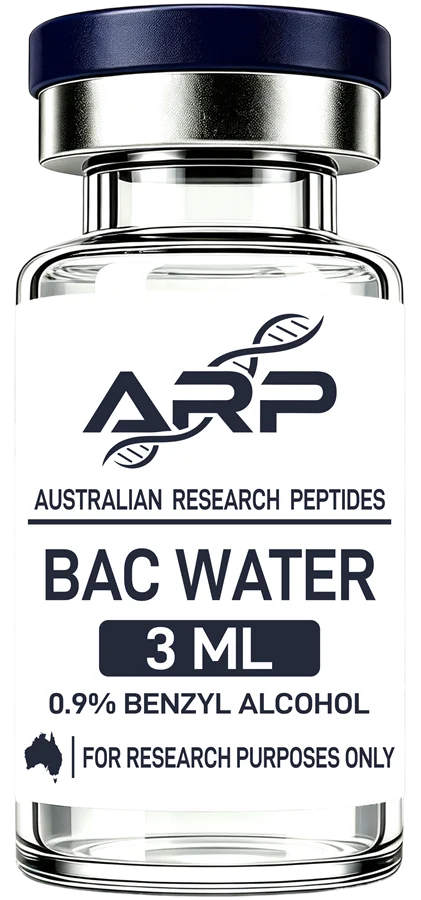
Bacteriostatic Water, often typed BAC water, comes from Australian Research Peptides in sealed 3 mL and 10 mL glass vials for laboratories and researchers across Australia — from $15.99, in stock; orders paid before 12pm Sydney time leave the same business day, and Express Post takes 1–2 business days to most of Australia. It is sterile-filtered water preserved with 0.9% benzyl alcohol (9 mg/mL), the USP strength, so one vial can be entered several times. It dissolves a freeze-dried peptide into solution. Sterile water carries no preservative and is single-entry. For in vitro research purposes only.
Same-day dispatch on business-day orders completed before 12pm Sydney time, Mon–Fri
Tracked shipping Australia-wide ·typically 1–2 business days to most areas by Express Post · free post over $199, free Express over $299
For in vitro research purposes only. Not for human consumption. Not for animal consumption. This product is not a drug, food, cosmetic, or dietary supplement. ARP gives no usage, medical or therapeutic guidance of its own.
Bacteriostatic water — BAC water on the vial label — is plain water carrying an added preservative. Bacteriostatic means it stops bacteria multiplying rather than killing them outright, which is what bactericidal would mean. That single ingredient is the whole difference between this and unpreserved laboratory water, and it is why a vial can be drawn from on several occasions. The US compounding standard USP 797 gives a punctured vial of that kind 28 days.
ARP's bacteriostatic water is preserved with benzyl alcohol at 0.9 per cent, or 9 mg per mL, as stated by its supplier. That matches the published USP standard for bacteriostatic water, which uses the same preservative at the same strength.
No chromatography applies to water, so this line carries no purity certificate; its grade is Sterile Filtered instead. It sits in Lab Supplies rather than with the peptides, and every quantity on this page is a millilitre figure.
Australian Research Peptides lists bacteriostatic water in Australia in two volumes, 3 mL and 10 mL — nothing larger, and no 5 mL. It is posted to every state and territory including Perth, Melbourne, Brisbane and Adelaide, and is searched under many spellings — bac water, bacteriostatic water, bacterio static water, bacstat water — all the same preserved diluent. It is stocked as a laboratory consumable beside the syringes rather than with the peptides, and it is not supplied for human or veterinary use. Being water rather than a peptide, it carries no purity certificate.
Class: Laboratory consumable — water with a bacteriostatic preservative
Appearance: Clear, colourless solution
Sizes & SKUs:3 mL (81901), 10 mL (82578)
Presentation: sealed glass vial
Form: Sterile Filtered Solution
Grade: Laboratory consumable, sterile filtered
Batch verification: sterile filtered
Classification: In vitro research purposes only — laboratory reference material
Storage
Room temperature; refrigerate after opening
Format
Bacteriostatic — multiple-entry vial
Handle in accordance with standard laboratory safety practice, including appropriate PPE. This information is provided for laboratory handling only and is not a usage instruction of any kind.
The water is sterile filtered. It is preserved with 0.9% benzyl alcohol.
Business-day orders before 12pm Sydney time are dispatched the same day with tracked shipping. Standard delivery within Australia typically takes 2–5 business days. See Shipping & Delivery for details, and follow your parcel on the Track Order page.
For in vitro research purposes only. Not for human consumption. Not for animal consumption. Not a drug, food, cosmetic, or dietary supplement. No therapeutic or medical claims are made.
Questions about BAC Water
Australian Research Peptides answers the main Australian questions about BAC Water, including exact specifications, live price and availability, ordering, storage, measurements, testing and comparisons with related supplies. Start with the quick answers, then browse every existing question by topic.
Buying, price and availability
Bacteriostatic Water is supplied by Australian Research Peptides and posted from within Australia, never imported to order. Place a weekday order before 12pm Sydney time and the vial is dispatched that same day. Express Post reaches every state and territory, with a tracked standard service beside it. Because nothing crosses a border, no parcel is held at customs. The 3 mL and 10 mL vials both carry the BAC code, and payment is by PayID or bank transfer.
Sound bacteriostatic water is clear, colourless and free of anything visible. The signs it should not be used are haziness, floating or settled particles, any tint at all, and a stopper or seal that is cracked, lifted or weeping. A preservative restrains bacterial growth between withdrawals but does not keep a punctured vial sterile forever, and repeated entries without wiping the closure shorten what protection there is. Contamination can also leave the liquid looking unchanged, which is why the date of first puncture matters as much as appearance.
Bacteriostatic Water goes into the peptide vial slowly, running down the inside of the glass. Aim it away from the powder rather than straight onto the cake. Swirl or roll the vial gently until the liquid turns clear. Never shake it, because shaking foams a peptide solution. Let a cold vial reach room temperature first, so moisture does not condense on the powder.
Bacteriostatic Water is the standard diluent for every lyophilised peptide Australian Research Peptides sells, from a 10 mg BPC-157 vial to a 100 mg GHK-Cu one. What changes between them is the volume, not the diluent.
BAC water does not come with a peptide Certificate of Analysis, because no peptide assay is performed on water, and none could be. A COA reports a chromatography purity result, and there is no peptide in the vial to separate or measure. Australian Research Peptides publishes a certificate against a product and strength only where a real report exists, so no BAC water vial carries one. ARP describes this consumable by its batch record instead, which traces a vial back to the filtration run it came from. Contact us with the order reference if that record is needed.
Identity, names and exact format
BAC water and bacteriostatic water are two names for one product in Australia: water with a preservative in it, which is why a single vial can be entered more than once. The vial label and the catalogue listing use the short form — bacstat water is the same thing again — while this page's heading spells it out in full. Nothing else differs — not the 3 mL and 10 mL volumes, not the preservative, not the grade, which is Sterile Filtered rather than HPLC Verified.
Both are search terms for the same product. 'Backwater for peptides' and 'bacwater' are frequent misspellings of BAC water, so anyone typing 'backwater peptides' or 'peptide water Australia' is looking for Bacteriostatic Water. Bacteriostatic Water, shortened to BAC water or just bac, is the correct name: sterile water carrying a preservative. It is the standard diluent for taking lyophilised peptide powders into solution for research work, and Australian Research Peptides posts the sealed vial from within Australia.
Bacteriostatic Water works by carrying a preservative that keeps microbial numbers from climbing between withdrawals. That is what makes repeated entry into one vial reasonable. It is not the same as sterilising. Anything already present is held in check rather than destroyed, so a vial still deserves clean handling. The label for the USP preparation describes repeated withdrawals from a single container.
BAC water is used to reconstitute lyophilised peptide powders — the freeze-dried cake a research vial arrives as — so the compound can be handled as a liquid. It contributes nothing itself; it brings the peptide into solution at the strength a protocol calls for. Its preservative restrains microbial growth between withdrawals, which is what lets a single vial serve several make-ups.
Benzyl alcohol, the preservative in the USP bacteriostatic water preparation, has been shown in published work to promote aggregation of some recombinant proteins in solution, so a preserved diluent is a handling choice rather than a default. Zhang and colleagues (2004) described the mechanism in recombinant human interleukin-1 receptor antagonist. Roy and colleagues (2005) reconstituted a lyophilised protein with a bacteriostatic benzyl alcohol solution. Thirumangalathu and colleagues (2006) reported the same effect in recombinant G-CSF, modulated by pH, temperature and sucrose. Every one of those studies used a recombinant protein, not the short synthetic peptides Australian Research Peptides lists, and none establishes anything about the material in ARP's vials.
Bacteriostatic water is sold in Australia as an ordinary laboratory consumable, and Australian Research Peptides supplies it to laboratories and researchers on that basis. It is not supplied for human or veterinary use, which is the boundary that matters more than the paperwork. ARP publishes no scheduling or registration position for this line, and nothing here is legal advice; a laboratory carrying an obligation of its own should confirm it independently rather than read it off a product page.
Research context and evidence
Bacteriostatic Water is preserved water used as the liquid that dissolves a freeze-dried peptide before laboratory work. Peptides arrive as a dry cake with no liquid in the vial. Adding the water turns that solid into a solution at the concentration the work calls for, and the preservative allows the resulting vial to be drawn from more than once.
Handling, storage and measurements
Bacteriostatic water is made of sterile water with a single thing added to it: an antimicrobial preservative, and nothing else at all. There is no salt, no buffer, no sugar and no peptide in the vial. Pfizer's published product label for the USP bacteriostatic water preparation, the reference product of this type, gives 9 mg of benzyl alcohol in every millilitre, and names an 11 mg per millilitre presentation, or 1.1 per cent, beside it. Australian Research Peptides' own vials carry benzyl alcohol at 0.9 per cent (9 mg per mL), as stated by its supplier: the lower of the two strengths on that label.
Bacteriostatic means holding bacterial numbers back; bactericidal means killing the organisms outright, and bacteriostatic water is the first of the two rather than the second. The difference is practical rather than academic: a preserved vial slows whatever was already inside it instead of clearing it, which is why the liquid has a working life rather than staying good indefinitely, and why it is never described as sterilising the peptide it is added to.
Bacteriostatic Water is sold by volume, so millilitres are the honest unit for it. The peptides are dry solids sold by mass, which is why those pages read in milligrams. Australian Research Peptides records the unit against each product rather than assuming one for the whole catalogue. A milligram figure on a liquid would describe nothing a buyer could act on.
A 3 mL BAC water vial suits one or two standard 10 mg peptide vials and is the usual first purchase, and it is the volume the bundles carry. The 10 mL suits a large-format vial such as 100 mg GHK-Cu, an 80 mg KLOW or a 70 mg GLOW, or several peptides at once. One 10 mL replaces more than three 3 mL vials, so fewer seals are broken and fewer lots need tracking, and it works out cheaper per millilitre. Either way the clock starts at the first puncture, not at delivery, so the larger vial only pays if it is used inside that window.
An unopened Bacteriostatic Water vial belongs at room temperature and out of direct light, and putting it in the fridge achieves nothing. The preservative in it does the work that cold would otherwise have to. Refrigeration is a rule about reconstituted peptide, and it gets misapplied to the diluent constantly.
Bacteriostatic Water keeps for around 28 days from first puncture, which is the conventional working limit and the period USP 797 — the United States compounding standard for sterile preparations — sets for a vial that is entered more than once. The preservative is what suppresses bacterial growth between entries, and that protection is not indefinite. Write the date on the vial when the seal is first broken, wipe the stopper each time, and discard it if the solution stops being clear.
An unopened bacteriostatic water vial is not governed by the roughly 28-day figure quoted elsewhere on this page, because that clock starts at the first puncture rather than at delivery. A sealed vial is limited by its own expiry dating instead, and Australian Research Peptides publishes no shelf-life figure for this line. The practical point is that a spare vial bought ahead is limited by its expiry dating while sealed, and by the roughly 28-day working life only once it is first punctured.
A bacteriostatic water vial is built to be entered more than once, but the number of entries is limited by the stopper and by the calendar rather than by how much liquid is left. That is what the preservative buys. Every entry through a rubber closure can shed a small fragment of it into the liquid, which is called coring, so the stopper wears a little each time. Clean the closure before every entry, and treat the roughly 28-day working life as the outer bound.
Bacteriostatic Water is stored at room temperature and not frozen, unlike the lyophilised peptides it is used to reconstitute. Keep the unopened vial out of direct light. Australian Research Peptides' stated condition for this grade is room temperature, then refrigeration after opening. The USP bacteriostatic water label gives 20 to 25 degrees Celsius. Discard any vial that has turned cloudy or shows particles.
Testing and batch documents
Bacteriostatic Water is supplied online by Australian Research Peptides in two sizes, 3 mL and 10 mL, both posted from within Australia. It is a catalogue line of its own, so a peptide and the water to dissolve it are two purchases rather than one packaged item. Settlement is by PayID or bank transfer from the buyer's own account, with the order reference in the payment description.
Bacteriostatic Water reaches Australian buyers in 1–2 business days via Express Post across much of the country, and in 2–5 via standard tracked post. As the one liquid item Australian Research Peptides stocks, its vials are wrapped against knocks and travel inside the same parcel as any peptides ordered with them. Photograph a cracked, leaking or unsealed vial before discarding it and contact support.
Bacteriostatic Water is almost always bought as part of a larger order, so it is paid for inside that order's single total rather than separately. Australian Research Peptides treats a later top-up as a fresh order, which means a second payment reference, a second transfer and a second parcel — so including the water first is simpler.
Bacteriostatic Water on its own reconstitutes nothing — it needs a syringe to move it and a lyophilised peptide to move it into. Australian Research Peptides lists graduated syringes as their own catalogue line, and a twenty-pack covers a great many transfers. The peptide is the other half and is whichever compound the work is about. Nothing else is required: no filters and no second diluent.
Comparisons and related products
Yes — bacteriostatic water moves from its vial to the peptide vial by syringe, so water alone is not enough to reconstitute anything. Graduated syringes are a catalogue line of their own, bought in the same order rather than packed in with the water. Water and syringes together are what turn a dry peptide vial into something you can actually draw from.
Bacteriostatic water from Australian Research Peptides is not FDA approved: it is a laboratory-grade diluent sold as a research consumable. The US approval behind the USP bacteriostatic water preparation covers each manufacturer's finished, Rx-only vials, made under that manufacturer's own application, and nothing beyond them. Grade and regulatory standing are separate ideas.
Ordering, payment and Australian delivery
At 1 mL per 10 mg peptide vial, a 3 mL Bacteriostatic Water vial covers three of them and a 10 mL covers ten. Using 2 mL per vial halves both figures. The real limit is usually time rather than volume, because a punctured water vial has a working life once its stopper is first pierced.
One bacteriostatic water vial from Australian Research Peptides can serve every peptide in an order, because the diluent does not change from one peptide to the next; only the volume drawn does. Those peptide vials arrive as dry powder with no liquid in them, and the water is a separate catalogue line rather than part of any vial. The same holds for BPC-157, TB-500, GHK-Cu and the blends.
Bacteriostatic Water has no single right volume, and Australian Research Peptides publishes none for any of its listings. What the volume changes is how concentrated the resulting solution is, never how much peptide is in the vial. It is sold in 3 mL and 10 mL, and which suits an order depends on how many vials it has to cover.
Bacteriostatic Water is supplied by Australian Research Peptides Pty Ltd, the Australian company behind ARP, dispatching from Sydney. The water is sterile filtered, and because it is not a peptide it carries no purity certificate. Monday to Friday, an order completed ahead of the 12pm Sydney time cut-off goes out the same day, with Express Post covering all states and territories. PayID and bank transfer are both accepted.
Bacteriostatic Water is sterile filtered rather than assayed by chromatography. A purity assay works by separating a peptide from whatever sits beside it, and water is not a peptide. Mass spectrometry has nothing in water to confirm either. What the Australian Research Peptides listing states instead is the water's grade, Sterile Filtered.
Access and regulatory questions
Bacteriostatic water reaches Perth from Australian Research Peptides, posted from within Australia rather than imported to order, and the same 3 mL and 10 mL vials go to Adelaide, Brisbane, Melbourne, Sydney, Darwin and Canberra. Nothing enters the country for the order, so no parcel waits on a clearance into Western Australia. An express service and a tracked standard service both cover WA, and the estimate for a given postcode is shown at checkout rather than promised on this page.
Bacteriostatic Water carries its own Australian-dollar price for each of the two vial sizes, 3 mL and 10 mL. Both figures are held in Australian Research Peptides' catalogue and quoted straight from it, never fixed into written text. It is graded Sterile Filtered rather than HPLC Verified, because it is a consumable rather than a research peptide. A second vial costs what the first did.
Bacteriostatic Water almost never reaches the free Standard tracked post threshold alone, and is not meant to — it would take a carton of vials. Its usual role is the reverse: ordered alongside peptides, it is frequently what tips a total over the mark. The test is run on the basket rather than on the line, so a water vial counts towards it exactly as a peptide vial does.
More questions
Bacteriostatic Water is preserved water, and that single difference explains all three products. Plain sterile water carries no preservative, so it is packaged for one use and discarded after a single entry. Bacteriostatic saline carries a preservative too, but its base is a salt solution rather than plain water. Australian Research Peptides lists the plain preserved water only and does not resell a saline version.
No, Bacteriostatic Water from Australian Research Peptides is not the Hospira product, and ARP does not resell it. ARP supplies its own sterile-filtered vials in 3 mL and 10 mL. Different suppliers, different products.
Sterile water used in place of bacteriostatic water carries no preservative, so once its stopper is pierced there is nothing suppressing bacterial growth in what remains. The USP preparation of bacteriostatic water is labelled at 0.9% benzyl alcohol, which is what makes a vial usable across multiple withdrawals rather than once. Tap or distilled water is not sterile at all and is not a substitute for either.
The two Bacteriostatic Water listings hold 3 mL and 10 mL of the same liquid. Formulation, filtration, glass and preservative are identical across both. Only the amount in the vial changes. The pair exists so that a small working quantity or a larger one can be ordered without buying two vials of the same size.
Bacteriostatic water comes from Australian Research Peptides in two sizes only: a 3 mL for one compound or a first order, and a 10 mL for longer runs and several peptides at once. There is no 5 mL vial, no 20 mL and no 30 mL, and ARP resells nobody else's, so those two volumes are the whole range. Both arrive as sealed, tamper-evident glass vials of sterile-filtered water, and both carry the preservative that keeps a part-used vial usable rather than single-entry.
Bacteriostatic Water travels at ambient temperature and needs no cold pack, which is why a parcel carrying it does not include one. The preservative in the vial is what holds bacterial growth back, and it does that at room temperature rather than relying on cold. Arriving warm with the seal intact is not a sign that anything has gone wrong — in transit the seal is what matters, not the thermometer.
A chemist, Chemist Warehouse included, is a different supply route from Australian Research Peptides: a retail pharmacy dispenses sterile-water products for approved medical use, while ARP supplies bacteriostatic water as a laboratory consumable. That is a different purpose and a different route, so the two are not interchangeable even where the contents read alike. ARP lists it beside the research vial it reconstitutes, dispatched in the same parcel.
Yes, Australian Research Peptides lists BAC water in 3 mL and 10 mL vials and 0.5 mL graduated syringes in packs of 20, and both can go in the same order as any research peptide. They are separate catalogue lines rather than a fixed kit, so the water volume and the number of syringe packs are chosen to suit the work.
All results are supplied for in vitro research purposes only.