
Same-Day DispatchAustralian StockDiscreet DeliveryPremium Research GradeVerified CoAs
Same-day dispatch on business-day orders before 12pm AEST.Same-day dispatch before 12pm AESTFree post $199+

Buy BPC-157 in Australia

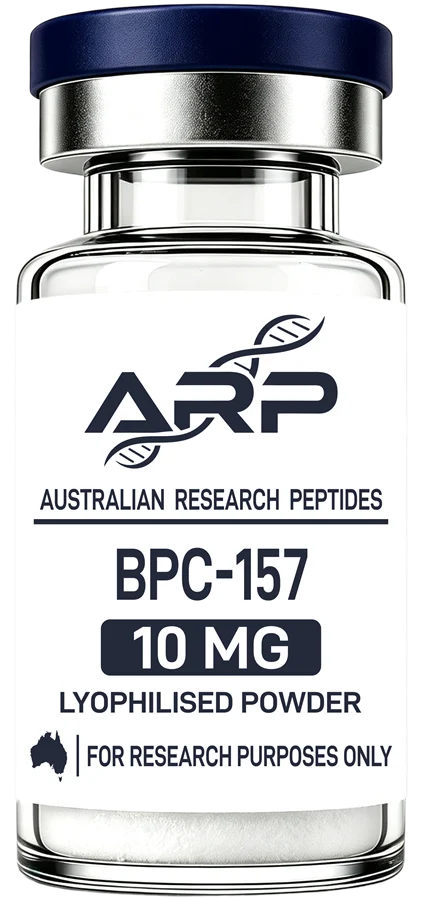
BPC-157, a fifteen-amino-acid chain that rebuilds damaged tissue by growing new blood vessels into it, can be bought in Australia from Australian Research Peptides as one 10 mg vial of freeze-dried white powder sealed in glass, shipped to all states and territories. It switches on VEGFR2 and raises nitric oxide to bring fresh blood supply to an injury, then drives fibroblasts to migrate and lay down straighter, stronger collagen, which is how tendon, muscle, gut lining and burnt skin knit back together. In vitro research purposes only.

Tissue Repair Research · Lyophilised Powder · Batch-tested · SKU ARP-BPC-10
In stock·99.635%
$89.99
1

2+ vials: 5% off — applied automatically in the cart

Presentation
10 mg per vial
Grade
High-Purity Research Grade
Form
Lyophilised Powder
Category
Tissue Repair Research
Same-day dispatch on business-day orders placed before 12pm AEST, Mon–Fri
Tracked shipping Australia-wide ·typically 1–2 business days to most areas by Express Post · free post over $199, free Express over $299
Batch certificates — published in the COA library
For in vitro research purposes only. Not for human consumption. Not for animal consumption. This product is not a drug, food, cosmetic, or dietary supplement. Any amounts shown are reported from published studies, with the species or trial population named. ARP gives no dosing, medical or therapeutic guidance of its own.
BPC-157 · 10 mg
$89.99

Frequently Bought Together

About BPC-157

Every published study on BPC-157 is preclinical. Researchers have run it through surgical animal models covering the Achilles tendon, ligament, muscle, skin burns and the gastrointestinal tract, plus bone-defect and hind-limb ischaemia work. In cell culture it sped up the outgrowth of rat tendon explants and increased fibroblast migration.

BPC-157 is a pentadecapeptide, which simply means a chain of fifteen amino acids. BPC is short for body protection compound. Its sequence, GEPPPGKPADDAGLV, matches a section of a larger protein found in human gastric juice. Four of the fifteen amino acids are proline. Reviews describe the compound as unusually stable in gastric juice, which is uncommon for a peptide. It also appears in the literature as bepecin, PL 14736 and PLD-116.

Australian Research Peptides supplies BPC-157 on its own, as a single peptide. It appears in two other ARP listings as well, blended with TB-500 and again inside GLOW. The quantity stated here therefore covers the fifteen-amino-acid chain and nothing else. Material sold on this page is a laboratory reference compound for work in glassware and cell culture. It is not intended for people or animals.

Content reviewed

Further reading: BPC-157 vs TB-500: What Is the Difference?

BPC-157 specifications, storage and shipping

  • Compound: BPC-157
  • Also known as: BPC-157 (body protection compound 157)
  • Class: Pentadecapeptide; sequence corresponding to a partial fragment of a gastric-juice protein
  • Sequence: GEPPPGKPADDAGLV (H-Gly-Glu-Pro-Pro-Pro-Gly-Lys-Pro-Ala-Asp-Asp-Ala-Gly-Leu-Val-OH)
  • Appearance: White to off-white lyophilised powder
  • Sizes & SKUs: 10 mg (ARP-BPC-10)
  • Presentation: sealed glass vial
  • Form: Lyophilised Powder
  • Grade: High-purity research grade
  • Purity verification: HPLC-assayed on every batch to a minimum of 99% purity — the measured result for your batch is stated on its Certificate of Analysis
  • Identity confirmation: Mass spectrometry
  • Batch traceability: every batch is tested, with its certificate published in the COA library
  • Classification: In vitro research purposes only — laboratory reference material

Lyophilised — long term
−20 °C to −80 °C — long-term storage
Lyophilised — short term
2–8 °C — refrigerated, for a few months
Reconstituted
2–8 °C — use within 8–12 weeks
Protect from light and moisture. Handle in accordance with standard laboratory safety practice, including appropriate PPE. This information is provided for laboratory handling only and is not a usage instruction of any kind.

Every batch undergoes HPLC purity analysis and mass-spectrometry identity confirmation. The full laboratory report is published in the COA library.

Business-day orders before 12pm AEST are dispatched the same day with tracked, discreet shipping. Standard delivery within Australia typically takes 2–5 business days. See Shipping & Delivery for details, and follow your parcel on the Track Order page.

For in vitro research purposes only. Not for human consumption. Not for animal consumption. Not a drug, food, cosmetic, or dietary supplement. No therapeutic or medical claims are made.

Questions about BPC-157

This question guide from Australian Research Peptides covers BPC-157 in Australia: what the listing contains, live buying and delivery questions, research context, handling, testing and comparisons. Start with the quick answers, then open the topic group that matches your search.

Buying, price and availability

Australian Research Peptides supplies BPC-157 within Australia, and a weekday order lodged before 12pm AEST leaves the same business day. The listing covers the fifteen-amino-acid chain on its own at one vial strength under stock code BPC. Tracked and Express Post delivers to all states and territories.

The supplier of BPC-157 in Australia is Australian Research Peptides, filing it under Tissue Repair Research as a single-peptide listing separate from the two-peptide blend. Each batch goes through HPLC testing before sale, and the resulting certificate sits in ARP's CoA library for anyone who asks. Vials post domestically by tracked or express service, so no parcel meets a customs desk. The weekday cut-off for same-day dispatch is 12pm AEST.

BPC-157 is sold by Australian Research Peptides at one vial strength, so the only lever on cost is how many vials an order carries. Prices are in Australian dollars and come from the current catalogue record rather than being typed into copy. The line is graded HPLC Verified, which is the grade that earns the automatic multi-vial discount. Postage is charged separately, by the service chosen.

BPC-157 is sold online only, by Australian Research Peptides, an Australian supplier that posts from within Australia to any address in the country. Money changes hands by PayID or bank transfer alone — no card number is ever taken, and no card processor is involved. An order reference and the payment details follow by email once the order is lodged.

Australian Research Peptides supplies BPC-157; Chemist Warehouse does not, and neither does any other Australian pharmacy. The peptide has no marketing authorisation here, which is the thing a pharmacy would need before it could put a product on a shelf. ARP lists it as a 10 mg lyophilised research vial rather than as a consumer product.

Identity, names and exact format

BPC-157 is a synthetic peptide built from fifteen amino acids. It corresponds to part of a protein first isolated from human gastric juice in 1993. The letters stand for body protection compound. Published work on it runs across repair models in tendon, bone, skin, gut and blood vessels, all of it in animals or cell culture.

BPC-157 stands for body protection compound 157, and that number is not a strength. The letters describe the parent protein and the number labels this particular fifteen-amino-acid sequence. That sequence is a section of a larger gastric-juice protein rather than a complete protein in itself.

BPC-157 also appears as bepecin, PL 14736 and PLD-116, and its full name is body protection compound 157. Chemists also identify its fifteen-amino-acid sequence as GEPPPGKPADDAGLV. It is sometimes called the "Wolverine peptide" online; that is an informal nickname, not a published scientific term or evidence claim.

BPC-157 contains fifteen amino acids joined in one chain. That is exactly what the word pentadecapeptide encodes, penta for five and deca for ten. The sequence reads GEPPPGKPADDAGLV, and four of the fifteen are proline. Those residues form part of a larger gastric-juice protein, so BPC-157 is a defined section of a bigger molecule rather than a protein in its own right.

Research context and evidence

BPC-157 appears to act mainly on blood-vessel formation, according to reviews of the animal work. Those reviews describe it raising nitric oxide and signalling through VEGFR2, a receptor that drives new vessel growth. In cultured rat tendon fibroblasts, Chang 2011 found the effect dose-dependent, so more peptide meant more FAK and paxillin phosphorylation and more cell migration. Cell numbers did not change. The mechanism work is preclinical throughout.

The BPC-157 evidence is almost entirely animal and cell-culture work. Biçer and colleagues, in 2026, cut and repaired the Achilles tendon in 32 rats, split across four arms. Sirius red staining showed more organised type I collagen in the treated animals, strongest in the TB-500 arm. Only TB-500 reached significance on load to failure. Reviews add bone-defect, hind-limb ischaemia, skin-burn and gut models.

Published BPC-157 research consists of preclinical animal and cell-culture studies. The literature spans musculoskeletal, gastrointestinal, vascular and neurological tissue, including surgical animal models and cell assays. Reviews still describe BPC-157 as investigational, and no controlled human trial has established a clinical outcome.

Biçer 2026, in Joint Diseases and Related Surgery, gave BPC-157 at 10 micrograms per kilogram per day. The route was intraperitoneal, which means into the abdominal cavity. Dosing ran for four weeks after surgery. The animals were 32 male Sprague-Dawley rats, twelve weeks old and about 330 grams. A parallel arm received TB-500 at 60 micrograms per kilogram per day. Both figures are rat doses from a single study.

BPC-157 vanishes from blood quickly. Mateescu's 2026 Pharmaceutics review places its plasma half-life beneath half an hour, with kinetics proportional to the quantity administered. The same review names the puzzle rival listings skip: outcomes recorded in animals ran on for hours or days after the peptide itself had gone. Fast removal from circulation therefore tells you nothing about when a measured change ends.

BPC-157 has produced consistent results in rat and mouse studies of tendon, muscle, ligament and gut injury, across multiple independent laboratories over roughly three decades. What it has never had is a published controlled human trial. So the animal evidence is genuinely substantial and the human evidence does not exist — both halves of that are true and neither cancels the other.

BPC-157's rodent studies typically ran daily for one to four weeks and measured tendon, muscle or gut outcomes at the end of that window rather than day by day. Some gut-injury models showed differences within days. No human timeline has ever been published, so any specific number of weeks you see quoted online is extrapolated from rats, not measured in people.

No study has ever followed a subject after BPC-157 was withdrawn, so the honest answer is that nobody knows. The literature is short-course animal and cell research measuring effects while treatment continues, with no arm tracking anything afterwards. No withdrawal syndrome has been reported, but silence is not evidence when nobody looked. Claims about a rebound are unsupported in either direction.

No controlled human trial of BPC-157 has ever been published, so no side-effect profile exists for it — not a clean one, and not a bad one. Rodent studies have reported it as well tolerated at the doses tested, but rodent tolerability at four weeks says nothing about a person. Anyone claiming a known human safety profile for BPC-157 is inventing it.

BPC-157 reaches the bloodstream unevenly, and the figure depends on the species. Mateescu 2026, writing in Pharmaceutics, reports intramuscular bioavailability of 14 to 51 per cent, depending on species. Plasma half-life sits under 30 minutes, with kinetics that scale in proportion to the amount given. That same review flags a gap: effects reported in animals last hours to days, far longer than the peptide persists.

BPC-157 has been studied by both routes, and unusual stability is why oral work exists at all. Most peptides break down in the stomach. Mateescu's 2026 review documents oral, injected and topical administration across the animal literature. It also notes the three human pilot studies used no standardised preparation. Australian Research Peptides supplies dry powder only.

Handling, storage and measurements

Normal, and BPC-157 is the clearest example of it. A fifteen-residue chain dried down to ten milligrams leaves a translucent film clinging to the interior glass instead of a heap of powder, and first-time buyers regularly conclude nothing was supplied. Held sideways under a lamp, the deposit catches light. Diluent settles the question at once, because the film lifts off the wall and goes into solution.

BPC-157 is a tougher peptide than most, but storage still decides how long a vial lasts. Reviews note it survives gastric juice, which few peptides manage. That resilience does not extend to a warm shelf. Keep the sealed vial frozen at -20 °C or colder, dry and away from direct light. Once dissolved, keep the solution cold and out of light, and avoid repeated freeze-thaw cycles.

A BPC-157 vial holds freeze-dried powder and nothing else. There is no diluent inside, no preservative and no second peptide. The diluent is whichever liquid does that dissolving. Add bacteriostatic water slowly, aiming the stream at the glass shoulder so it never lands on the cake. Swirl gently until the powder clears, and never shake it. The volume of bacteriostatic water chosen is what fixes the final strength.

A reconstituted BPC-157 vial is held between 2 and 8 degrees and worked through inside eight weeks to twelve, the condition Australian Research Peptides publishes. The sequence GEPPPGKPADDAGLV sets two aspartates side by side, and aspartate is the residue chemists watch most closely in aqueous solution. Cysteine, methionine and tryptophan are all absent, so oxidation is not the leading worry.

A BPC-157 vial holds 10 mg of peptide, so the water you add sets the strength. Put in 1 mL and you get 10 mg per mL. Two millilitres gives 5 mg per mL. Five millilitres gives 2 mg per mL. Divide the milligrams in the vial by the millilitres for any other figure. The same working is built into Australian Research Peptides' reconstitution calculator guide.

Two harmless causes cover most cloudy BPC-157 preparations. Air worked into the liquid while mixing reads as cloudiness and disperses on standing, and a vial used straight from cold storage both fogs on the outside and takes up its diluent more slowly. True turbidity surviving a quarter of an hour, or flecks that will not clear, means the material has not fully entered solution.

Yes, bacteriostatic water is the customary diluent for BPC-157 in laboratory work. The vial arrives dry with no liquid included. BPC-157 is one plain fifteen-amino-acid chain, carrying no fatty-acid tail and no metal ion. Australian Research Peptides lists bacteriostatic water under Lab Supplies as its own line, measured in millilitres, under product code BAC.

Forty draws at a quarter of a milligram, twenty at half, a hundred at a tenth. The figure people expect to matter — how much water went in — changes none of those, because diluent sets concentration and therefore syringe units, while the peptide in the vial stays 10,000 micrograms whatever it is dissolved in.

Testing and batch documents

Australian Research Peptides tests every BPC-157 batch before supply. HPLC measures how pure the material is, and mass spectrometry confirms the measured mass is BPC-157's. Identity carries the most weight with BPC-157. A chain a few amino acids too long or short shares nearly all the same sequence, and only the mass separates them. A matching certificate is currently published for this product and strength. Open the 10 mg certificate.

The only real check on BPC-157 is third-party HPLC analysis tied to the batch you received. Australian Research Peptides publishes its certificates in a COA library that names the product and strength each one covers, readable before you order rather than on request afterwards. A supplier who will not show you a batch-matched certificate has not given you evidence.

Ordering, payment and Australian delivery

Not on one vial, and not on two — a third BPC-157 vial takes an order past the threshold for free Standard tracked post. The cheaper route is usually the bacteriostatic water and syringes the vial needs anyway, which close the gap without a third peptide. Free Express Post sits higher again. Both thresholds are measured by Australian Research Peptides on what the goods came to before any discount was applied.

BPC-157 reaches most Australian addresses in two to five business days on standard tracked post, or one to two on Express Post across the better-served states. Dispatch turns on a midday AEST cut-off: an order whose payment is matched before that cut-off leaves the same afternoon, and anything after that waits for the next business day. Nothing crosses a border, because Australian Research Peptides posts domestically.

PayID is the fastest route and the one that decides whether a BPC-157 order makes the same-day cut-off, because dispatch counts from when the money is matched rather than when the order is placed. PayID typically lands in minutes; a standard transfer may not. Bank transfer is the only other option accepted. The account details and an order reference follow by email as soon as the order is lodged.

Water goes much further than peptide, which is worth knowing before you buy both. One 3 mL bacteriostatic water vial reconstitutes roughly three 10 mg BPC-157 vials at 1 mL each, so most people replace peptide two or three times for every water vial. Syringes are the consumable that runs out fastest.

Access, approval and sport questions

BPC-157 is not approved by the TGA and is not registered for human or veterinary use in Australia. Australia's Poisons Standard lists it as a Schedule 4 prescription-only substance. Australian Research Peptides supplies it as a laboratory reference material for in vitro research and makes no medical claim about it. Buyers are responsible for meeting the rules that apply to their own work.

BPC-157 has no approval from the FDA or any comparable agency, and no licensed BPC-157 medicine exists in any country. Its standing under America's pharmacy-compounding rules moved twice during 2026, so anything read about that category is worth checking against the agency itself rather than against a supplier. Australia's position is separate again: the Poisons Standard puts BPC-157 in Schedule 4, prescription only.

BPC-157 is banned in sport and prohibited at all times, sitting under S0, the non-approved category, because no health regulator anywhere has cleared it for human therapeutic use. Sport Integrity Australia publishes a dedicated substance-education page on it. A therapeutic use exemption is effectively unreachable, since exemptions rest on an approved medical use BPC-157 does not have.

Research peptides bought from Australian Research Peptides need no prescription, because ARP supplies nothing as a medicine — the material is sold for laboratory work and is never dispensed to a patient. Scheduling is a separate matter: BPC-157 is Schedule 4, which is what prescription-only means, so anyone intending a different purpose faces a different question. Direct that one to the TGA or a doctor.

Importing a peptide into Australia is regulated rather than open: the Therapeutic Goods Administration controls what may be brought in, the Personal Importation Scheme attaches conditions to any exemption, and BPC-157 additionally sits in Schedule 4 of the Poisons Standard. An Australian Research Peptides order raises none of that, since stock is held and posted inside Australia and the buyer imports nothing. Import questions belong with the TGA.

Peptide consignments arriving from abroad can be intercepted in Australia, because unapproved therapeutic goods are among the categories inbound screening looks for, and a detained parcel usually means money gone with nothing received. That exposure does not arise on a BPC-157 order from Australian Research Peptides, which travels only between two Australian addresses. The TGA and Border Force both set out what they screen for.