
Same-Day DispatchAustralian StockDiscreet DeliveryPremium Research GradeVerified CoAs
Same-day dispatch on business-day orders before 12pm AEST.Same-day dispatch before 12pm AESTFree post $199+

Buy Tesamorelin in Australia

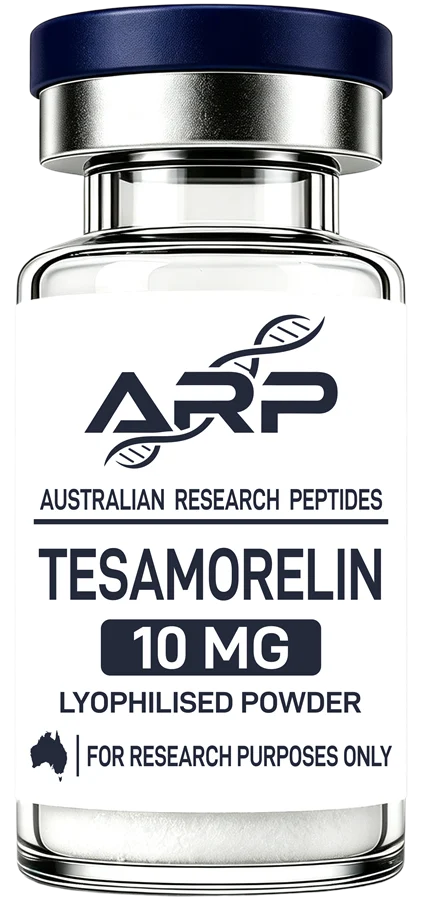
Tesamorelin is stocked in Australia by Australian Research Peptides as 10 mg of freeze-dried powder — the full 44-amino-acid growth-hormone-releasing hormone chain with its hex-3-enoyl group — posted to every state and territory. Deep abdominal fat is what the peptide is known for shifting. As a synthetic copy of that hormone it prompts the pituitary to release more growth hormone, which in turn lifts IGF-1. Visceral fat — the deep fat packed around the organs rather than under the skin — is the compartment it is studied against. Sold for in vitro research purposes only.

Growth Hormone Research · Lyophilised Powder · Batch-tested · SKU ARP-TES-10
In stock·99.290%
$139.99
1

2+ vials: 5% off — applied automatically in the cart

Presentation
10 mg per vial
Grade
High-Purity Research Grade
Form
Lyophilised Powder
Category
Growth Hormone Research
Same-day dispatch on business-day orders placed before 12pm AEST, Mon–Fri
Tracked shipping Australia-wide ·typically 1–2 business days to most areas by Express Post · free post over $199, free Express over $299
Batch certificates — published in the COA library
For in vitro research purposes only. Not for human consumption. Not for animal consumption. This product is not a drug, food, cosmetic, or dietary supplement. Any amounts shown are reported from published studies, with the species or trial population named. ARP gives no dosing, medical or therapeutic guidance of its own.
Tesamorelin · 10 mg
$139.99

Frequently Bought Together

About Tesamorelin

Tesamorelin is an analogue of growth-hormone-releasing hormone, usually shortened to GHRH. An analogue copies the structure of another molecule and changes one part of it. GHRH is the signal the body uses to tell the pituitary gland to put out growth hormone, and tesamorelin is a longer-lasting stand-in for that signal. It works one step above growth hormone rather than replacing it.

The vial holds the full 44-amino-acid chain of human GHRH. A hex-3-enoyl group sits on the tyrosine at the N-terminal end, and that is the piece the natural hormone does not have. Published records say the N-terminal part was modified to improve the molecule's stability. Length is what separates tesamorelin from ARP's other growth-hormone listing: the CJC-1295 vial carries a 29-amino-acid fragment analogue instead.

Australian Research Peptides holds tesamorelin as a laboratory reference material for in vitro work in glassware and cell culture. Every batch is HPLC-assayed and its certificate is available on request. The material is not supplied for use in people or animals, and ARP makes no claim about what it does in either.

Content reviewed

Further reading: Tesamorelin: What It Is and Who the Trials Studied

Tesamorelin specifications, storage and shipping

  • Compound: Tesamorelin
  • Also known as: Tesamorelin
  • Class: Synthetic growth-hormone-releasing hormone (GHRH) analogue, full-length sequence
  • Appearance: White to off-white lyophilised powder
  • Sizes & SKUs: 10 mg (ARP-TES-10)
  • Presentation: sealed glass vial
  • Form: Lyophilised Powder
  • Grade: High-purity research grade
  • Purity verification: HPLC-assayed on every batch to a minimum of 99% purity — the measured result for your batch is stated on its Certificate of Analysis
  • Identity confirmation: Mass spectrometry
  • Batch traceability: every batch is tested, with its certificate published in the COA library
  • Classification: In vitro research purposes only — laboratory reference material

Lyophilised — long term
−20 °C to −80 °C — long-term storage
Lyophilised — short term
2–8 °C — refrigerated, for a few months
Reconstituted
2–8 °C — use within 8–12 weeks
Protect from light and moisture. Handle in accordance with standard laboratory safety practice, including appropriate PPE. This information is provided for laboratory handling only and is not a usage instruction of any kind.

Every batch undergoes HPLC purity analysis and mass-spectrometry identity confirmation. The full laboratory report is published in the COA library.

Business-day orders before 12pm AEST are dispatched the same day with tracked, discreet shipping. Standard delivery within Australia typically takes 2–5 business days. See Shipping & Delivery for details, and follow your parcel on the Track Order page.

For in vitro research purposes only. Not for human consumption. Not for animal consumption. Not a drug, food, cosmetic, or dietary supplement. No therapeutic or medical claims are made.

Questions about Tesamorelin

This question guide from Australian Research Peptides covers Tesamorelin in Australia: what the listing contains, live buying and delivery questions, research context, handling, testing and comparisons. Start with the quick answers, then open the topic group that matches your search.

Buying, price and availability

Tesamorelin is sold by Australian Research Peptides, and an order placed on a weekday morning, ahead of 12pm AEST, leaves that same day. ARP lists it as one 10 mg vial carrying the TES code, filed under Growth Hormone Research. Everything ARP sends goes out from within Australia, so delivery is domestic — Express or standard tracked — with no import step to wait on.

Tesamorelin comes from Australian Research Peptides, an Australian company working from Sydney rather than routing orders through an overseas warehouse. The listing is the full 44-amino-acid GHRH sequence with its hex-3-enoyl group, one 10 mg vial, HPLC Verified grade. Express Post covers all states and territories, with a 12pm AEST weekday cut-off.

Tesamorelin carries one Australian-dollar price, covering the single 10 mg vial. The amount is pulled from Australian Research Peptides' live catalogue data, never keyed into fixed copy. ARP quotes nothing per milligram. That price sits against the same batch and grade.

Tesamorelin is sold online by Australian Research Peptides, an Australian research-peptide supplier stocking it as a single 10 mg vial. Payment is a transfer sent from the buyer's own bank, by PayID or to the account details issued with each order. Cards, wallets and cryptocurrency are refused. The parcel is released once that transfer has been reconciled, and it posts domestically.

Tesamorelin is supplied here by Australian Research Peptides rather than by Chemist Warehouse, which does not carry it. The brand approved overseas has never been registered in Australia, so the question of a retail chain stocking it does not arise locally. What ARP lists is the research compound in powdered form, which is a different thing from a dispensed medicine.

Identity, names and exact format

The Tesamorelin 10 mg vial holds 10 mg of freeze-dried peptide at the HPLC Verified grade. The phase 3 trials ran 26 weeks at 2 mg a day, and Australian Research Peptides leaves that arithmetic to you.

The hex-3-enoyl group is a short fatty chain fixed to the tyrosine at tesamorelin's N-terminal end. The published reason for it is stability. Changing that end of the molecule improves how it holds up and how long it lasts in the body. That is a fact about the molecule, not a claim about an effect. Strip it away and what is left is the plain GHRH sequence.

Tesamorelin contains 44 amino acids, the complete chain of human growth-hormone-releasing hormone rather than a shortened piece of it. It is therefore classed as a full-length sequence. The count covers the peptide chain only. The hex-3-enoyl group at one end is a fatty acyl group, not an amino acid, so it sits outside the 44. No residue-by-residue sequence is published on this page.

Tesamorelin is a synthetic, full-length analogue of human growth-hormone-releasing hormone (GHRH) with 44 amino acids and a hex-3-enoyl group at its N-terminal end. It is studied in endocrine research on the growth-hormone axis, the chain of signals controlling when growth hormone is released. Research covers GHRH-receptor pharmacology in cell culture and animal models, plus clinical trials measuring visceral fat. Australian Research Peptides supplies this material for in vitro laboratory work and does not claim an outcome from the clinical literature.

Tesamorelin arrives as an off-white dry cake, sealed under a tamper-evident closure. The quantity is 10 mg, and Australian Research Peptides carries no other size of it. Bacteriostatic water and syringes are listed separately as lab consumables.

Tesamorelin is also known as TH9507, the development code from its clinical programme, sometimes written TH-9507, and Egrifta is the brand name of the medicine approved on that molecule in 2010. Chemical registries list it as N-[(3E)-hex-3-enoyl]tyrosyl hGRF(1-44) amide under CAS 218949-48-5, with 804475-66-9 covering the acetate salt, and the literature often calls it simply a full-length GHRH analogue. Australian Research Peptides maps the shorthand tesa to the listing. Whichever term you searched, the vial ships from inside Australia, so nothing waits on customs.

Research context and evidence

Tesamorelin binds GHRH receptors on pituitary cells, and those cells then release growth hormone. The growth hormone travels on to other tissues, including liver cells, where it prompts production of insulin-like growth factor-1, or IGF-1. Records of its pharmacology list IGF-1 and IGFBP-3 both rising afterwards. That pharmacology describes Tesamorelin as studied; it is not a claim about the research material on this page.

Research on Tesamorelin has mostly measured visceral fat, the fat packed deep in the abdomen around the organs. Falutz 2007, reporting in the New England Journal of Medicine, enrolled 412 people with HIV who had a build-up of abdominal fat. Each got either 2 mg of tesamorelin a day, injected under the skin, or a placebo, for 26 weeks. Visceral fat fell 15.2% on tesamorelin and rose 5.0% on placebo. Falutz's 2010 pooled analysis of 806 people put the treatment effect at 15.4%.

Both phase 3 trials of Tesamorelin used 2 mg a day, given as an injection under the skin. Falutz's 2010 pooled analysis put 543 of its 806 participants on that amount for 26 weeks, all of them HIV-positive patients with excess abdominal fat. The Egrifta SV prescribing information labels the approved medicine at 1.4 mg once daily instead. Australian Research Peptides publishes these as research history, not as instructions.

Tesamorelin leaves circulation within the hour. The original EGRIFTA prescribing information reports a mean elimination half-life of 26 minutes in healthy subjects and 38 minutes in HIV-infected patients, alongside absolute bioavailability under four per cent; the later EGRIFTA SV label gives eight minutes for its own formulation. The trials behind that medicine read their results at 26 and 52 weeks, so a brief spell in blood and a slow-moving outcome sit together comfortably.

Tesamorelin has something almost nothing else on this site has: a completed clinical programme that ended in an approval, granted in the United States in 2010 for a defined patient group. Within that group the trials met their endpoints. Outside it nothing has been established, and research-grade powder has never been assessed by anyone — an approval for a labelled medicine does not travel to a laboratory vial.

Tesamorelin's published trials measured visceral adipose tissue by CT at 26 weeks and again at 52, so the timescale in the evidence is months rather than weeks. Growth-hormone and IGF-1 changes are detectable far sooner because they were sampled sooner. There is no published measurement of what happens at four or eight weeks.

No published figure describes how much of tesamorelin's effect persists once treatment ends. Falutz's 2010 pooled analysis of two phase 3 trials measured a 15.4% reduction in visceral adipose tissue at week 26 of daily treatment — a reading taken during therapy, with no post-withdrawal arm reported beside it. The approved medicine is used continuously. Anything further is inference rather than a published result.

Tesamorelin is one of the few research peptides with real human safety data, because its trials were run for regulatory approval. Injection-site reactions, joint pain, muscle aches, swelling in the limbs and tingling in the hands were among those reported, along with rises in blood glucose. That data comes from supervised trials of a prescribed product.

Handling, storage and measurements

Sealed Tesamorelin is a lyophilised powder, and lyophilised peptides tolerate ambient transit — which is why the vial posts without a cold chain and arrives stable. Cold storage matters from the point you take delivery, not during transit, and it matters most after reconstitution. A vial that arrives warm and still sealed is not a spoiled vial.

That is the correct appearance: Tesamorelin dries to an off-white cake of ten milligrams and, although the molecule is a 44-residue chain and long by peptide standards, that mass still barely coats the bottom. Freeze-drying reduces a frozen solution to its solids alone. Movement in the post can crumble the cake into dust that scatters up the walls, leaving the container reading as untouched.

Tesamorelin is a freeze-dried peptide, and dry is the state it keeps best in. Australian Research Peptides' stated condition for the sealed powder is -20 C, protected from light and moisture. Once dissolved the condition changes to 2-8 C, with a working life of 8 to 12 weeks. Do not refreeze a solution that has thawed. A short warm interval in transit is normal for freeze-dried material.

Reconstitution turns Tesamorelin's freeze-dried powder into a solution, normally using bacteriostatic water. Let the sealed Tesamorelin vial reach ambient temperature first. Tesamorelin takes the liquid best down the glass wall, never dropped directly onto the dry cake. Roll or swirl it gently, never shake, and chill what you make. The Egrifta SV label reconstitutes its own 2 mg vial with 0.5 mL of sterile water, which is 4 mg/mL.

A Tesamorelin vial's concentration is its milligrams divided by the millilitres of water you add. Two millilitres into the 10 mg vial gives 5 mg/mL. Double that water and the same vial reads 2.5 mg/mL. One millilitre gives 10 mg/mL. Australian Research Peptides publishes no fill volume, so the choice and the record are yours. The reconstitution calculator in ARP's guides checks any pair you pick.

Dissolved Tesamorelin is stored at 2–8 °C across an eight-to-twelve-week working life, the condition Australian Research Peptides states for reconstituted material. Tesamorelin runs 44 amino acids, the longest chain ARP catalogues, and more residues mean more bonds for water to attack. Its hex-3-enoyl cap improves how the molecule holds up inside the body, which is a separate question from how it holds up in glass.

Tesamorelin is supplied as a 10 mg vial and the diluent volume is a bench decision rather than a fixed one, because it changes concentration and not quantity. Adding 1.5 mL gives about 6.67 mg per mL; 2.5 mL gives 4 mg per mL. Work any other pairing out by dividing the milligrams in the vial by the millilitres going into it.

Agitation is the usual cause, which is why the Egrifta SV label for the approved tesamorelin product directs that its vial be rolled gently rather than shaken. Rolling avoids driving air through the liquid, where it shows as a milky suspension that disperses on standing. Cloudiness which persists, or particles remaining once the cake has apparently gone, means the preparation is not sound.

Yes, a Tesamorelin vial holds dry peptide only, and a diluent is what dissolves the tesamorelin. Diluent is the term for the liquid that returns a lyophilised powder to solution. Tesamorelin is normally taken up in bacteriostatic water. Australian Research Peptides sells that as a separate consumable, measured in millilitres, whereas the Tesamorelin vial is measured in milligrams.

Ten draws at 1 mg, five at 2 mg, twenty at 500 mcg. The approved product's registered strength is 2 mg per dose, which puts a 10 mg vial at five of those. Australian Research Peptides' reconstitution calculator converts whichever figure is used into syringe units.

Testing and batch documents

Every Tesamorelin batch is analysed by HPLC before Australian Research Peptides releases it. HPLC is the separation method behind the HPLC Verified grade. Identity matters as much as purity because shorter fragment analogues of the same hormone sit in the same category. A measured result belongs only to the exact published batch document, when one is registered; testing does not establish sterility. A matching certificate is currently published for this product and strength. Open the 10 mg certificate.

Ordering, payment and Australian delivery

Two Tesamorelin vials earn free Standard tracked post and one does not. In practice tesamorelin is often ordered beside a second compound, and that pairing usually reaches the threshold without needing two vials of tesamorelin at all. Free Express Post is set at a higher figure again. Australian Research Peptides settles the question against whatever an individual order actually totals.

Tesamorelin moves in 1–2 business days under Express Post to most destinations and 2–5 under standard tracked post, measured from lodgement rather than from checkout. A tracking number is emailed the moment the parcel goes to the carrier, not when the order is placed, so the gap between those two events is dispatch rather than delay. If tracking has not updated for two business days, contact support.

Tesamorelin is paid for by PayID or bank transfer, and every order gets a unique reference that must go in the payment description. That reference is the only thing linking your transfer to your order — reconciliation is manual, so a payment arriving without one has to be matched by hand against name and amount, which delays dispatch and occasionally cannot be resolved at all.

Buy diluent for the whole order rather than for the Tesamorelin vial alone. Tesamorelin is commonly run beside a second compound, and one 10 mL bacteriostatic water vial covers several reconstitutions inside its working life, where two or three 3 mL vials would cost more and waste more. Syringes are the other thing not included.

Access, approval and sport questions

Tesamorelin is sold in Australia for in vitro research purposes only, never as a medicine. Australian Research Peptides does not supply it as a therapeutic good, a supplement or a food, and it is not intended for human or animal use. Any amount quoted alongside Tesamorelin comes from published trials rather than from ARP, and none of them is a direction.

Tesamorelin is FDA approved — as Egrifta, licensed in America during 2010 to reduce excess abdominal fat in HIV patients with lipodystrophy. That approval belongs to a manufactured, labelled, prescribed medicine under clinical supervision. It does not travel across to research-grade tesamorelin powder, which no agency has evaluated and no pharmacist dispenses. Identical peptide name, entirely different regulatory standing.

Tesamorelin is banned in sport, and is one of the few peptides written out by name — it appears among the growth-hormone-releasing hormone analogues at section S2.2, beside sermorelin and CJC-1295. That section carries no in-competition-only limit and applies all year. Athletes registered with Sport Integrity Australia are answerable for whatever a sample contains, however the vial was described.

Tesamorelin is not available from an Australian pharmacy under the brand approved overseas, and no pharmacist can dispense Australian Research Peptides’ listing because it is not a registered medicine. What ARP supplies is the research compound in powdered form. Anyone offering a pharmacy-dispensed tesamorelin product in Australia should be asked which registration they are dispensing against.

Tesamorelin is unusual here: it is an approved prescription medicine in the United States and has never been registered in Australia, so importing it means bringing in a foreign prescription product rather than an unlicensed chemical. The TGA's Personal Importation Scheme sets conditions on exactly that situation. Australian Research Peptides sidesteps it entirely by supplying research-grade material from Sydney, which crosses no border.