
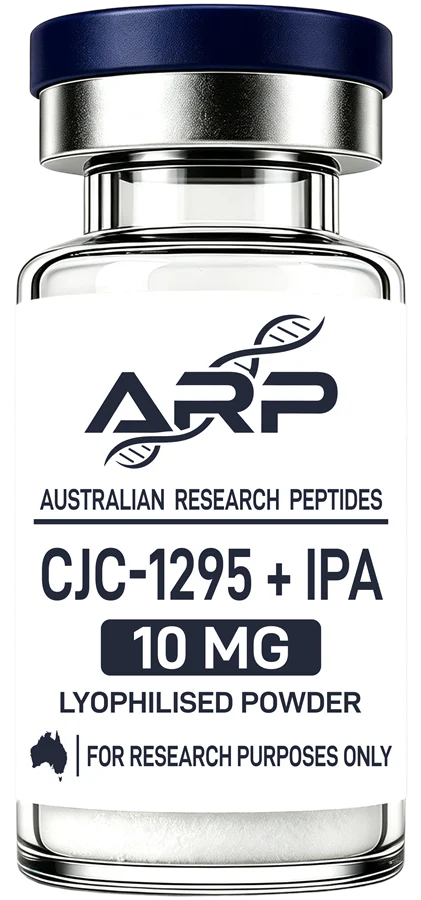
Buy CJC-1295 (no DAC) + Ipamorelin 10 mg in Australia
CJC-1295 (no DAC) + Ipamorelin 10 mg, typed by buyers as CJC 1295 ipamorelin, is $124.99 a vial in Australia from Australian Research Peptides, supplier to laboratories and researchers, in stock; an order paid before 12pm Sydney time on a business day goes out that day. Both peptides are freeze-dried together at a fixed ratio. The 29-amino-acid CJC-1295 half is a modified copy of growth-hormone-releasing hormone and binds the GHRH receptor; the five-amino-acid ipamorelin half binds the ghrelin receptor. Both are studied in growth hormone research, and ARP ships to every state and territory. In vitro research purposes only.
Browse all GHRH and Secretagogue Research
About CJC-1295 (no DAC) + Ipamorelin
This vial holds two peptides with two different receptor targets. CJC-1295 without DAC is a modified copy of the first 29 amino acids of growth-hormone-releasing hormone, the signal the hypothalamus sends down to the pituitary gland, where the receptor for it sits on the growth-hormone cells. Ipamorelin is five amino acids long and binds a separate target, the growth hormone secretagogue receptor — the one ghrelin binds. An agonist is a molecule that binds a receptor and switches it on. Both molecules are studied in growth hormone research.
Australian Research Peptides supplies the no-DAC form, and the distinction matters. CJC-1295 exists in two versions that are routinely confused. The DAC version carries an added Drug Affinity Complex, a lysine linked through maleimidopropionic acid, which binds serum albumin — a protein that circulates in the blood. That is a structural difference, and the reason the two forms are not interchangeable. The no-DAC version has no such tail, and it is the same compound catalogued elsewhere as Modified GRF (1-29). Both peptides dry together into one powder, so the strength shown covers the pair rather than either one alone.
Australian Research Peptides supplies the pair as a single freeze-dried solid, white to off-white, sealed in a tamper-evident glass vial. Nothing separates the two peptides once they are in that glass, which is why a reconstitution volume sets concentration and can never set ratio. The material is a laboratory reference compound, characterised for work in glassware and cell culture rather than for any use in a living subject.
What is in the vial
| Component | Amount per vial |
|---|---|
| CJC-1295 (no DAC) — no DAC — not the DAC-modified analogue; also catalogued as Modified GRF (1-29) | ~5 mg |
| Ipamorelin | ~5 mg |
| Total | 10 mg per vial |
CJC-1295 (no DAC) + Ipamorelin specifications, storage and shipping
- Compound: CJC-1295 (no DAC) + Ipamorelin
- Also known as: CJC-1295 without DAC (Modified GRF (1-29)) with ipamorelin
- Class: Two-peptide blend: a growth-hormone-releasing-hormone analogue with a growth-hormone secretagogue-receptor ligand
- Appearance: White to off-white lyophilised powder
- Sizes & SKUs: 10 mg (45388)
- Presentation: sealed glass vial
- Form: Lyophilised Powder
- Grade: Research grade
- Testing: Independently lab-tested for identity and amount before release — the laboratory's report for this blend gives a measured amount for each peptide and no purity figure
- Identity confirmation: Mass spectrometry
- Certificates: issued by Janoshik, an independent laboratory, and published in the COA library
- Classification: In vitro research purposes only — laboratory reference material
- Lyophilised — long term
- −20 °C to −80 °C — long-term storage
- Lyophilised — short term
- 2–8 °C — refrigerated, for a few months
- Reconstituted
- 2–8 °C — use within 8–12 weeks
- CJC-1295 (no DAC) + Ipamorelin 10 mg: measured content Ipamorelin 5.48 mg · CJC-1295 (mod GRF 1-29) 5.41 mg · CJC-1295 DAC not detected · laboratory batch 2026-06 · analysed 22 June 2026
Questions about CJC-1295 (no DAC) + Ipamorelin
This question guide from Australian Research Peptides covers CJC-1295 (no DAC) + Ipamorelin in Australia: what the listing contains, live buying and delivery questions, research context, handling, testing and comparisons. Start with the quick answers, then open the topic group that matches your search.