
Same-Day DispatchAustralian StockDiscreet DeliveryPremium Research GradeVerified CoAs
Same-day dispatch on business-day orders before 12pm AEST.Same-day dispatch before 12pm AESTFree post $199+

Buy GLOW Peptide Blend in Australia

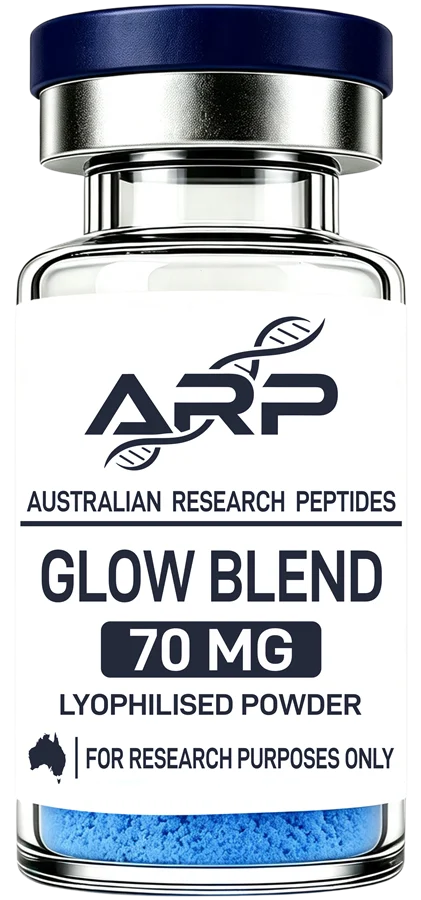
GLOW is sold in Australia by Australian Research Peptides as three repair peptides dried into a single 70 mg cake, each doing a different job. BPC-157 drives new blood-vessel growth through VEGFR2 and nitric oxide signalling. TB-500's actin-binding fragment powers cell migration and vessel sprouting. GHK-Cu lifts collagen and elastin production, the proteins that keep skin firm. Together they target wound repair and skin renewal, and ARP ships to every state and territory. Strictly for in vitro research purposes.

Skin & Cellular Research · Lyophilised Powder · Batch-tested · SKU ARP-GLOW-70
In stock·
$229.99
1

2+ vials: 5% off — applied automatically in the cart

Presentation
70 mg per vial
Grade
High-Purity Research Grade
Form
Lyophilised Powder
Category
Skin & Cellular Research
Same-day dispatch on business-day orders placed before 12pm AEST, Mon–Fri
Tracked shipping Australia-wide ·typically 1–2 business days to most areas by Express Post · free post over $199, free Express over $299
Batch certificates — published in the COA library
For in vitro research purposes only. Not for human consumption. Not for animal consumption. This product is not a drug, food, cosmetic, or dietary supplement. Any amounts shown are reported from published studies, with the species or trial population named. ARP gives no dosing, medical or therapeutic guidance of its own.
GLOW · 70 mg
$229.99

Frequently Bought Together

About GLOW

Every peptide in a GLOW vial comes out of preclinical repair research, and each has its own literature. Animal and cell work on BPC-157 points at blood-vessel formation, through VEGFR2 and nitric oxide signalling. TB-500 is the seven-amino-acid actin-binding motif of thymosin beta-4, and in cell assays that motif alone matched the full protein for angiogenic activity at about 50 nM. GHK-Cu is a human tripeptide carrying copper, reported in laboratory work to raise synthesis of collagen and elastin. None of that is a result in a person.

GLOW is not a compound. It is the name this category uses for three peptides freeze-dried together into one vial: BPC-157, TB-500 and GHK-Cu. The name is a market label, not a specification. Two vials sold under it need not hold the same total, so read the compound list and the milligram figure instead of the word. ARP catalogues each of the three in its own right as well, and two of them again as a pair.

The split is published on this page as a nominal formulation: roughly 50 mg of GHK-Cu with about 10 mg each of BPC-157 and TB-500, itemised under "What is in the vial". What is not published is a laboratory-measured amount for each of the three in the vial you receive, so read those figures as the recipe rather than as an assay result. Two of the three, BPC-157 and TB-500, are Schedule 4 substances in Australia. The FAQ below says where each of them sits, and ARP holds the material here as a laboratory reagent for in vitro research purposes only.

What is in the vial

GLOW composition per vial
ComponentAmount per vial
BPC-157~10 mg
TB-500a fragment corresponding to the actin-binding region of thymosin beta-4~10 mg
GHK-Cuthe copper(II) complex of the GHK tripeptide~50 mg
Total70 mg per vial

GLOW specifications, storage and shipping

  • Compound: GLOW
  • Also known as: BPC-157, TB-500 and GHK-Cu combination
  • Class: Three-peptide blend
  • Appearance: Lyophilised powder
  • Sizes & SKUs: 70 mg (ARP-GLOW-70)
  • Presentation: sealed glass vial
  • Form: Lyophilised Powder
  • Grade: High-purity research grade
  • Purity verification: HPLC-assayed on every batch to a minimum of 99% purity — the measured result for your batch is stated on its Certificate of Analysis
  • Identity confirmation: Mass spectrometry
  • Batch traceability: every batch is tested, with its certificate published in the COA library
  • Classification: In vitro research purposes only — laboratory reference material

Lyophilised — long term
−20 °C to −80 °C — long-term storage
Lyophilised — short term
2–8 °C — refrigerated, for a few months
Reconstituted
2–8 °C — use within 8–12 weeks
Protect from light and moisture. Handle in accordance with standard laboratory safety practice, including appropriate PPE. This information is provided for laboratory handling only and is not a usage instruction of any kind.

Every batch undergoes HPLC purity analysis and mass-spectrometry identity confirmation. The full laboratory report is published in the COA library.

Business-day orders before 12pm AEST are dispatched the same day with tracked, discreet shipping. Standard delivery within Australia typically takes 2–5 business days. See Shipping & Delivery for details, and follow your parcel on the Track Order page.

For in vitro research purposes only. Not for human consumption. Not for animal consumption. Not a drug, food, cosmetic, or dietary supplement. No therapeutic or medical claims are made.

Questions about GLOW

This question guide from Australian Research Peptides covers GLOW in Australia: what the listing contains, live buying and delivery questions, research context, handling, testing and comparisons. Start with the quick answers, then open the topic group that matches your search.

Buying, price and availability

Australian Research Peptides supplies GLOW throughout Australia — one 70 mg vial combining BPC-157, TB-500 and GHK-Cu, catalogued under the GLOW code and reached by searching "glow blend". Weekday orders confirmed before 12pm AEST are packed and posted that same afternoon from Sydney, so no parcel meets customs. Express Post and standard tracked services reach every state and territory. Every batch is HPLC-tested, its certificate available from ARP's CoA library, and payment runs on PayID or bank transfer.

One GLOW vial replaces three separate vials, and the honest comparison is its price against what BPC-157, TB-500 and GHK-Cu come to bought individually from Australian Research Peptides. What the blend costs you is flexibility — the ratio between the three peptides is fixed in the vial, so it cannot be adjusted the way three separate vials can.

GLOW is a three-peptide blend — BPC-157, TB-500 and GHK-Cu in a single 70mg vial — supplied by Australian Research Peptides Pty Ltd, which trades as ARP. Every lot behind the GLOW blend is HPLC-tested. Nothing crosses a border. Beat the 12pm AEST cut-off on a business day and the vial is lodged that afternoon, on either postage service, to any address the carrier reaches.

A GLOW vial carries one Australian-dollar figure covering all three peptides at once. Setting that against a single-compound page compares a three-peptide vial with a one-peptide vial, which is not a like-for-like read. The fairer comparison is another blend of stated total quantity. Postage is charged on top and is quoted separately.

GLOW is supplied by Australian Research Peptides, which supplies the three-peptide vial from within Australia and takes orders online rather than by phone or counter. PayID and bank transfer are the only payment methods accepted; cards, wallets and crypto are not taken at all. Delivery is by domestic post to any Australian address.

The GLOW blend comes from Australian Research Peptides and is not stocked by Chemist Warehouse. It combines three research peptides in one vial and none of them is registered for supply in Australia, so no pharmacy could dispense the blend or its parts. ARP lists it as a single 70 mg research vial.

Identity, names and exact format

GLOW is a market label for a three-peptide blend of BPC-157, TB-500 and GHK-Cu; the four letters do not stand for a published expansion. Australian Research Peptides uses GLOW as the catalogue label rather than an abbreviation. Because the name is not a specification, two products sold as GLOW need not match: compare the compounds named and the total quantity.

GLOW has no single amino-acid count, because the vial holds three separate chains. BPC-157 is a pentadecapeptide, fifteen amino acids long. The TB-500 fragment is seven. The GHK part of GHK-Cu is three, and its copper is bound to that chain rather than counted as a fourth unit. Three chains, three counts, one vial.

A GLOW vial from Australian Research Peptides holds 70 mg in total, blended at the standard GLOW ratio, so it is about 50 mg of GHK-Cu with about 10 mg each of BPC-157 and TB-500. Those are nominal formulation figures rather than an assayed result for this vial, and the quantity on the label is the combined total for all three. When an exact-strength batch document is published, its laboratory-measured amount for each of the three components takes precedence over the nominal formulation figures.

No, GLOW is not a protein powder, and it is not a food of any kind. Protein powder is a bulk dietary ingredient measured in grams and eaten. GLOW is a milligram quantity of three short synthetic peptides sealed in a laboratory vial. Australian Research Peptides supplies it for in vitro research, and it is not for consumption by anyone.

Combining three peptides in a GLOW vial is a packaging decision, not a scientific finding. Each compound has its own body of research, and the one published test of any pair among them found nothing extra from the combination. Australian Research Peptides does not claim the three behave differently together than apart. What the format saves is handling.

GLOW's colour comes from its GHK-Cu component — copper complexes are pigmented, which is unusual among peptides and catches people out on first opening a vial. Expect blue in the dry cake and blue in solution. A GLOW preparation showing no colour at all is the one that raises a question about what is in it.

GLOW has no chemical synonym; it is a market label often written GLOW Blend. Australian Research Peptides uses GLOW as the catalogue code for its blend of BPC-157, TB-500 and GHK-Cu. Because GLOW is not a standardised scientific name, products with that label can differ between suppliers; compare the named components and quantities.

GLOW is one vial, not three, and all three peptides sit in the same freeze-dried powder. Nothing arrives as a boxed set of separate vials. The glass is sealed and tamper-evident. Because the peptides share a container, the whole vial takes one storage decision and one mixing step rather than three of each.

Research context and evidence

GLOW has three mechanisms under study, one per peptide, and none of them is settled. BPC-157 is linked in animal and cell work to VEGFR2 and to nitric oxide signalling, both tied to new blood-vessel growth. TB-500 is the actin-binding motif of thymosin beta-4, and peptides missing part of that motif were inactive in cell assays. GHK-Cu binds copper and raised collagen and elastin synthesis in laboratory studies.

No published study tests GLOW's three peptides together. A PubMed search naming BPC-157, TB-500 and GHK-Cu returned four records in August 2026, and every one is a review article. The closest work, Biçer 2026, paired BPC-157 with TB-500 in 32 rats after Achilles tendon repair, and the pairing gave no benefit beyond either peptide alone. All three literatures are preclinical.

The rat study on two of GLOW's peptides gave BPC-157 at 10 µg/kg/day and TB-500 at 60 µg/kg/day. Biçer and colleagues gave both intraperitoneally, into the abdominal cavity, every day for four weeks after Achilles tendon repair. The animals were 32 male Sprague-Dawley rats, aged 12 weeks and around 330 g. Those are rat amounts.

GLOW's third peptide, GHK-Cu, was given to mice at 0.2, 2 and 20 µg/g/day. That unit is micrograms per gram of body weight, as the paper states it. Ma and colleagues injected it intraperitoneally on alternate days across 21 days. The animals were C57BL/6j mice with bleomycin-induced lung fibrosis, and collagen deposition fell.

GLOW combines three peptides whose disposal rates were never measured together. Mateescu's 2026 review gives BPC-157 under half an hour in plasma. The seven-residue thymosin fragment has no published figure, only rat metabolite data reaching 72 hours, and the copper tripeptide has none in humans either. So a blend carries no single elimination time, and any supplier quoting one invented it.

Three peptides, three separate preclinical literatures, and no human timeline for any of them. BPC-157 and TB-500's rodent repair studies measured at one to four weeks; the controlled GHK-Cu work took about twelve weeks and applied a cream to skin. None of that produces an answer for this blend in a person.

Nobody has published anything about discontinuing GLOW, which is unsurprising: the three-peptide combination has no clinical literature at all, and each ingredient's own record is preclinical. So no after-effect is described, no rebound is documented, and no evidence shows whether stopping matters. That absence is the accurate reply, and filling it with confident guesswork is what unreliable sellers do.

GLOW combines three peptides, and none of BPC-157, TB-500 or GHK-Cu has controlled human injectable safety data. So GLOW has no measured side-effect profile, and combining three unstudied compounds compounds that uncertainty rather than diluting it. GHK-Cu's own human evidence is topical, which does not carry across to this preparation.

One of GLOW's three peptides has a published human dose, and it is BPC-157. Lee and Burgess, in a 2025 pilot, infused 10 mg on day one and 20 mg on day two into two healthy adults, intravenously in saline over an hour. It was a safety study in two people. PubMed lists no trial giving a human amount of TB-500 or of GHK-Cu.

GLOW has never been tested as a blend. A PubMed search naming BPC-157, TB-500 and GHK-Cu returned four records in August 2026, and every one was a review rather than an experiment. The nearest study, Biçer 2026, paired two of the three in rats and found no benefit over either peptide on its own. GHK-Cu is the only one of the three with controlled human data, and that data is topical. Three preclinical literatures sitting side by side are not evidence for the combination.

Handling, storage and measurements

GLOW seldom prompts this worry. Seventy milligrams of combined solid is ample to see, and its GHK-Cu component tints the whole mass blue, so expect a coloured chalky body rather than an invisible layer. The three peptides dry as one and are not visible as separate bands. A cake sitting unevenly, or cracked from handling, changes nothing about the contents.

One storage decision covers all three of GLOW's peptides, because they share a vial. Keep the sealed powder dry, below -15 °C and away from direct light. Peptides pull moisture out of the air, so let the vial warm up inside a desiccator first and only then break the seal. Bachem advises splitting any solution into portions and freezing them rather than keeping one volume.

Reconstituting GLOW puts all three peptides into solution at once, since they were dried together. Draw the bacteriostatic water into a syringe and send it against the glass, never onto the powder. Swirl the vial gently rather than shaking it, and wait until the liquid runs clear. Bachem notes that dissolving a peptide can occasionally take several hours.

Seventy milligrams of peptide sit in a GLOW vial, and the diluent volume decides the concentration. One millilitre makes 70 mg/mL. Two millilitres make 35 mg/mL. Seven millilitres make 10 mg/mL. Each figure covers all three peptides together, because the nominal split of roughly 50 mg of GHK-Cu to about 10 mg each of BPC-157 and TB-500 is a formulation figure rather than a measured one. For a volume not listed, divide 70 by the millilitres. Australian Research Peptides' guides include a calculator that does this division.

GLOW in solution is worked through inside twelve weeks, refrigerated between 2 and 8 degrees Celsius — Australian Research Peptides' general figure rather than a measured one, since no published study has followed three peptides sharing a single vial. GLOW is also the only ARP blend placing a bound copper ion beside two plain peptide chains, which argues for the short end.

Colour and clarity are separate properties, and GLOW's GHK-Cu fraction makes the liquid blue while leaving it perfectly see-through; opacity is what indicates trouble. Because three peptides take up water at unequal rates, a short hazy interval while the slowest finishes is expected, and shaking beats in air on top of that. Allow ten quiet minutes before judging.

Yes, GLOW needs a diluent, because the vial holds dry powder and nothing else. A diluent takes dry material into solution, and one volume of it covers all three of GLOW's peptides. Bacteriostatic water is the one ordinarily chosen for work of this kind. Australian Research Peptides shelves it under Lab Supplies rather than beside the peptides, and none travels with a GLOW vial, so order it separately.

GLOW's 70 mg is a combined figure across three peptides, so every draw carries all three in the blend's fixed proportions rather than 70 mg of any single compound. Seventy draws at 1 mg of blend, thirty-five at 2 mg. The per-peptide composition behind each draw is unconfirmed and is therefore not stated by Australian Research Peptides.

Testing and batch documents

Yes, Australian Research Peptides tests every GLOW batch before supplying it, and three peptides means three things to account for. HPLC measures purity by separating the sample into its parts. Mass spectrometry confirms identity by weighing the molecules, so this vial has three expected masses rather than one. The results are specific to the batch tested. A matching certificate is currently published for this product and strength. Open the 70 mg certificate.

Ordering, payment and Australian delivery

One GLOW vial earns free Standard tracked post on its own — true of only a handful of Australian Research Peptides lines, and a consequence of it holding three peptides rather than one. It does not reach the higher Express Post threshold, so choosing Express on a single-vial order still adds a fee. Water and syringes can be added without affecting the standard entitlement.

A GLOW order takes 2–5 business days to travel by standard tracked post, or 1–2 on Express Post into the faster states. One 70 mg vial holds three peptides, so what would otherwise be three parcels is one. Anything else on the same order — water, syringes, another vial — is packed into that same satchel under a single tracking number.

Pay a GLOW order to the cent. An amount that does not match the order total has to be reconciled by hand, and a short payment cannot release the stock at all. If you have underpaid or overpaid, contact support with the reference rather than sending a second transfer, which creates two unmatched payments instead of one.

One GLOW vial replaces three, but it does not reduce the diluent needed, because water is worked out from milligrams and GLOW holds 70 of them. That is well past what a 3 mL bacteriostatic water vial comfortably covers, so the 10 mL is the sensible pairing. Insulin syringes are the remaining item.

Access, approval and sport questions

GHK-Cu, one of GLOW's three peptides, is not scheduled in Australia. The other two are. Schedule 4 of the federal Poisons Standard covers BPC-157 and TB-500, making both prescription only, and Appendix D clause 5 names them again as poisons requiring authority to possess. Australian Research Peptides supplies GLOW strictly for bench research, never for use in a person.

Not one of GLOW's three peptides has ever been licensed as a medicine, so the combination holds no American approval and none anywhere else. Regulators assess a combination as a whole product, and no agency has assessed this one. Two of the three components are additionally scheduled under Australian law. The vial is a research reagent: unregistered, unreviewed, and not for a person.

GLOW is banned in sport, because two of its three peptides are: BPC-157 under the non-approved heading S0, and TB-500 with the growth factors under S2. GHK-Cu is named in neither, though that is not a clearance. One blended vial is enough to produce a positive sample, and Sport Integrity Australia would treat it accordingly.

GLOW is a blend, and at the Australian border a blend is treated as its strictest component rather than its mildest. Two of its three peptides sit in Schedule 4 of the Poisons Standard, so importing GLOW under the Personal Importation Scheme means importing a prescription-only good and needing a prescription for it. GHK-Cu being unscheduled does not soften that. Australian Research Peptides supplies GLOW domestically, so no ARP order is an import at all.