Same-Day DispatchAustralian StockDiscreet DeliveryPremium Research GradeVerified CoAs
Same-day dispatch on business-day orders before 12pm AEST.Same-day dispatch before 12pm AESTFree post $199+

Buy GHK-Cu in Australia

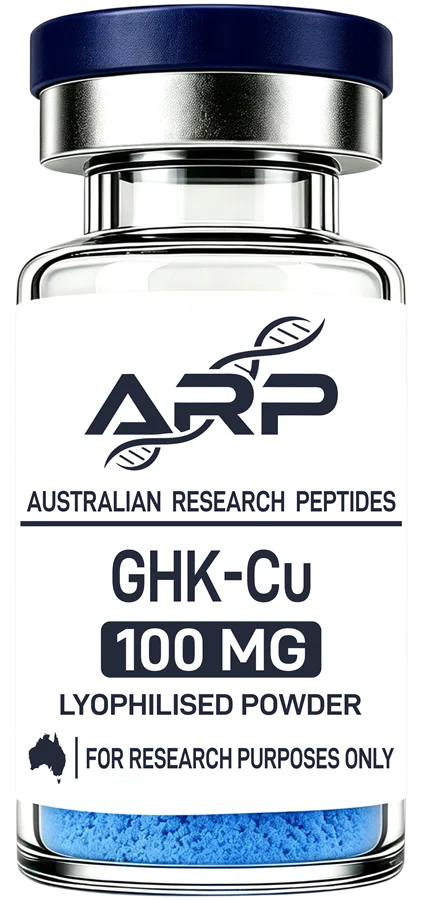
GHK-Cu can be bought in Australia from Australian Research Peptides as one sealed glass vial holding 100 mg of freeze-dried copper peptide, the copper bound inside a three-amino-acid chain. Controlled studies on aged skin found it tightens the skin, improves elasticity and firmness, and reduces fine lines, wrinkles, photodamage and dark patches. That bound copper lifts collagen output, rebuilds the matrix holding cells in place and stimulates wound healing. Shipped to every state and territory. Sold for in vitro research purposes only.

Skin & Cellular Research · Lyophilised Powder · Batch-tested · SKU ARP-GHK-100
In stock·99.912%
$139.99
1

2+ vials: 5% off — applied automatically in the cart

Presentation
100 mg per vial
Grade
High-Purity Research Grade
Form
Lyophilised Powder
Category
Skin & Cellular Research
Same-day dispatch on business-day orders placed before 12pm AEST, Mon–Fri
Tracked shipping Australia-wide ·typically 1–2 business days to most areas by Express Post · free post over $199, free Express over $299
Batch certificates — published in the COA library
For in vitro research purposes only. Not for human consumption. Not for animal consumption. This product is not a drug, food, cosmetic, or dietary supplement. Any amounts shown are reported from published studies, with the species or trial population named. ARP gives no dosing, medical or therapeutic guidance of its own.
GHK-Cu · 100 mg
$139.99

Frequently Bought Together

About GHK-Cu

GHK-Cu has a research literature that runs back to 1973, when GHK was first isolated from human plasma. Cell-culture work examines it against tissue remodelling. That is the constant breakdown and rebuild of the matrix that holds cells in place. Reviews of that work describe rises in collagen output, in certain glycosaminoglycans and in the proteoglycan decorin, measured in fibroblasts and in animal models. ARP reports the literature and claims nothing about any reader.

GHK is a tripeptide, which means a chain of three amino acids: glycine, L-histidine and L-lysine. GHK-Cu is that chain carrying a copper(II) ion. The copper is bound into the molecule, not stirred in beside it. GHK holds copper about as tightly as the copper transport site on albumin. A listing that says GHK with no copper is a different item.

Compare vial sizes before you compare GHK-Cu prices. This category mixes 50 mg and 100 mg listings more than any other in the catalogue, so a cheaper page elsewhere is often a smaller vial. ARP lists a single 100 mg GHK-Cu vial and no other size.

Content reviewed

Further reading: GHK-Cu: What It Is and Why It Carries Copper

GHK-Cu specifications, storage and shipping

  • Compound: GHK-Cu
  • Also known as: GHK-Cu (glycyl-L-histidyl-L-lysine copper(II) complex)
  • Class: Copper-binding tripeptide complex
  • Appearance: Lyophilised powder
  • Sizes & SKUs: 100 mg (ARP-GHK-100)
  • Presentation: sealed glass vial
  • Form: Lyophilised Powder
  • Grade: High-purity research grade
  • Purity verification: HPLC-assayed on every batch to a minimum of 99% purity — the measured result for your batch is stated on its Certificate of Analysis
  • Identity confirmation: Mass spectrometry
  • Batch traceability: every batch is tested, with its certificate published in the COA library
  • Classification: In vitro research purposes only — laboratory reference material

Lyophilised — long term
−20 °C to −80 °C — long-term storage
Lyophilised — short term
2–8 °C — refrigerated, for a few months
Reconstituted
2–8 °C — use within 8–12 weeks
Protect from light and moisture. Handle in accordance with standard laboratory safety practice, including appropriate PPE. This information is provided for laboratory handling only and is not a usage instruction of any kind.

Every batch undergoes HPLC purity analysis and mass-spectrometry identity confirmation. The full laboratory report is published in the COA library.

Business-day orders before 12pm AEST are dispatched the same day with tracked, discreet shipping. Standard delivery within Australia typically takes 2–5 business days. See Shipping & Delivery for details, and follow your parcel on the Track Order page.

For in vitro research purposes only. Not for human consumption. Not for animal consumption. Not a drug, food, cosmetic, or dietary supplement. No therapeutic or medical claims are made.

Questions about GHK-Cu

This question guide from Australian Research Peptides covers GHK-Cu in Australia: what the listing contains, live buying and delivery questions, research context, handling, testing and comparisons. Start with the quick answers, then open the topic group that matches your search.

Buying, price and availability

Australian Research Peptides supplies GHK-Cu throughout Australia as a 100 mg vial, shipped by Express Post or standard tracked post. Orders lodged before the 12pm AEST weekday cut-off leave that afternoon. The parcel begins its trip in Australia and remains inside the country end to end.

GHK-Cu is listed by Australian Research Peptides, an Australian supplier dispatching from Sydney — the copper tripeptide is filed under Skin & Cellular Research as code GHK, in a single 100 mg vial. Weekday orders confirmed by 12pm AEST go out that same afternoon, by Express or tracked Standard Post to every state and territory. No border crossing, no customs desk. Every batch carries HPLC results, with the certificate provided on request. Payment is PayID or bank transfer.

Australian Research Peptides carries a single GHK-Cu vial size, so there is one Australian-dollar figure and no strength ladder. That figure comes straight from the live catalogue record rather than from typed copy. The GLOW blend is a separate product with a price of its own. GLOW holds BPC-157, TB-500 and GHK-Cu together, with only about 50 mg of its 70 mg nominally the copper tripeptide, so a GLOW price says nothing about the standalone vial.

GHK-Cu is sold direct by Australian Research Peptides, an Australian business that lists the copper tripeptide as a single 100 mg vial and supplies it from within Australia. Payment goes through PayID or a direct bank transfer, so no card number and no digital wallet is ever handed over. Orders travel domestically.

Australian Research Peptides supplies GHK-Cu as a 100 mg research vial, which Chemist Warehouse does not sell. It does sell cosmetic skincare, and copper tripeptide turns up in some of it at very low inclusion — but that is a different product class, and the two should not be read as the same purchase. The ARP vial is catalogued under Skin & Cellular Research.

Identity, names and exact format

GHK-Cu is the copper(II) complex of the three-amino-acid peptide glycyl-L-histidyl-L-lysine. It is studied in tissue remodelling, including cell-culture experiments measuring collagen and other matrix components made by fibroblasts. A second line of research examines how tightly the peptide binds copper. These are descriptions of the literature, not statements about what happens in a person.

GHK-Cu stands for glycyl-L-histidyl-L-lysine copper(II) complex, and every part of that name has a role. G, H and K are the one-letter codes for glycine, histidine and lysine, while Cu is the chemical symbol for copper. The same identity can be described by its class: a copper-binding tripeptide complex.

GHK-Cu contains three amino acids: glycine, L-histidine and L-lysine, in that order. Three is why the peptide half of the name is called a tripeptide. The copper is not a fourth amino acid. It is a metal ion bound to the three-unit chain, so the count stays at three whether the material is written GHK or GHK-Cu. That same sequence turns up naturally in human plasma.

No, GHK-Cu arrives dry. It is a freeze-dried powder, sealed into a tamper-evident glass vial at the quantity Australian Research Peptides lists. Freeze-drying pulls the water out, and a dry peptide keeps far better than one sitting in liquid. It becomes a solution only after a researcher dissolves it. ARP does not supply GHK-Cu ready-mixed.

GHK-Cu is distinctively blue once reconstituted, because the copper ion at the centre of the complex is coloured — it is the one peptide in Australian Research Peptides’ range where a blue solution is expected rather than a warning sign. The dry powder is blue too. A GHK-Cu solution that is colourless is the one worth questioning.

GHK-Cu is also known as copper peptide, GHK copper, Cu-GHK and copper tripeptide-1, the INCI name used by cosmetic chemists. PubChem files the same complex as prezatide copper and in full as glycyl-L-histidyl-L-lysine copper(II) complex. GHK without copper is a different material, not a shorthand for GHK-Cu.

Research context and evidence

GHK-Cu works by holding a copper(II) ion inside a short three-unit peptide chain. Pickart 2008 puts its affinity for copper close to that of the copper transport site on albumin, a blood protein that carries copper. Copper is a trace metal that connective-tissue enzymes depend on. The published mechanism work is chemistry and cell culture, so what it describes is behaviour in a dish rather than an effect in a person.

GHK-Cu research is laboratory research, and most of it uses cell culture and animal models. Pickart's 2015 review in BioMed Research International reports GHK levels in human plasma near 200 ng/mL at age 20, falling to about 80 ng/mL by age 60. The same review credits GHK with altering the expression of at least 4,000 human genes. This answer reports the published literature and does not claim an outcome for the reader.

Most published GHK-Cu work is not injection research at all: the controlled human studies applied it topically in creams at fractions of a percent, and the cell-culture literature works in nanomolar to micromolar concentrations in the dish. No injected human dose has been established for it. Figures quoted elsewhere are usually read across from topical or in vitro work, which is not the same thing.

No pharmacokinetic half-life for GHK-Cu has been published in people. Endo and colleagues gave the metal-free tripeptide intravenously to rats for a 1997 chromatography paper and described swift degradation into histidyl-lysine, which itself cleared quickly, but their abstract prints no figure. Pickart's readings near 200 nanograms per millilitre at age twenty, falling to 80 by sixty, are resting concentrations rather than a clearance rate. Those two get confused constantly.

GHK-Cu has controlled human data, which is unusual for a research peptide — but it is topical data. Studies applying copper-peptide creams to aged facial and leg skin reported measurable improvements against control preparations. Those results describe a cream on skin. They do not transfer to any other route, and no equivalent injectable human trial has been published.

The controlled topical studies behind GHK-Cu ran for around twelve weeks before measuring skin outcomes, so the evidenced timescale is months of daily application. Cell-culture work shows changes in collagen signalling far faster than that, but a response in a dish is not a visible change on a person.

No trial has measured skin or tissue once GHK-Cu was discontinued. The controlled cosmetic studies behind it ran a fixed number of weeks and took their readings while application was still under way, with no washout observation reported afterwards. Cosmetic results generally depend on continued use, but that is a broad expectation about topical products, not something demonstrated for this copper complex.

GHK-Cu's published safety record comes from topical cosmetic studies, where irritation at the application site is the main reported issue. There is no controlled human safety data for any other route. Copper is also a mineral with an upper intake limit, which is a consideration a topical study never had to address.

Controlled studies on aged skin reported tighter skin and improved elasticity and firmness with GHK-Cu. The same work reported fewer fine lines and wrinkles, plus less photodamage and hyperpigmentation. Pickart's 2008 review of GHK and tissue remodelling summarises those findings and also reports wound-healing stimulation across numerous models and in humans. This answer restates the published results without adding a claim about the product on this page.

Handling, storage and measurements

GHK-Cu is the exception across this range. Its vial holds one hundred milligrams, ten times the usual peptide quantity, and copper bound inside the tripeptide gives the dried material a distinct blue. The result is a substantial, plainly coloured cake nobody mistakes for an empty container. A GHK-Cu vial that genuinely does appear bare, or that shows no blue whatever, is the one worth raising.

GHK-Cu is a copper complex, so the vial holds a metal bound into a peptide rather than a plain chain. Keep the powder sealed, dry, cold and away from light. A freezer suits long storage and a fridge suits short. Once dissolved, refrigerate the solution, keep it dark and do not refreeze it. Australian Research Peptides publishes a separate window for how long a reconstituted GHK-Cu solution keeps.

GHK-Cu is reconstituted like any freeze-dried peptide, with one difference. The copper is already inside the molecule, so no metal gets added at this step. Bacteriostatic water is the usual diluent, and a diluent is the liquid a dried solid is dissolved into. Let the vial warm, then aim the liquid at the glass so it runs down the side. Swirl until it clears, and never shake. Australian Research Peptides publishes worked volume examples for the 100 mg vial.

GHK-Cu is unusually robust in water for a peptide complex. Badenhorst's 2016 preformulation study held it stable in pH 4.5 to 7.4 buffers for two weeks at 60 °C, which is a stress test rather than a shelf life. Australian Research Peptides' published window for a reconstituted HPLC Verified line is eight to twelve weeks at 2 to 8 °C. Freeze aliquots below -15 °C beyond that.

A 100 mg GHK-Cu vial takes whatever volume the work calls for, and that volume fixes the strength. Two millilitres of bacteriostatic water makes 50 mg/mL. Five millilitres makes 20 mg/mL. Ten millilitres makes 10 mg/mL. For any other figure, divide 100 by the millilitres added. A concentration calculator sits in Australian Research Peptides' published research guides.

Blue is not cloudy, and with GHK-Cu separating those two properties is the whole answer. A sound preparation is strongly coloured yet still transparent, because light passes through it; turbidity means light being scattered, which shows as dullness or visible suspension. The commonest genuine cause with this compound is too little diluent for one hundred milligrams of solid, leaving material undissolved rather than aggregated.

Yes, GHK-Cu arrives as a dry solid and has to be dissolved before any laboratory work with it. Bacteriostatic water is the usual choice of liquid for that. The copper is part of the molecule, which is what the -Cu in the name records. Australian Research Peptides catalogues bacteriostatic water as a Lab Supplies consumable in its own right, so no vial ships with it.

A 100 mg GHK-Cu vial holds ten times the peptide of the ordinary 10 mg listings, so the arithmetic runs a long way: at 1 mg per draw it gives a hundred, at 2 mg fifty, at 5 mg twenty. That is division rather than direction — how much constitutes a draw is set by the protocol being run, and Australian Research Peptides publishes no protocol.

Testing and batch documents

Every GHK-Cu batch goes through analysis before supply. HPLC separates the sample into its parts and shows how much of it is the peptide. Mass spectrometry weighs the molecule and checks identity. A matching certificate is currently published for this product and strength. Open the 100 mg certificate.

Ordering, payment and Australian delivery

One transfer covers an entire order, however many items are in it — a GHK-Cu vial, bacteriostatic water and syringes together are a single amount against a single reference, not three payments. Splitting one order across several transfers makes it harder to match, not easier, and is the most common cause of a delayed dispatch.

A single 100 mg GHK-Cu vial does not reach the standard free-post threshold by itself. A second vial clears it, and so does pairing GHK-Cu with a companion compound, or with the generous volume of bacteriostatic water a 100 mg vial needs. Express sits higher again. Qualification is assessed on the subtotal before any multi-vial reduction.

GHK-Cu is with most buyers 2–5 business days after lodgement on standard tracked post, and 1–2 where Express Post serves the state quickly. No cold pack goes in the satchel and none is needed, because lyophilised peptide holds up at ambient temperature while travelling. Chilling only becomes relevant once a customer has the vial, and most of all after reconstitution.

GHK-Cu is the largest vial in the catalogue at 100 mg, and diluent scales with milligrams rather than with vial count — so it takes roughly ten times the water a 10 mg peptide does for the same concentration. That puts it firmly on the 10 mL bacteriostatic water vial. Australian Research Peptides' reconstitution calculator gives the exact volume.

Access, approval and sport questions

Australian Research Peptides supplies GHK-Cu in Australia as a laboratory research material. It is not sold as a medicine, a cosmetic or a supplement, and ARP makes no therapeutic claim for it. Anyone with a regulatory question about their own work can put it to a qualified adviser.

GHK-Cu carries no FDA approval, and the question sits slightly awkwardly against how it is normally sold. American regulators approve drugs; they do not approve cosmetic ingredients, and this copper complex has spent most of its commercial life in skincare, a category marketed without pre-market clearance. So a copper-peptide serum on a shelf demonstrates nothing about approval. Laboratory powder is unregistered too.

GHK-Cu is named in no section of the prohibited list, which is not the same as being cleared. Category S0 sweeps up any pharmacological substance lacking therapeutic approval from a government regulator, and use as a cosmetic ingredient is not such an approval. An injected copper tripeptide therefore sits in genuinely unsettled ground, and only Sport Integrity Australia can answer it for an Australian competitor.

GHK-Cu carries no Australian schedule entry, so no prescription attaches to it — unlike several peptides Australian Research Peptides lists, it appears in neither Schedule 4 nor Appendix D of the Poisons Standard. ARP still supplies it only as laboratory research material, and not as a medicine, cosmetic or dietary product. A qualified adviser, not a supplier, answers regulatory questions.

GHK-Cu is not scheduled in Australia and is not an approved therapeutic good either, which puts it in a quieter position than the peptides listed beside it. Quieter is not exempt. The TGA still governs whether an unapproved good may be imported, and the answer turns on what the importer intends to do with it. Buying from Australian Research Peptides avoids the question, because nothing crosses a border.