
Same-Day DispatchAustralian StockDiscreet DeliveryPremium Research GradeVerified CoAs
Same-day dispatch on business-day orders before 12pm AEST.Same-day dispatch before 12pm AESTFree post $199+

Buy Semaglutide Research Peptide in Australia

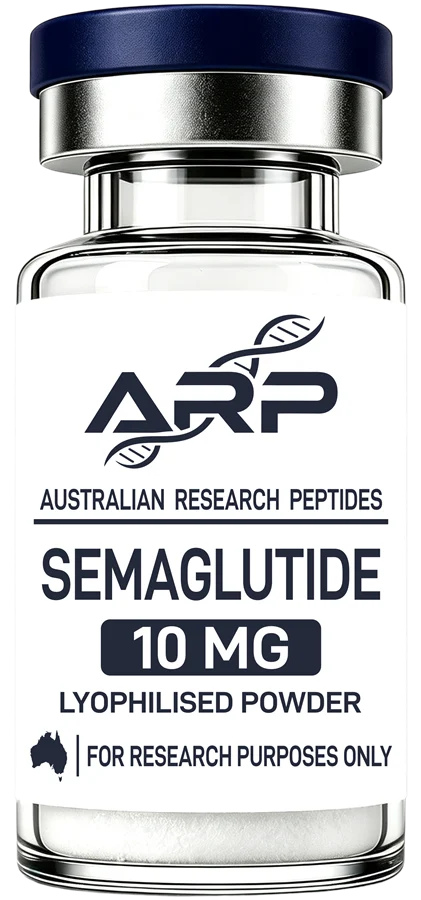
Semaglutide is sold in Australia by Australian Research Peptides as a GLP-1 receptor agonist, one 10 mg vial of the freeze-dried 31-amino-acid peptide, sealed and sent to all states and territories. It mimics the gut hormone that signals fullness, cutting food intake and shifting food preference, with insulin release rising and glucagon falling. Appetite, how much is eaten and body weight all move as a result. The peptide carries a fatty diacid chain. In vitro research purposes only, and not for people or animals.

Metabolic Research · Lyophilised Powder · Batch-tested · SKU ARP-SEMA-10
In stock·99.262%
$99.99
1

2+ vials: 5% off — applied automatically in the cart

Presentation
10 mg per vial
Grade
High-Purity Research Grade
Form
Lyophilised Powder
Category
Metabolic Research
Same-day dispatch on business-day orders placed before 12pm AEST, Mon–Fri
Tracked shipping Australia-wide ·typically 1–2 business days to most areas by Express Post · free post over $199, free Express over $299
Batch certificates — published in the COA library
For in vitro research purposes only. Not for human consumption. Not for animal consumption. This product is not a drug, food, cosmetic, or dietary supplement. Any amounts shown are reported from published studies, with the species or trial population named. ARP gives no dosing, medical or therapeutic guidance of its own.
Semaglutide · 10 mg
$99.99

Frequently Bought Together

About Semaglutide

In rodent studies semaglutide reduced food intake and body weight, and shifted food preference. Energy expenditure did not fall alongside it. Those are measurements in mice and rats, not statements about people. Semaglutide acts at a single receptor, the GLP-1 receptor. One target is the quickest way to separate it from ARP's two- and three-receptor listings.

Semaglutide is a modified copy of glucagon-like peptide-1, an incretin hormone released by cells in the gut. Two positions differ from human GLP-1: Aib at position 8 and arginine at position 34. A fatty diacid chain is attached to the lysine at position 26, which is what the word acylated records. Published work gives the purpose of that chain as albumin binding and resistance to enzyme breakdown.

Its measured affinity for the GLP-1 receptor is 0.38 nM, three-fold lower than liraglutide's. Plasma half-life was 46.1 hours in mini-pigs given the peptide intravenously. ARP supplies semaglutide as an in vitro reference material.

Semaglutide specifications, storage and shipping

  • Compound: Semaglutide
  • Also known as: Semaglutide
  • Class: Acylated GLP-1 receptor agonist peptide
  • Appearance: White to off-white lyophilised powder
  • Sizes & SKUs: 10 mg (ARP-SEMA-10)
  • Presentation: sealed glass vial
  • Form: Lyophilised Powder
  • Grade: High-purity research grade
  • Purity verification: HPLC-assayed on every batch to a minimum of 99% purity — the measured result for your batch is stated on its Certificate of Analysis
  • Identity confirmation: Mass spectrometry
  • Batch traceability: every batch is tested, with its certificate published in the COA library
  • Classification: In vitro research purposes only — laboratory reference material

Lyophilised — long term
−20 °C to −80 °C — long-term storage
Lyophilised — short term
2–8 °C — refrigerated, for a few months
Reconstituted
2–8 °C — use within 8–12 weeks
Protect from light and moisture. Handle in accordance with standard laboratory safety practice, including appropriate PPE. This information is provided for laboratory handling only and is not a usage instruction of any kind.

Every batch undergoes HPLC purity analysis and mass-spectrometry identity confirmation. The full laboratory report is published in the COA library.

Business-day orders before 12pm AEST are dispatched the same day with tracked, discreet shipping. Standard delivery within Australia typically takes 2–5 business days. See Shipping & Delivery for details, and follow your parcel on the Track Order page.

For in vitro research purposes only. Not for human consumption. Not for animal consumption. Not a drug, food, cosmetic, or dietary supplement. No therapeutic or medical claims are made.

Questions about Semaglutide

This question guide from Australian Research Peptides covers Semaglutide in Australia: what the listing contains, live buying and delivery questions, research context, handling, testing and comparisons. Start with the quick answers, then open the topic group that matches your search.

Buying, price and availability

Semaglutide reaches Australian buyers through Australian Research Peptides, or ARP, and every SEMA batch is HPLC-tested before release, with published certificates listed per product and strength in the CoA library. One 10 mg lyophilised vial sits in the Metabolic Research range, findable by typing sema or semag. Weekday orders confirmed before 12pm AEST go out that afternoon, Express Post reaching every state and territory, and nothing crosses a border. Orders are settled by PayID or bank transfer.

Semaglutide comes from Australian Research Peptides Pty Ltd, which operates from Sydney rather than shipping stock in from abroad. Every batch goes through HPLC before release, and ARP's CoA library sets out which strengths have a certificate published against them. Orders settle by PayID or bank transfer only — no cards, no wallets, no crypto.

Each Semaglutide vial carries one settled Australian-dollar figure, not a provisional one, and Australian Research Peptides publishes no per-milligram rate beside it. The compound is graded HPLC Verified, and that grading, not its Metabolic Research category, is what lets the automatic multi-vial discount reach the line. Postage sits outside that figure and is quoted per order.

Semaglutide is listed and dispatched in Australia by Australian Research Peptides, which catalogues it as one 10 mg lyophilised vial and takes orders online only. It is paid for by PayID or by direct bank transfer, and no card, wallet or crypto route is offered at any point. Stock is warehoused locally rather than imported to order, so the parcel travels domestically and leaves once a vial is on hand and the transfer has been matched.

Chemist Warehouse does dispense the registered semaglutide medicines on prescription, so for that question the answer is yes — but what Australian Research Peptides lists is a different product. ARP supplies semaglutide as a research compound, freeze-dried in a vial for in vitro laboratory work. The molecule is shared; the product, the supply route and the permitted purpose are not.

Identity, names and exact format

Semaglutide is a 31-amino-acid peptide modelled on the gut hormone GLP-1. Two of its amino acids differ from the human hormone, and a fatty diacid chain is attached at lysine 26. Chemistry registries index it as ChEBI:167574 and DrugBank DB13928. Australian Research Peptides sells it as a freeze-dried reference material for laboratory work.

An acylated analogue is a peptide that copies another peptide and carries an added fatty chain. For semaglutide the copied peptide is GLP-1 and the added chain is a fatty diacid at lysine 26. The published reason for adding it is to bind albumin in the blood and resist the enzymes that break peptides down. That is a durability property, not an effect.

Semaglutide has 31 amino acids. An Aib residue sits at position 8 and an arginine at position 34, which is where the chain departs from human GLP-1. The fatty diacid attached at lysine 26 is not an amino acid, so it does not raise the count. No residue-by-residue sequence is published on this page.

Semaglutide is catalogued under its own generic name almost everywhere, with no separate compound name and no development code in the records Australian Research Peptides checked. Chemistry databases index the identical molecule as ChEBI:167574 and DrugBank DB13928. Buyers type sema and semag, both of which ARP's search resolves. GLP-1 is the hormone semaglutide copies, not a synonym for it. ARP warehouses the peptide locally and HPLC-tests each batch; its CoA library is the page naming the strengths a published certificate covers.

Research context and evidence

Semaglutide binds and activates one receptor, the GLP-1 receptor. GLP-1 itself is an incretin hormone released by gut cells, where it raises insulin secretion and lowers glucagon secretion. Lau 2015, the discovery paper in the Journal of Medicinal Chemistry, puts semaglutide's affinity for that receptor at 0.38 nM, three-fold weaker than liraglutide's. What follows that binding step has been measured in cells, in animals and in human trials.

Research on semaglutide is strongest in rodents, and Gabery's 2020 study in JCI Insight is the clearest example. It found the peptide does not cross the blood-brain barrier, reaching brain tissue instead through the circumventricular organs and a few sites next to the ventricles. c-Fos activity rose in ten brain areas. In rats, area postrema tissue showed higher prolactin-releasing hormone and tyrosine hydroxylase.

STEP 1 gave semaglutide 2.4 mg once a week, injected under the skin, for 68 weeks. Its 1,961 adults had a BMI of 30 or more, or 27 with a weight-related condition, and no diabetes. STEP 2 used the same 2.4 mg weekly amount for 68 weeks in 1,210 adults who did have type 2 diabetes.

Semaglutide lingers about a week. Hall, Isaacs and Clements reported a seven-day half-life in Clinical Pharmacokinetics in 2018, with steady concentrations reached only after four to five weeks of repeated use. Lau's 2015 discovery paper measured 46.1 hours in mini-pigs given it intravenously, which is another species by another route. Neither value marks when an observed change starts or stops; the trials assessed that over many months.

Semaglutide's registered dosing schedule escalates over roughly 16 weeks before reaching the maintenance strength, and its trials measured the primary weight outcome at 68 weeks. Glucose effects appear far earlier than weight effects. The published evidence therefore describes a timescale of months, and nothing supports a figure measured in days.

Weight regain is the documented outcome after semaglutide is withdrawn. Wilding and colleagues followed STEP 1 participants for twelve months past the end of treatment and reported in 2022 that roughly two-thirds of the lost weight came back, with cardiometabolic improvements reverting toward baseline alongside it. That was a supervised trial of a registered medicine, and it describes that medicine rather than any research compound.

Semaglutide has extensive human safety data because it is a registered medicine. Gastrointestinal effects dominate — nausea, vomiting, diarrhoea, constipation and abdominal pain — and are most pronounced while the dose is being escalated. Gallbladder events and pancreatitis appear in the safety labelling, and the registered products carry a thyroid C-cell tumour warning from rodent studies.

DrugBank records semaglutide lowering HbA1c, systolic blood pressure and body weight in patients. In STEP 1 mean body weight fell 14.9% against 2.4% on placebo. In STEP 2, where every adult had type 2 diabetes, it fell 9.6% against 3.4%. DrugBank also logs lower fasting and post-meal glucose after 12 weeks. Those are trial findings, not claims about the research vial on this page.

Semaglutide's STEP 1 trial reported a mean body-weight reduction of about 15% at 68 weeks on 2.4 mg weekly against roughly 2.4% on placebo, in adults with overweight or obesity, alongside lifestyle intervention. That result comes from a supervised trial of a registered medicine and is not a projection for anyone using the research compound.

Handling, storage and measurements

That is normal: Semaglutide arrives as a freeze-dried solid weighing ten milligrams, which spreads over the base of a glass container as little more than a pale smear. Vacuum drying takes the water away and leaves a fragile matrix behind, one that often collapses into a ring or shifts to one side during postage. An apparently bare vial is the standard presentation at this quantity; an intact seal is the check that counts.

Semaglutide's fatty diacid chain was built to survive blood, not a warm shelf. Published peptide handling guidance puts freeze-dried material at -20 °C, away from light and moisture. Let the vial reach room temperature inside a closed desiccator first, then open it. That keeps water from condensing on the cake. Freeze any solution you make, and thaw it as few times as possible.

Semaglutide ships as a freeze-dried cake, so a diluent has to dissolve it before any in vitro assay. Diluent is the general term for whatever dissolves a freeze-dried cake. Semaglutide's is normally bacteriostatic water. Send the stream against the glass wall rather than at the cake, then rock the vial slowly instead of shaking it until nothing solid is left. Whatever volume is chosen fixes the concentration of the finished solution.

Reconstituted Semaglutide has no published stability study behind it, so Australian Research Peptides' own handling figure governs: a fridge at 2–8 °C, with twelve weeks the outer edge and eight the comfortable one. The Aib residue at position 8 was engineered to blunt an enzyme in blood — a wholly different problem from glass on a cold shelf. Never refreeze thawed material.

Bubbles are the usual explanation, because Semaglutide dissolves readily and milkiness appearing straight after reconstitution is normally entrained air from agitating the container too hard; left standing, the liquid clears from the top downwards. Haze that persists is a different matter and suggests solid which never dissolved, or aggregated peptide. A finished preparation should be clear and colourless with nothing suspended in it.

Yes — semaglutide sits in the vial as a dry solid and will not dissolve itself. Australian Research Peptides records its appearance as white to off-white freeze-dried powder. Bacteriostatic water is what that powder is normally dissolved into before bench work. The water itself is a separate Lab Supplies line, stocked under the code BAC.

The registered semaglutide maintenance strength is 2.4 mg weekly, which puts a 10 mg vial at four of those, or rather more during the low-dose escalation period the registered schedule starts with. At 1 mg it is ten draws. Australian Research Peptides' calculator converts whichever figure into insulin-syringe units for a chosen water volume.

Semaglutide's vial holds 10 mg, so the volume of diluent you add decides the strength. Add 1 mL of bacteriostatic water and the solution is 10 mg/mL. Two millilitres gives 5 mg/mL. Five millilitres gives 2 mg/mL. For any other volume, divide 10 by the millilitres. Australian Research Peptides' reconstitution calculator does that arithmetic.

Testing and batch documents

Semaglutide is checked on two fronts before any of it leaves. HPLC reports what share of the sample the main peak accounts for. Mass spectrometry then confirms the measured mass is semaglutide's. Identity is the harder half here, because the acyl chain has to be visible in the result. A matching certificate is currently published for this product and strength. Open the 10 mg certificate.

Ordering, payment and Australian delivery

Two Semaglutide vials clear the free Standard tracked post threshold by the narrowest margin of any line Australian Research Peptides stocks — close enough that the order total is worth checking against the threshold rather than assumed. One vial does not qualify. Express Post is waived at a higher figure that two vials do not reach. The check runs before the multi-vial discount, so that discount cannot drop the order back under.

Semaglutide delivery is 1–2 business days with Express Post for much of Australia and 2–5 with standard tracked post, but the clock starts when payment is matched, not when the order is placed — a bank transfer sitting overnight has not started it. PayID usually clears in minutes and closes that gap entirely. Dispatch is the parcel leaving; delivery is the carrier arriving.

There is no card option on a Semaglutide order because the business holds no card facility at all — not a disabled one, not a planned one. PayID and bank transfer are the two methods. The consequence for you is that no card details exist to be exposed, and the consequence for us is manual reconciliation.

The single most common surprise on a Semaglutide order is that it is not a pen. There is no device, no dial, no cartridge and no needle tips — it is powder in a glass vial, so it needs bacteriostatic water to reconstitute and insulin syringes to draw. Neither is supplied with it.

Access, approval and sport questions

Australian Research Peptides sells semaglutide in Australia as a laboratory research material, not as a medicine. It is supplied for in vitro research purposes only, and not for human or veterinary use. Because it ships from within Australia, the buyer imports nothing and no customs declaration is involved. Anyone ordering it is responsible for working within the rules that govern their own laboratory.

Semaglutide is approved in the United States, though not in the form a research supplier ships. The Food and Drug Administration first licensed a prescription semaglutide injection for type 2 diabetes in 2017, an oral tablet in 2019, and a weight-management version in 2021 — each a finished pharmaceutical product with a label, a strength and a manufacturer standing behind it. Unregistered laboratory powder carries none of those things.

Semaglutide is not banned in sport. WADA's prohibited list names it in no category, and its approval as a registered medicine in many countries keeps it outside the non-approved sweep that catches experimental peptides. Semaglutide does sit on WADA's Monitoring Program, which gathers usage data rather than penalising anybody. Sport Integrity Australia holds the current position for Australian competitors.

Registered semaglutide medicines are prescription-only in Australia and cannot be bought over a counter. Australian Research Peptides' listing is not one of them — it is an unregistered research chemical, sold as laboratory material, which is a different legal category rather than a way around the prescription requirement. It is not supplied for use in people.

Semaglutide shipped in from a foreign vendor can be stopped at the border, and a package stopped at the frontier is generally unrecoverable — the money and the material both go. Australian Research Peptides' semaglutide never meets that risk, because ARP dispatches within Australia rather than importing to order, so it travels domestically to the buyer. The Australian Border Force sets out the categories it acts against.

No, semaglutide from Australian Research Peptides is not a registered medicine and is not sold as one. It is supplied only as a reference material for in vitro laboratory research. ARP does not offer it as a substitute for a registered product, and names no such product for comparison. The vial holds freeze-dried powder for bench work.