
For laboratory research use only. Not for human or veterinary use.Lab research use only. Not for human or animal use.

Same-Day DispatchAustralian StockPremium Research GradePublished CoAsPayID · Clears in Seconds
Same-day dispatch on business-day orders before 12pm Sydney time.Same-day dispatch before 12pm Sydney timeFree standard post $199+Free std post $199+

Buy Epitalon 10 mg in Australia

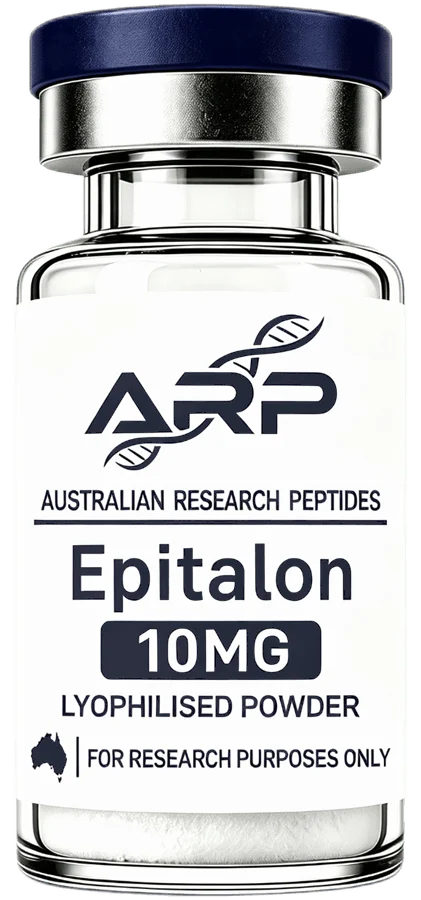
For laboratories and researchers in Australia, Australian Research Peptides lists Epitalon 10 mg as a freeze-dried vial at A$74.99, currently out of stock. Epitalon, also spelled Epithalon, is the four-amino-acid peptide Ala-Glu-Asp-Gly (PubChem CID 219042). Research covers telomerase, the enzyme that rebuilds chromosome caps, in cultured human cells, and night-time melatonin, mostly in lab and animal work plus a few small human studies. An independent laboratory commissioned by the manufacturer tests it before listing. For in vitro research purposes only.

Mitochondrial Research · Lyophilised Powder · Independently lab-tested · SKU 48193
Out of stock·
$74.99
Presentation
10 mg per vial
Grade
Research Grade
Form
Lyophilised Powder
Category
Mitochondrial Research
Currently out of stock — stocked lines dispatch same business day before 12pm Sydney time, Mon–Fri
Tracked shipping Australia-wide · typically 1–2 business days to most areas by Express Post · free post over $199, free Express over $299
For in vitro research purposes only. Not for human consumption. Not for animal consumption. This product is not a drug, food, cosmetic, or dietary supplement. ARP gives no usage, medical or therapeutic guidance of its own.
Epitalon · 10 mg
$74.99

In stock at Australian Research Peptides

Epitalon is out of stock, and Australian Research Peptides has not put a substitute in its place. These are in stock on the shelf in Australia.

About Epitalon

Epitalon research is mostly laboratory and animal work, with a few small human studies, and it centres on two themes. The first is telomerase, the enzyme that rebuilds the protective caps on the ends of chromosomes. Khavinson and colleagues reported in 2003 and 2004 that cultured human fetal fibroblasts (connective-tissue cells) exposed to the peptide switched that enzyme on, lengthened those caps and kept dividing after untreated cells had stopped. The second is the pineal gland, the small gland in the brain that releases melatonin at night, where work in old monkeys and elderly people measured night-time melatonin output. Australian Research Peptides reports that record and claims nothing more.

Epitalon's chain is made of four amino acids: alanine, glutamic acid, aspartic acid and glycine, written Ala-Glu-Asp-Gly and indexed as AEDG. A chain of four amino acids is called a tetrapeptide. It was designed from the amino-acid makeup of Epithalamin, an extract of cattle pineal glands, and the same four-amino-acid sequence was later found inside a group of proteins from the human pineal gland. PubChem lists the peptide on its own at CID 219042, with the formula C14H22N4O9.

Epitalon and Epithalon are two spellings of the same molecule, not two products, so Australian Research Peptides keeps them on one page. Epithalone, Epitalone and AEDG all point to the same product too. Both main spellings are in common use, with the 2003 telomerase paper titled Epithalon and PubChem heading its record Epitalon, so the listing leads with Epitalon.

Australian Research Peptides lists Epitalon in one size: a 10 mg vial of freeze-dried powder with a tamper-evident seal, posted within Australia rather than sent from overseas. Before a batch is listed, it is tested by an independent outside laboratory engaged by the manufacturer, including mass spectrometry, which confirms the peptide's identity by its weight. A certificate of analysis belongs to the batch tested, not to the listing, and the certificate library shows which listings have one.

BAC water (bacteriostatic water) is also in our range.

The peptide calculator works out the mg/mL concentration of a reconstituted vial.

Content reviewed

Further reading: Where Is the Best Place to Buy Peptides in Australia?

Epitalon specifications, storage and shipping

  • Compound: Epitalon
  • Also known as: Epitalon (Ala-Glu-Asp-Gly; AEDG)
  • Class: Laboratory-made peptide of four amino acids (a tetrapeptide), modelled on the pineal extract Epithalamin
  • Sequence: Ala-Glu-Asp-Gly (AEDG)
  • Appearance: White to off-white freeze-dried powder
  • Sizes & SKUs: 10 mg (48193)
  • Presentation: sealed glass vial
  • Form: Lyophilised Powder
  • Grade: Research grade
  • Testing: Independently lab-tested before release
  • Identity confirmation: Mass spectrometry
  • Classification: In vitro research purposes only — laboratory reference material

Lyophilised — long term
−20 °C to −80 °C — long-term storage
Lyophilised — short term
2–8 °C — refrigerated, for a few months
Reconstituted
2–8 °C — use within 8–12 weeks
Protect from light and moisture. Handle in accordance with standard laboratory safety practice, including appropriate PPE. This information is provided for laboratory handling only and is not a usage instruction of any kind.

Epitalon is independently lab-tested before release. No laboratory report is published for this line yet. The COA library lists every product and strength, and says which reports are available.

This line is currently out of stock. Stocked lines ordered before 12pm Sydney time on a business day are dispatched the same day with tracked shipping. Standard delivery within Australia typically takes 2–5 business days. See Shipping & Delivery for details, and follow your parcel on the Track Order page.

For in vitro research purposes only. Not for human consumption. Not for animal consumption. Not a drug, food, cosmetic, or dietary supplement. No therapeutic or medical claims are made.

Questions about Epitalon

This question guide from Australian Research Peptides covers Epitalon — also spelled Epithalon — in Australia: what the 10 mg vial holds, why the two spellings are one compound, live buying and delivery answers, the published laboratory research, handling and testing. Start with the quick answers, then open the topic group that matches your search.

Quick answers

Epitalon is supplied across Australia by Australian Research Peptides, a Sydney business serving laboratories and researchers, as a 10 mg vial at A$74.99, out of stock for now. The four-amino-acid peptide is freeze-dried and sealed, and it travels within the country, so it never has to clear customs. You can pay by PayID or direct bank transfer, and there are no wallets, instalment plans or crypto options.

Yes, Epitalon and Epithalon are the same compound spelled two ways, not two products: one four-amino-acid peptide, one listing and one page. Both spellings are in common use, with PubChem heading its record Epitalon and the 2003 telomerase paper titled Epithalon, so Australian Research Peptides links Epithalon, Epithalone, Epitalone and AEDG to the same vial.

Epitalon is a laboratory-made peptide of four amino acids, alanine, glutamic acid, aspartic acid and glycine, modelled on an extract of the brain's pineal gland. A four-amino-acid chain like this is called a tetrapeptide. Researchers are interested in it because of telomerase, the enzyme that rebuilds the caps on the ends of chromosomes and is switched off in most adult human cells, and published cell studies asked whether Epitalon could switch it back on. It is a laboratory reference compound, not a medicine.

Yes, every Epitalon batch is independently lab-tested before it is supplied in Australia, at a laboratory commissioned by the manufacturer, including mass spectrometry, which confirms the peptide's identity by its weight. Identity is the harder part to check here, because the chain is only four amino acids long, so a shortened or wrongly ordered version can weigh almost the same. No matching certificate is currently published for this product and strength.

An Epitalon order counts toward Australian Research Peptides' free shipping thresholds like any other peptide vial, and Standard and Express Post qualify at different order totals. The cart panel shows how far your order still has to go. An order that qualifies for free Standard Post hasn't automatically qualified for free Express, and every product in the order adds to the same running total.

Published Epitalon research falls into three areas: telomerase, the enzyme that rebuilds chromosome caps, in cultured human cells; life span in mice; and melatonin levels in middle-aged people. Khavinson 2003 and 2004 reported the enzyme switched on and the caps lengthened in fetal fibroblasts, which kept dividing past their 34th transfer to a fresh dish (passage 34). Anisimov 2003 reported a 12.3 percent rise in maximum life span in female SHR mice. Ivko 2020 reported a melatonin breakdown product in urine rising 1.7 times in middle-aged people whose melatonin output was already low. No large randomised human trial exists.

Buying, price and availability

Epitalon costs A$74.99 for the 10 mg vial (out of stock) at Australian Research Peptides, which lists it in that one size for laboratories and researchers. There is no range of strengths, so a single price per vial covers the listing, and postage is added at checkout. Epitalon goes out again when it is restocked.

Epitalon availability is shown live on this page rather than written into the text, because a typed stock level would go out of date as soon as a vial sells. Australian Research Peptides lists one size, 10 mg, so there is a single price per vial and no range to compare. When the listing is empty, the alert box takes your email address and sends one message when stock returns.

You can buy Epitalon online from Australian Research Peptides, where it sits in the Mitochondrial Research category as a single 10 mg listing rather than a range of strengths. At checkout you can pay by PayID transfer or direct deposit, and wallet and crypto payments are deliberately not offered. Parcels travel within Australia by tracked post, so nothing goes through customs.

Australian Research Peptides, trading as ARP, supplies Epitalon from a Sydney address to laboratories and researchers in every state and territory, with tracked post as standard and Express Post when speed matters. It is a single-strength listing, one 10 mg vial of dried powder with a tamper-evident seal. Australian Research Peptides is the seller of record, with no pharmacy, distributor or overseas reshipper in between.

You'll know when Epitalon is back in stock by leaving your email address in the restock alert on its listing, which sends a single message once a vial is available again. It is one notification, not a subscription, so no newsletter follows, and the message includes an unsubscribe link. Your address is stored against this one product and used for nothing else.

Identity, names and exact format

Epitalon is also known as Epithalon, Epithalone, Epitalone and AEDG, and in chemistry as Ala-Glu-Asp-Gly or alanyl-glutamyl-aspartyl-glycine, and all of these names mean the same substance. PubChem lists Epitalon, Epithalon, Epithalone and Ala-Glu-Asp-Gly on one record, CID 219042. AEDG is the one-letter code for each of the four amino acids, and Australian Research Peptides also recognises the spelling Epitalone in its search.

AEDG stands for alanine, glutamic acid, aspartic acid and glycine, the four amino acids in Epitalon, written as one-letter codes in the order they sit in the chain. Chemists also write it as Ala-Glu-Asp-Gly, using three-letter codes instead. At four amino acids, Epitalon is one of the shortest chains in this catalogue, and KPV, at three, is shorter still.

Epitalon is made in a laboratory, not extracted from tissue, although the sequence it copies does occur in the pineal gland. Khavinson 2017 found the AEDG chain inside a group of pineal gland proteins, using mass spectrometry, which weighs molecules, and chromatography, which separates a sample into its parts. The Epitalon that Australian Research Peptides lists is made synthetically, which is what makes it a single defined compound rather than a mixture.

An Epitalon vial holds just one substance, the dried four-amino-acid chain Ala-Glu-Asp-Gly, with no blend partner, no carrier and no liquid. The amount of powder is printed on the label, and the glass has a tamper-evident seal. It is a single-compound listing, not a multi-peptide mix, which matters because Epithalamin, the extract Epitalon was modelled on, is a mixture and is not what is in this vial.

Epitalon is made of four amino acids, alanine, glutamic acid, aspartic acid and glycine, joined in that order and written Ala-Glu-Asp-Gly, which is why it is called a tetrapeptide. Tetra means four. The 10 mg on the label is the weight of powder sealed in the vial and says nothing about how many amino acids are in the chain.

PubChem records Epitalon as CID 219042, with the molecular formula C14H22N4O9 and a molecular weight of 390.35 g/mol, and lists the registry numbers 307297-39-8 and 64082-79-7 on the same entry. Those figures describe the peptide on its own. Peptides are often supplied paired with a small amount of acid, such as an acetate salt, which changes the formula, the mass and the registry number. Australian Research Peptides hasn't confirmed which form the supplied powder is, so the specification panel leaves all three out.

Epitalon 10 mg is the only size Australian Research Peptides lists, ten milligrams of freeze-dried Ala-Glu-Asp-Gly in a sealed glass vial, with no liquid included. Ten milligrams is 10,000 micrograms, which explains most searches that pair Epitalon with a microgram figure. Australian Research Peptides publishes how much the vial holds and no amount to use.

Research context and evidence

Telomeres are repeated stretches of DNA that cap the ends of chromosomes, a bit like the plastic tip on a shoelace, and they get a little shorter every time a cell divides. They matter in Epitalon research because telomerase, the enzyme that rebuilds those caps, is switched off in most adult human cells, and published cell studies asked whether this four-amino-acid peptide could switch it back on.

Epitalon is thought to work by changing which genes a cell switches on, rather than by attaching to a receptor like most drugs. The peptide is small enough to enter the cell nucleus, and a 2020 computer-modelling paper in Molecules reported it binding to two histones, H1/3 and H1/6, proteins that sit along DNA and help decide which genes get read. Khavinson's group describes this as the route short peptides take. The best-known reported finding is that it switched on telomerase, the chromosome-cap enzyme, in cultured cells.

Sleep itself has not been measured in Epitalon research, and the published record only contains measurements of when melatonin is released at night. Korkushko 2007 reported night-time melatonin release in old monkeys and elderly people given pineal gland preparations (Epithalamin and Epitalon together, not Epitalon alone), and Ivko 2020 measured a melatonin breakdown product in urine. Neither study measured sleep quality, and no randomised trial has tested it. Australian Research Peptides makes no claim that Epitalon does anything to sleep.

Epitalon has not been tested for ageing in people, because no long-term human trial has been run and the published record is animal and cell work. Anisimov 2003 reported a 12.3 percent gain in maximum life span in female SHR mice, and a 2005 study in mice bred to age unusually fast reported longer survival in the animals that stayed tumour-free. Neither finding carries over to a person. Australian Research Peptides makes no claim about Epitalon and ageing, whatever its reputation online suggests.

The best-known Epitalon model is cultured human fetal fibroblasts, connective-tissue cells grown in a dish, used in the 2003 and 2004 telomerase papers, alongside HeLa cells and white blood cells prompted to divide. Rodent studies used Swiss-derived SHR mice and mice bred to age unusually fast, and primate work used aged rhesus monkeys. Human data is limited to small observational studies of melatonin breakdown products and gene activity. None of these establishes anything about an individual person.

The 2025 review in the International Journal of Molecular Sciences gives no figure for how long Epitalon stays in the body, how fast it is cleared or where it travels. That review covers twenty-five years of work on the peptide. It says information on its safety is missing, and that short peptides like Epitalon are usually unstable and break down quickly inside a living body, though this has not been tested for Epitalon itself.

Handling, storage and measurements

To reconstitute Epitalon, you dissolve the dried powder in a sterile liquid, and gentle handling matters most, because there is so little powder in the vial that it is easily lost to foam. Tilt the vial so the liquid runs down the glass rather than dropping onto the powder, and swirl slowly. Once the contents look clear, divide them into single-use portions and freeze them. The volume you add decides how strong the solution is.

Epitalon keeps best as a sealed, unopened powder stored dry below -15 °C, and the vial should warm to room temperature before you open it, because cold glass draws in moisture. Bachem's handling guide names five amino acids that shorten a peptide's shelf life (asparagine, glutamine, cysteine, methionine and tryptophan), and Epitalon contains none of them. Once dissolved, keep it cold and split it into portions so the same vial isn't thawed again and again.

There is no single correct volume of diluent for a 10 mg Epitalon vial, and Australian Research Peptides publishes none, because the strength of the solution is chosen by the researcher, not the supplier. The maths is a simple division: milligrams in the vial divided by millilitres added. Two millilitres gives 5 mg/mL, and five millilitres gives 2 mg/mL. The powder dissolves easily and needs no coaxing.

Epitalon is usually dissolved in an aqueous (water-based) diluent for laboratory work, because it ships as a dry powder and needs a liquid before any bench work can begin. The vial holds only the peptide, with no second powder, no liquid and no filler, and the volume of liquid added sets the concentration of the finished solution.

Reconstituted Epitalon is generally kept in the fridge at 2–8 °C and used within the eight-to-twelve-week window Australian Research Peptides publishes for dissolved peptides. A preserved diluent can expire before the peptide does, because it has its own in-use period once the vial is pierced. Freezing single-use portions avoids thawing the same vial again and again. Published data on how Epitalon holds up in solution is thin, so work to whichever limit comes first.

Epitalon looking cloudy straight after mixing is nearly always trapped air rather than a problem with the powder, and the tiny bubbles gather near the surface and clear on their own within a few minutes. Powder taken from the freezer behaves the same way until it warms up. If the liquid still isn't clear after standing for ten minutes, the likely cause is undissolved powder or peptide that has clumped together.

Yes, it is normal for an Epitalon vial to look empty, because ten milligrams of a four-amino-acid peptide dries into a thin film that is genuinely hard to see through glass. Tilt the vial under a light and look for loose particles moving, rather than trying to judge a volume. Powders this light also cling to the walls of the vial instead of settling into one visible lump.

Testing and batch documents

Epitalon's laboratory testing proves what the material weighs, but it does not prove the order of the amino acids in the chain. Mass spectrometry can't tell Ala-Glu-Asp-Gly apart from the same four amino acids in a different order, because both weigh the same. The testing also doesn't check for microbes, bacterial toxins or sterility, and a certificate only covers the one batch that was sampled.

Ordering, payment and Australian delivery

Epitalon reaches most Australian addresses within 2–5 business days by standard tracked post, or 1–2 business days by Express Post, counted from dispatch rather than from when the order was placed. Remote and regional addresses are at the longer end of both ranges. The tracking number is emailed when the parcel is lodged, and any carrier investigation starts from it.

You can pay for Epitalon by PayID or by direct bank transfer to Australian Research Peptides, and the payment window counts business days only, so a Friday order doesn't fall due over the weekend. A bank transfer can take a business day to arrive, which is why payment reminders are sent before the reservation runs out, not after.

No, an Epitalon vial does not come with a diluent, because it arrives as dry powder only, so the liquid and the equipment to measure small volumes come from the laboratory. A 10 mg vial is normally dissolved once, using a volume chosen to give the concentration the work needs.

Access and regulatory questions

Epitalon is not an approved medicine in Australia, which is why Australian Research Peptides supplies it to laboratories and researchers as a reference compound, not as a treatment of any kind. The 2025 review in the International Journal of Molecular Sciences says more short- and long-term toxicity studies are essential before Epitalon could be approved as a drug ingredient. Buyers should check their own legal obligations before handling it.

No, Epitalon is not approved by the United States Food and Drug Administration (FDA), so there is no approved product to buy there and no prescribing information to read anywhere. Its published research is mostly cell-culture and rodent work, plus a small number of human studies that observed people rather than testing the peptide against a dummy treatment. A 2025 review concluded that more toxicity research is needed before approval could be considered.

Epitalon is not named on the World Anti-Doping Agency prohibited list, but that offers less cover than it seems, because the list's S0 category covers any substance with no approval for human medical use, named or not. Epitalon has no such approval. Sport Integrity Australia runs anti-doping for Australian athletes and publishes education on substances, and it is the right body to ask, rather than a supplier.

Importing Epitalon into Australia means bringing in what the TGA calls an unapproved therapeutic good, because Epitalon has no Therapeutic Goods Administration approval and is not on the Australian Register of Therapeutic Goods. The regulator publishes its own guidance on supplying and distributing these products, including import and export. Ordering from Australian Research Peptides avoids the question, because the parcel is posted within Australia and crosses no border.

No, Chemist Warehouse does not stock Epitalon, and neither does any other pharmacy in Australia, because there is no registered Epitalon medicine for a pharmacist to dispense or order in. Australian Research Peptides lists it instead as a 10 mg research vial. The difference comes down to regulation, not business: a pharmacy can only supply products that carry an Australian registration.