
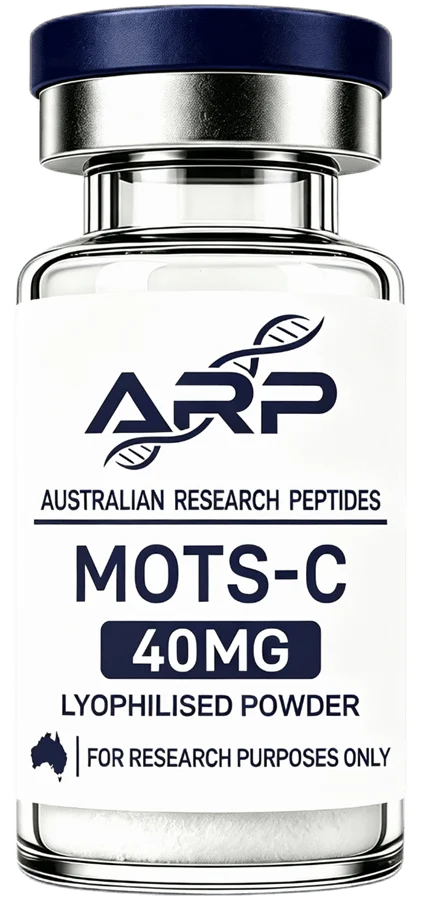
Buy MOTS-C 40 mg in Australia
In Australia, MOTS-C comes from Australian Research Peptides in sealed, freeze-dried 40 mg vial for laboratories and researchers — $149.99, in stock; payment received before 12pm Sydney time on a business day means same-day dispatch. The MOTS-C 40 mg certificate states 99.234% purity. MOTS-C is a sixteen-amino-acid chain coded inside mitochondria rather than the nucleus, studied in cellular energy-metabolism research. Its reported molecular target is AMPK, a fuel-sensing protein, and skeletal muscle is the tissue most often examined. It is HPLC-tested and checked by mass spectrometry. In vitro research purposes only — not for human or animal use.
Browse all Mitochondrial Research
About MOTS-C
MOTS-C is studied in relation to energy metabolism, meaning how cells make and spend energy. Published work in mice and in cell culture reports it switching on AMPK, a protein that senses when a cell is short of fuel. Skeletal muscle looks like its main target tissue. This page names the research field and the measurements taken, and reports no outcome in a person.
The peptide is coded by a short stretch of the 12S ribosomal RNA gene, which sits inside mitochondrial DNA rather than in the nucleus. Peptides coded that way are grouped together as mitochondrial-derived peptides. Humanin was the first of the group to be described, and MOTS-C followed it. The name is written and searched as MOTS-C, MOTSc and MOTS C.
Lee and colleagues first described MOTS-C in 2015 in Cell Metabolism, identifying the reading frame it is coded from and the AMPK signalling pathway it was tested against in cells and in mice. ARP reports the existence of that published record and claims nothing about the material in its own vials.
Australian Research Peptides lists MOTS-C in Australia as a 40 mg vial of freeze-dried powder, sealed in tamper-evident glass. It is searched as MOTS-C, MOTSc, MOTS C and the compressed motsc, and as a mitochondrial or longevity peptide. Stock is held locally and posted to every state and territory, so an order does not wait on an overseas consignment. The powder is assayed by HPLC, and the CoA library shows the certificate published for it.
BAC water (bacteriostatic water) is also in our range.
The peptide calculator works out the mg/mL concentration of a reconstituted vial.
Content reviewed
Further reading: Where Is the Best Place to Buy Peptides in Australia? · MOTS-C Research: What Studies Show and What Is Still Unknown
MOTS-C specifications, storage and shipping
- Compound: MOTS-C
- Also known as: MOTS-c (mitochondrial ORF of the 12S rRNA type-c)
- Class: Mitochondrial-derived peptide; sixteen residues
- Appearance: White to off-white lyophilised powder
- Sizes & SKUs: 40 mg (58106)
- Presentation: sealed glass vial
- Form: Lyophilised Powder
- Grade: High-purity research grade
- Purity verification: HPLC-assayed to a minimum of 99% purity — the measured result is stated on the published Certificate of Analysis
- Identity confirmation: Mass spectrometry
- Certificates: issued by Janoshik, an independent laboratory, and published in the COA library
- Classification: In vitro research purposes only — laboratory reference material
- Lyophilised — long term
- −20 °C to −80 °C — long-term storage
- Lyophilised — short term
- 2–8 °C — refrigerated, for a few months
- Reconstituted
- 2–8 °C — use within 8–12 weeks
- MOTS-C 40 mg: assayed purity 99.234% · measured content 46.46 mg · laboratory batch 2026-06 · analysed 19 June 2026
Questions about MOTS-C
This question guide from Australian Research Peptides covers MOTS-C in Australia: what the listing contains, live buying and delivery questions, research context, handling, testing and comparisons. Start with the quick answers, then open the topic group that matches your search.
