
For laboratory research use only. Not for human or veterinary use.Lab research use only. Not for human or animal use.

Same-Day DispatchAustralian StockPremium Research GradePublished CoAsPayID · Clears in Seconds
Same-day dispatch on business-day orders before 12pm Sydney time.Same-day dispatch before 12pm Sydney timeFree standard post $199+Free std post $199+

Buy TB-500 Peptide 10 mg in Australia

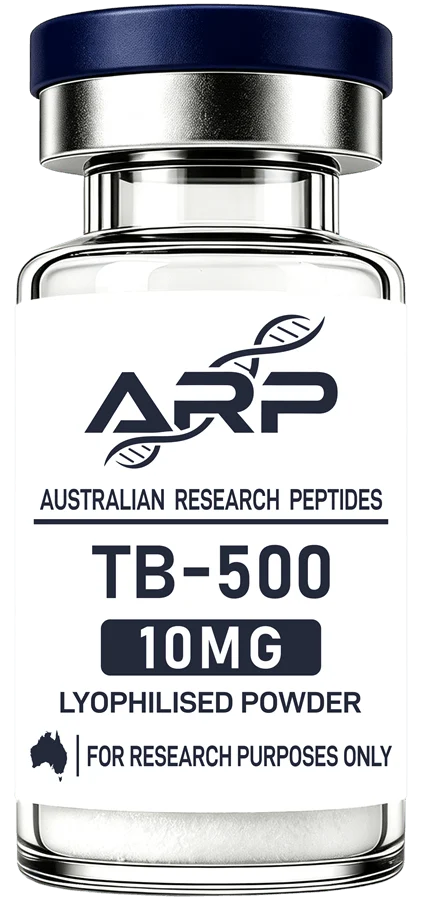
Australian Research Peptides sells TB-500 10 mg, also written TB500 or TB 500, to laboratories and researchers in Australia, where the tamper-sealed vial costs A$119.99, but is out of stock right now; BPC-157 + TB-500 10 mg, which contains TB-500, is in stock at A$109.99. No certificate is published for TB-500 yet; the vial holds a dried solid, Ac-Leu-Lys-Lys-Thr-Glu-Thr-Gln: seven amino acids copied from positions 17 to 23 of the 43-amino-acid thymosin beta-4, which binds free actin. It is studied in cell-migration research and posted to every state and territory. Not for people or animals. In vitro research purposes only.

Cell Signalling Research · Lyophilised Powder · Independently lab-tested · SKU 40000
Out of stock·
$119.99

TB-500 10 mg is sold out for now. Leave your email and ARP will send you one email the day it is back. Nothing else.

Presentation
10 mg per vial
Grade
Research Grade
Form
Lyophilised Powder
Category
Cell Signalling Research
This strength is not in stock — stocked lines dispatch same business day before 12pm Sydney time, Mon–Fri
Tracked shipping Australia-wide · typically 1–2 business days to most areas by Express Post · free post over $199, free Express over $299
For in vitro research purposes only. Not for human consumption. Not for animal consumption. This product is not a drug, food, cosmetic, or dietary supplement. No medical, therapeutic, or usage information is provided.
TB-500 10 mg
$119.99
Notify Me

In stock instead: BPC-157 + TB-500 10 mg

TB-500 is out of stock at Australian Research Peptides, but BPC-157 + TB-500 contains it and is in stock on the shelf in Australia.

View BPC-157 + TB-500 10 mg

About TB-500

TB-500 is studied in actin-binding and cell-migration research, in cell culture and preclinical models only. The key finding in the literature is about the molecule itself: LKKTETQ is the actin-binding section of thymosin beta-4, and 2003 work in the FASEB Journal traced the parent protein's activity in lab tests to that seven-amino-acid section rather than the rest of the chain. Australian Research Peptides supplies the fragment for in vitro use only.

TB-500, also commonly written TB500 or TB 500, is a heptapeptide, which means a chain of seven amino acids. The sequence is Leu-Lys-Lys-Thr-Glu-Thr-Gln, written LKKTETQ, with an acetyl cap on the N-terminal (front) end. Those seven match positions 17 to 23 of thymosin beta-4. The difference matters, because the two names often get swapped, and a study on the 43-amino-acid protein is not a study on this fragment.

Australian Research Peptides supplies TB-500 in one strength, as a freeze-dried powder in a tamper-evident sealed glass vial. PubChem records the free acid form as C38H68N10O14, about 889 g/mol, under CAS 885340-08-9. Those values aren't printed on this listing as a specification, because the salt and end form of the supplied material isn't confirmed, and both figures change with it. The certificate of analysis describes the actual batch.

BAC water (bacteriostatic water) is also sold by Australian Research Peptides.

The peptide calculator works out the mg/mL concentration of a reconstituted vial.

TB-500 specifications, storage and shipping

  • Compound: TB-500
  • Also known as: TB-500 (N-terminally acetylated thymosin beta-4 fragment 17-23)
  • Class: Synthetic acetylated heptapeptide; actin-binding fragment of thymosin beta-4
  • Appearance: White to off-white lyophilised powder
  • Quantity: 10 mg
  • SKU: 40000
  • Sizes & SKUs: 10 mg (40000)
  • Presentation: sealed glass vial
  • Form: Lyophilised Powder
  • Grade: Research grade
  • Testing: Independently lab-tested by Janoshik
  • Identity confirmation: Mass spectrometry
  • Classification: In vitro research purposes only — laboratory reference material

Lyophilised — long term
−20 °C to −80 °C — long-term storage
Lyophilised — short term
2–8 °C — refrigerated, for a few months
Reconstituted
2–8 °C — use within 8–12 weeks
Protect from light and moisture. Handle in accordance with standard laboratory safety practice, including appropriate PPE. This information is provided for laboratory handling only and is not a usage instruction of any kind.

TB-500 is independently lab-tested by Janoshik. No laboratory report is published for this strength yet. The COA library lists every product and strength, and says which reports are available.

This strength is not in stock today. Stocked lines ordered before 12pm Sydney time on a business day are dispatched the same day with tracked shipping. Standard delivery within Australia typically takes 2–5 business days. See Shipping & Delivery for details, and follow your parcel on the Track Order page.

For in vitro research purposes only. Not for human consumption. Not for animal consumption. Not a drug, food, cosmetic, or dietary supplement. No therapeutic or medical claims are made.

Questions about TB-500

This question guide from Australian Research Peptides covers TB-500 in Australia: what the listing contains, live buying and delivery questions, research context, handling, testing and comparisons. Start with the quick answers, then open the topic group that matches your search.

Quick answers

TB-500, also searched as TB500, TB4 or thymosin beta, is listed by Australian Research Peptides for Australian laboratories and researchers as one 10 mg vial for A$119.99, out of stock at the moment. It is lyophilised (freeze-dried) for in vitro research. Orders go by Express or tracked standard post to every state and territory, all posted within Australia, so customs never sees them. There is no TB-500 to send today, and the weekday 12pm Sydney time cut-off applies again once a new batch arrives.

TB-500 is also written TB500 or TB 500, searched as TB 500 peptide, tb4 or beta thymosin, and its formal name is thymosin beta-4 fragment 17-23, N-terminally acetylated. Databases list it under CAS 885340-08-9 and PubChem CID 62707662. The name thymosin beta-4 on its own means the 43-amino-acid parent protein, not this seven-amino-acid chain. All these names point to the same vial, posted by Australian Research Peptides from within Australia, so no customs is involved.

Yes, TB-500 is tested before Australian Research Peptides supplies it, by a laboratory independent of both Australian Research Peptides and the manufacturer, at the manufacturer's request. The identity test has to account for the acetyl cap, because that group adds weight, and an uncapped seven-amino-acid chain would weigh less. Any batch document for an exact strength describes the material that was tested, not a catalogue specification. No matching certificate is currently published for this product and strength.

A TB-500 order needs two vials to qualify for free Standard tracked post in Australia, as one vial falls short, and three vials clear the separate, higher Express Post threshold. TB-500 is often ordered alongside BPC-157, and that pair reaches the standard threshold without a second TB-500 vial. Australian Research Peptides sets both thresholds on the order total rather than per product, so everything in the same order counts toward them.

TB-500 and BPC-157 are unrelated peptides that are often discussed together, with TB-500 being seven amino acids taken from thymosin beta-4 and BPC-157 a longer chain of fifteen. TB-500's published work centres on actin binding and angiogenesis (the growth of new blood vessels), measured in cell culture. BPC-157 comes from a sequence first described in gastric juice, and its research sits elsewhere. Australian Research Peptides lists each on its own page and also sells the two dried together in one vial.

TB-500 is the actin-binding section of thymosin beta-4, made on its own, and actin is the protein cells use to build their internal scaffolding. UniProt records the parent protein as binding loose, single actin units and stopping them joining together. That binding property is why the seven-amino-acid fragment was isolated, and why cell-culture work focuses on this section rather than the whole protein. It is a property of the molecule, measured in glassware.

Buying, price and availability

To find out when TB-500 is back in stock, use the restock alert from Australian Research Peptides: leave your email address and one message is sent when stock arrives. It is a single notification, not a subscription, so there is no newsletter or follow-up mail, and your address is used for that one purpose only. Registering costs nothing and doesn't reserve any stock.

Australian Research Peptides supplies TB-500 to laboratories and researchers in Australia, listing the single 10mg vial in its Cell Signalling Research range. Searches for tb500, thymosin beta or tb4 lead to the same product. Orders are posted from within Australia, so there's no customs step. No certificate is published for TB-500 yet, and the CoA library shows which products and strengths currently have one. Express Post and tracked standard post cover every state and territory, and the weekday 12pm Sydney time cut-off applies again once a new batch arrives.

TB-500 costs A$119.99 for the 10 mg vial (out of stock) at Australian Research Peptides, which lists it in a single size with no range of strengths to choose from. Comparing it with the two blends that also contain TB-500 isn't like for like, because their price buys several peptides at once. TB-500 is dispatched again once stock returns. Each product is priced on its own.

You can get TB-500 online directly from Australian Research Peptides, which supplies laboratories and researchers from within Australia and posts nationally rather than drop-shipping from overseas. There are two ways to pay, PayID or direct bank transfer, and both are matched to your order by its reference, and wallets, instalment plans and crypto are not accepted.

No, TB-500 isn't sold at Chemist Warehouse or any other Australian pharmacy, and is supplied instead by Australian Research Peptides for laboratory research. Thymosin beta-4 fragments have no registration in Australia, so there is no product a pharmacist could supply and no way to order one in. Australian Research Peptides lists TB-500 as a 10 mg research vial for laboratory use.

Identity, names and exact format

TB-500 is a synthetic peptide of seven amino acids that matches the part of thymosin beta-4 that binds actin, the protein that forms a cell's internal scaffolding (Philp 2003). Thymosin beta-4 itself occurs naturally in most mammalian cells. TB-500 is a fragment, not the whole protein, which is why the two names aren't interchangeable in a study.

A TB-500 vial holds one freeze-dried compound, the acetylated heptapeptide Ac-LKKTETQ, meaning seven amino acids with an acetyl cap, under a tamper-evident seal. The acetyl cap is part of the molecule itself, not something added to it, which is why Ac- appears in the name. Nothing else is in the glass. Both blends that include TB-500 spread their stated milligrams across more than one peptide.

TB-500 contains seven amino acids, Leu-Lys-Lys-Thr-Glu-Thr-Gln (written LKKTETQ), taken from positions 17 to 23 of thymosin beta-4, which has 43 amino acids in all. The acetyl group on the front end is a chemical cap, not an eighth amino acid, so it changes the measured mass without changing the count. Seven amino acids make TB-500 a heptapeptide.

Research context and evidence

TB-500 has been studied in cell-migration and actin-binding assays and in animal models of tendon, ligament and muscle damage, which are laboratory and animal systems only, and it is not used to treat anything. Pairing it with BPC-157 is a common line of research, and the one published test of the pairing, in rats, found no added effect over either peptide alone. Australian Research Peptides lists TB-500 and BPC-157 separately and as one pre-combined blend vial, and supplies each to laboratories and researchers for in vitro research only, never for giving to a person or an animal.

Published TB-500 research is preclinical work in animals and cell culture, including cell tests measuring whether endothelial cells, which line blood vessels, move and start forming new vessels. The published record stops at those model systems, and it does not establish what happens in people or animals outside those studies.

Handling, storage and measurements

Yes, it is normal for a TB-500 vial to look almost empty, because ten milligrams of this very short seven-amino-acid fragment dries to a wisp on the bottom of the glass. Sometimes it is no more than a dull patch where the glass stops looking perfectly clear. Freeze-drying turns the frozen water straight into vapour, leaving the solid exactly where the liquid sat, so a cake broken up in transit can look like nothing at all.

TB-500 should be stored as a sealed, dry vial in a freezer, out of bright light, and kept away from moisture because its chain contains two lysines and a glutamate. GenScript names exactly those amino acids as ones to keep in a desiccator (a dry container) in a tightly capped vial. TB-500 has no cysteine, methionine or tryptophan, so oxidation is not the main concern. Bachem advises letting the vial come back to room temperature in a desiccator before opening, because absorbed moisture lowers the peptide content.

To reconstitute TB-500, let the sealed vial warm up, run the liquid down the inside of the glass and swirl rather than shake, and it will dissolve readily in water. That's because six of its seven amino acids are polar or charged, meaning they mix well with water. Australian Research Peptides doesn't publish a fill volume for the vial, and the laboratory chooses the diluent.

Reconstituted TB-500 keeps for eight to twelve weeks at 2 to 8 °C, the window Australian Research Peptides publishes for every research peptide it lists. Keep it in the dark. TB-500 ends in glutamine, one of the amino acids that Bachem and the NIBSC both flag as shortening a dissolved peptide's life. If you need longer, freeze single-use portions (aliquots) below -15 °C.

There is no set volume of diluent for a TB-500 vial, which is supplied as a single 10 mg vial, and the volume added changes nothing about the amount of peptide in it. More liquid makes the solution weaker, not the peptide, and the vial holds the same 10 mg either way. Australian Research Peptides doesn't publish a fill volume, so choosing and recording it is up to you.

Cloudy TB-500 right after mixing is usually just foam, not the peptide, because TB-500 is a short fragment that dissolves easily and normally clears without trouble. Leave it undisturbed for several minutes. If it stays cloudy, or fine strands drift through the liquid, something besides air is present: that is aggregation (clumping), and more swirling won't reverse it.

TB-500 ships as a dry powder and is dissolved in a water-based (aqueous) diluent for laboratory work, which is the only thing that needs to be added. The sealed glass holds nothing but the acetylated seven-amino-acid peptide. Diluent is simply the name for that liquid once it is used to dissolve something.

Yes, a 10 mg TB-500 vial is normally dissolved all at once in one step, and the volume added sets the concentration, not the amount of peptide. Small amounts of the finished solution are measured with the laboratory's own equipment, and splitting it into portions avoids repeated freezing and thawing.

Testing and batch documents

Analytical testing on TB-500 establishes which molecule is in the vial, clearing up the common confusion between TB-500 and the full thymosin beta-4 protein. Mass spectrometry weighs what is in the vial, and seven amino acids weigh nowhere near as much as a 43-amino-acid protein, so the two are easy to tell apart. That is how independent lab testing confirms the identity of the contents.

Ordering, payment and Australian delivery

You can pay for TB-500 by PayID or bank transfer, which are matched when the money lands, and a confirmation email follows once your payment is matched. Until that email arrives, the order is placed but not paid. If it hasn't come through well after your bank shows the money has gone, contact support with your order reference.

TB-500 takes 2–5 business days to arrive in Australia by standard tracked post, and 1–2 business days by Express Post to most of the country. If nobody is home when the parcel arrives, the carrier usually leaves a card and holds it at a nearby collection point rather than returning it to the sender. Choosing signature on delivery, which is opt-in and never pre-ticked, changes what happens at the door.

Access and regulatory questions

No, TB-500 is not FDA approved, and it has never been approved as a medicine by American regulators or any other regulator. The published research on the fragment stops at cell culture and animal models, which is a long way short of a licence. Work on full-length thymosin beta-4 is a separate programme on a larger molecule, and its status doesn't carry across.

Yes, TB-500 is banned in sport, as TB-500 and thymosin beta-4 are listed under growth factors on the World Anti-Doping Agency's prohibited list (Sport Integrity Australia). Athletes should also know that the presence of a substance is what triggers a finding, not the intent behind it, and a supplier calling something a research chemical makes no difference to an anti-doping rule.

TB-500 is not an approved medicine anywhere in the world, so there is no overseas licensed product to bring in, and personal importation of unapproved goods is governed by the TGA, with Border Force enforcing it at the border. It is also prohibited in sport at all times. Australian Research Peptides supplies TB-500 from Sydney, so an order never goes through customs or waits for clearance, which is why local stock reaches a lab faster than imported stock. That removes a customs step and nothing else: the substance is the same, and so are the obligations of whoever holds it.