
For laboratory research use only. Not for human or veterinary use.Lab research use only. Not for human or animal use.

Same-Day DispatchAustralian StockPremium Research GradePublished CoAsPayID · Clears in Seconds
Same-day dispatch on business-day orders before 12pm Sydney time.Same-day dispatch before 12pm Sydney timeFree standard post $199+Free std post $199+

Buy BPC-157 + TB-500 Blend 10 mg in Australia

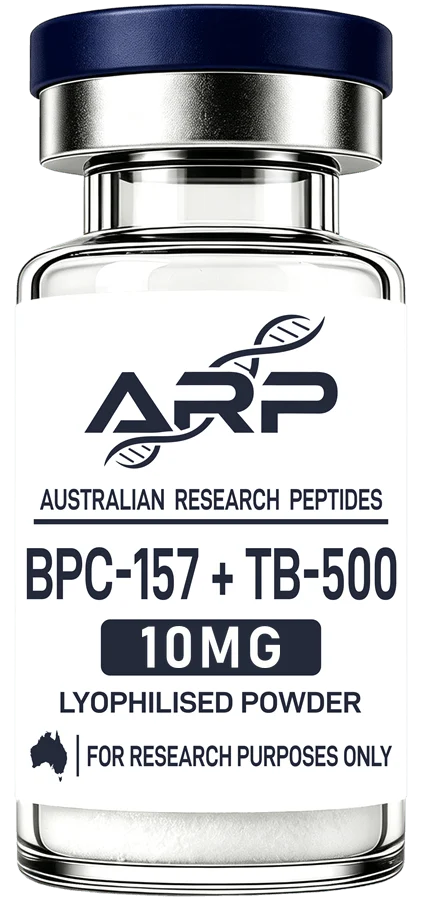
For laboratories and researchers in Australia, the BPC-157 + TB-500 Blend 10 mg vial, also written BPC157 and TB500, costs A$109.99 from Australian Research Peptides, in stock and sent the same business day when paid before 12pm Sydney time. The vial holds both peptides as one freeze-dried powder, and its certificate records BPC-157 6.54 mg and TB-500 5.76 mg. BPC-157 is a fifteen-amino-acid chain, GEPPPGKPADDAGLV, that lab tests link to VEGFR2. TB-500 is Ac-LKKTETQ, the seven-amino-acid piece of thymosin beta-4 that binds actin. Both are studied in cell-signalling research, and the blend ships Australia-wide. In vitro research purposes only.

Cell Signalling Research · Lyophilised Powder · Independently lab-tested · SKU 40519
In stock·
$109.99
1
Presentation
10 mg per vial
Grade
Research Grade
Form
Lyophilised Powder
Category
Cell Signalling Research
Same-day dispatch on business-day orders completed before 12pm Sydney time, Mon–Fri
Tracked shipping Australia-wide · typically 1–2 business days to most areas by Express Post · free post over $199, free Express over $299
Batch certificates — published in the COA library
For in vitro research purposes only. Not for human consumption. Not for animal consumption. This product is not a drug, food, cosmetic, or dietary supplement. No medical, therapeutic, or usage information is provided.
BPC-157 + TB-500 10 mg
$109.99

About BPC-157 + TB-500

BPC-157 and TB-500 both come from preclinical cell-signalling research. Putting them in one vial is a packaging choice, not a research finding: nothing published shows the pair does more than either peptide on its own. The amount on this listing is the total for the vial, covering both peptides together.

The freeze-dried powder holds two chains of very different lengths. BPC-157 is fifteen amino acids long, with the sequence GEPPPGKPADDAGLV. TB-500 is seven, Ac-LKKTETQ, matching positions 17 to 23 of thymosin beta-4, with an acetyl cap on one end. Thymosin beta-4 itself is 43 amino acids long, so TB-500 is a small piece of it rather than the whole protein. Australian Research Peptides also lists each peptide on its own, and the pair is written BPC157 and TB500 as often as it is written with hyphens.

The two are studied along different lines. Lab work on BPC-157 links it to VEGFR2, short for vascular endothelial growth factor receptor 2. The LKKTETQ stretch in TB-500 is the part of thymosin beta-4 that binds actin, the protein cells use to build their internal scaffolding. Whether the two share any downstream pathways is still an open question in the research.

BAC water (bacteriostatic water) is also sold by Australian Research Peptides.

Ordering more than 10 vials? Australian Research Peptides takes wholesale peptide orders from laboratories and researchers through its bulk enquiry form.

The peptide calculator works out the mg/mL concentration of a reconstituted vial.

What is in the vial

BPC-157 + TB-500 composition per vial
ComponentAmount per vial
BPC-157~5 mg
TB-500 — a fragment corresponding to the actin-binding region of thymosin beta-4 — not the full protein~5 mg
Total10 mg per vial

BPC-157 + TB-500 specifications, storage and shipping

  • Compound: BPC-157 + TB-500
  • Also known as: BPC-157 with TB-500 (thymosin beta-4 fragment)
  • Class: Two-peptide blend: a pentadecapeptide with an actin-binding thymosin beta-4 fragment
  • Appearance: White to off-white lyophilised powder
  • Quantity: 10 mg
  • SKU: 40519
  • Sizes & SKUs: 10 mg (40519)
  • Presentation: sealed glass vial
  • Form: Lyophilised Powder
  • Grade: Research grade
  • Testing: Independently lab-tested for identity and amount before release — the laboratory's report for this blend gives a measured amount for each peptide and no purity figure
  • Identity confirmation: Mass spectrometry
  • Certificates: issued by Janoshik, an independent laboratory, and published in the COA library
  • Classification: In vitro research purposes only — laboratory reference material

Lyophilised — long term
−20 °C to −80 °C — long-term storage
Lyophilised — short term
2–8 °C — refrigerated, for a few months
Reconstituted
2–8 °C — use within 8–12 weeks
Protect from light and moisture. Handle in accordance with standard laboratory safety practice, including appropriate PPE. This information is provided for laboratory handling only and is not a usage instruction of any kind.

BPC-157 + TB-500 is independently lab-tested for identity and amount. The full laboratory report is published in the COA library. BPC-157 + TB-500 is tested by Janoshik, an independent laboratory, commissioned by the manufacturer rather than by Australian Research Peptides.
  • BPC-157 + TB-500 10 mg: measured content BPC-157 6.54 mg · TB-500 5.76 mg · laboratory batch 2026-06 · analysed 23 June 2026

Business-day orders before 12pm Sydney time are dispatched the same day with tracked shipping. Standard delivery within Australia typically takes 2–5 business days. See Shipping & Delivery for details, and follow your parcel on the Track Order page.

For in vitro research purposes only. Not for human consumption. Not for animal consumption. Not a drug, food, cosmetic, or dietary supplement. No therapeutic or medical claims are made.

Questions about BPC-157 + TB-500

This question guide from Australian Research Peptides covers BPC-157 + TB-500 in Australia: what the listing contains, live buying and delivery questions, research context, handling, testing and comparisons. Start with the quick answers, then open the topic group that matches your search.

Quick answers

BPC-157 + TB-500 is sold in Australia by Australian Research Peptides, to laboratories and researchers, as a 10 mg vial at A$109.99, in stock and dispatched from Sydney. One vial holds both peptides, fifteen and seven amino acids long, under the single product code BPCTB, with no strength to choose. Searches for bpc tb, bpc 157 tb 500 and tb500 bpc all lead to the same product. Every parcel is posted within Australia, so it never waits at customs, and Express delivery reaches every state and territory.

BPC-157 + TB-500 is a single vial holding two research peptides, BPC-157 and TB-500, freeze-dried together into one cake of powder. BPC-157 is fifteen amino acids long and was first described in gastric juice. TB-500 is a seven-amino-acid piece of thymosin beta-4, a protein involved in how cells organise actin. Both appear in preclinical cell-migration studies.

Yes, BPC-157 + TB-500 is independently lab-tested for identity and amount by an outside laboratory, engaged by the manufacturer rather than by Australian Research Peptides. The report names both peptides, one fifteen amino acids long and one seven, and gives a measured milligram amount for each; it gives no purity figure. The blend's BPC-157 + TB-500 COA is an entry in the CoA library, searchable by product name, which shows each product and strength as published or still to come.

A BPC-157 + TB-500 order of two vials qualifies for free Standard tracked post, though only just, while a single vial on its own does not. Free Express Post needs a higher total that two vials do not reach, so choosing Express still costs a fee. The threshold is checked on the goods total before any discount code is taken off, so using a code can never cost you free postage.

Yes, one BPC-157 + TB-500 blend vial costs less than the two single vials it replaces, and Australian Research Peptides shows a current price for all three so you can compare directly. The trade-off is control: a blend fixes the ratio between the two peptides, so they cannot be varied independently. Buy them separately when the ratio matters, and blended when it does not.

BPC-157 + TB-500 combines two separate molecules in one vial, and each one is studied against its own binding target rather than as a single compound. BPC-157, a fifteen-amino-acid sequence (GEPPPGKPADDAGLV), is linked in lab work to VEGFR2, a receptor for vascular endothelial growth factor (Hsieh 2017). TB-500 carries LKKTETQ, the seven-amino-acid stretch of thymosin beta-4 that binds actin, a structural protein inside cells (Philp 2003). Both are studied in cell-signalling research.

Buying, price and availability

Australian Research Peptides supplies the BPC-157 + TB-500 blend in Australia, and weekday orders that arrive before 12pm Sydney time go out the same day. Australian Research Peptides is an Australian company that posts from Sydney to laboratories and researchers, listing the blend under Cell Signalling Research alongside each peptide sold separately. The blend is independently lab-tested for identity and amount. Bank transfer and PayID are the accepted payment methods.

BPC-157 + TB-500 costs A$109.99 for the 10 mg vial (in stock) at Australian Research Peptides, one price for the whole blend rather than two prices for the two peptides. The vial is blended at a nominal 5 mg of each peptide, so that price covers both together. A paid weekday order placed before 12pm Sydney time is sent the same day. A second vial costs the same as the first, and delivery is charged on top.

You can order BPC-157 + TB-500 online directly from Australian Research Peptides, rather than through an online marketplace or a pharmacy. The blend vial holds the two peptides and nothing else. Two payment methods are accepted, Australian bank transfer and PayID, each paid from your own bank. Your confirmation includes an order reference and the account details to pay into.

No, BPC-157 + TB-500 is not sold at Chemist Warehouse or any other Australian pharmacy, and the blend is stocked by Australian Research Peptides instead. Neither peptide is registered as a medicine in Australia, and a mix of two unregistered compounds cannot be dispensed under any authorisation a retailer holds. Australian Research Peptides supplies the pair in one 10 mg research vial.

When comparing BPC-157 + TB-500 suppliers, check what each one actually publishes: the independent laboratory's own report, not figures retyped into a listing, and the identity and measured amount of each peptide. Australian Research Peptides publishes that report for this blend, and as a two-peptide blend it has no single purity figure. Stock is held in Australia and sent from Sydney, so no vial crosses a border.

Identity, names and exact format

BPC-157 + TB-500 is two peptide names joined together rather than the name of one compound, with BPC-157 a lab code and TB short for thymosin beta. In BPC-157, the 157 marks one particular sequence of fifteen amino acids. TB-500 gets that name because it is a fragment of thymosin beta-4. What the 500 refers to is not established in the sources reviewed, so this answer does not guess.

BPC-157 + TB-500 contains twenty-two amino acids in total, split across two separate molecules, with BPC-157 contributing fifteen and TB-500 contributing seven. They stay as two chains in the vial, so this is not one peptide of twenty-two amino acids. The acetyl group capping TB-500 is a chemical modification, not an extra amino acid. The sequences are GEPPPGKPADDAGLV and Ac-LKKTETQ.

A BPC-157 + TB-500 vial from Australian Research Peptides holds 10 mg in total, blended at the standard 1:1 ratio, so it contains about 5 mg of each peptide. Those are the planned formulation amounts. When a batch report for this exact strength is published, its lab-measured amount for each peptide takes priority over them. Compare this vial with another blend rather than with a single-peptide vial, or you are comparing different things.

BPC-157 + TB-500 has no other scientific name of its own because it contains two peptides: BPC-157, also recorded as bepecin or PL 14736, and TB-500, the acetylated thymosin beta-4 fragment covering positions 17-23 of the protein. Australian Research Peptides uses BPCTB as the catalogue code for this blend.

Yes, BPC157 and TB500 written without hyphens are the same two peptides that Australian Research Peptides combines in one 10 mg vial, listed as the BPC-157 + TB-500 blend. Whichever spelling you type, you reach the same product. Each peptide is also sold on its own, as BPC-157 10 mg and TB-500 10 mg, so you can order the pair blended or as two separate vials.

Research context and evidence

BPC-157 + TB-500 belongs to the field of cell-signalling research, where both peptides are studied in the laboratory and nowhere beyond it. BPC-157 is the fifteen-amino-acid sequence GEPPPGKPADDAGLV, and TB-500 is Ac-LKKTETQ, a seven-amino-acid piece of thymosin beta-4 with an acetyl group capping one end. Australian Research Peptides combines the pair in one 10 mg vial and supplies it for in vitro research purposes only.

What is actually known about BPC-157 + TB-500 is its chemistry rather than any outcome, meaning what each peptide is made of and how it is tested. BPC-157 is a fifteen-amino-acid sequence and TB-500 is an acetylated seven-amino-acid fragment of thymosin beta-4, and both are studied in cell-signalling research in the lab. Neither is approved by any medicines regulator. Australian Research Peptides publishes the testing laboratory's own certificate for the blend, confirming the identity and amount of each peptide, and that document is the part a buyer can check.

Handling, storage and measurements

Yes, it is normal for a BPC-157 + TB-500 vial to look nearly empty, because the 10 mg figure covers both peptides together, so combining two does not double what you can see. What dries down is one thin, shared cake of powder that is often hard to tell apart from clean glass. Two compounds in one vial means two chemistries, not twice the bulk.

BPC-157 + TB-500 keeps best as a sealed, dry powder in a freezer below −15 °C, away from light and moisture. Its TB-500 half ends in glutamine, which Bachem lists among the amino acids that shorten a peptide solution's life, so the dry powder lasts longer than the mixed liquid. Let the vial reach room temperature inside a desiccator before breaking the seal, because freeze-dried peptide draws moisture from the air.

To reconstitute BPC-157 + TB-500, run a suitable diluent gently down the inside of the glass rather than straight onto the powder, and one addition covers the whole vial. Both peptides dissolve into the same liquid. Swirl rather than shake, and allow time, because dissolving can take minutes and occasionally hours. Bachem advises splitting peptide solutions into portions and keeping them frozen below −15 °C rather than storing one volume long term.

Reconstituted BPC-157 + TB-500 keeps for the 8–12 weeks in the fridge that Australian Research Peptides gives for every peptide it sells, but a blend only lasts as long as whichever peptide breaks down first. Bachem lists glutamine among the amino acids that limit how long a dissolved peptide lasts, and TB-500 ends in exactly that. There is no way to discard one peptide and keep the other.

There is no published diluent volume for a BPC-157 + TB-500 vial, and whatever volume is used applies to both peptides together, never to one alone. The vial holds 10 mg in total, which Australian Research Peptides blends at roughly 5 mg of each. The ratio between the two is fixed when the blend is made, not at the bench.

BPC-157 + TB-500 often looks cloudy at first because it clears more slowly than a single peptide, as its two peptides dissolve at different speeds. A short cloudy phase while one is still dissolving is normal, and bubbles from rough handling add to it. Stand the vial upright and check again ten minutes later. Cloudiness that lasts, or grit settling out afterwards, means something has degraded.

BPC-157 + TB-500 arrives dry, with no liquid in the vial, so for laboratory work it first needs a diluent, usually a water-based one. A diluent is simply the liquid a powder is dissolved in. One volume of it serves the whole vial, because both peptides dissolve into the same liquid.

Yes, a BPC-157 + TB-500 vial needs less preparation than two separate vials, because it takes one reconstitution and one volume of diluent instead of two of each. The ratio between the two peptides is fixed when the blend is made, so it cannot be adjusted at the bench, and the vial holds only those two peptides.

Ordering, payment and Australian delivery

The account name, BSB, account number and PayID for a BPC-157 + TB-500 order are sent to you twice, once when you place the order and again in the confirmation email, and nowhere else. Nobody at Australian Research Peptides will phone or text you different details, so treat any message that does as a scam.

By Express Post, a BPC-157 + TB-500 order takes 1–2 business days to Canberra, Sydney, Melbourne and Adelaide, 1–3 to Brisbane and 2–4 to Perth and Darwin, or 2–5 business days anywhere by standard tracked post. Because both peptides are in one vial, it travels as a single small parcel rather than two, and adding other items does not split it.

Access and regulatory questions

No, the BPC-157 + TB-500 blend is not FDA approved, because neither peptide has marketing approval in the United States or anywhere else, so the pair cannot be approved either. Thymosin beta-4 never became a licensed product, and no agency has ever reviewed BPC-157 for approval as a medicine. Two unapproved compounds in one vial do not gain approval by being combined.

Yes, BPC-157 + TB-500 is banned in sport, because both of its peptides are prohibited, each under a different section of the anti-doping list. BPC-157 falls under S0 because no regulator has approved it, while thymosin beta-4 and TB-500 sit with the growth factors in section S2. Both apply all year round, not only in competition. Sport Integrity Australia tests Australian athletes, and a finding follows from the substance being present.

No, BPC-157 and TB-500 hold no approval from any medicines regulator, and Australian Research Peptides lists this vial for in vitro research purposes only. Nothing on this website is medical, therapeutic or usage advice. What can be checked about the material is its chemistry: the blend is independently lab-tested, and its published certificate records the identity and measured amount of each peptide.