For laboratory research use only. Not for human or veterinary use.Lab research use only. Not for human or animal use.

Same-Day DispatchAustralian StockPremium Research GradePublished CoAsPayID · Clears in Seconds
Same-day dispatch on business-day orders before 12pm Sydney time.Same-day dispatch before 12pm Sydney timeFree standard post $199+Free std post $199+

Buy BPC-157 Peptide 10 mg in Australia

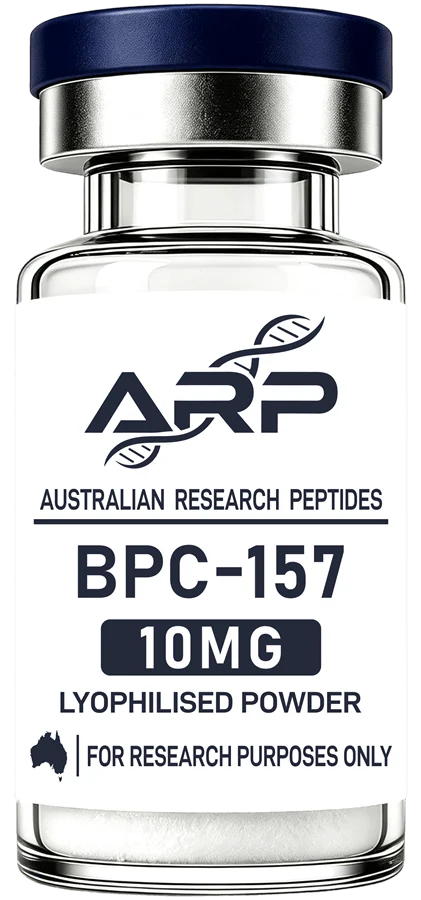
BPC-157 peptide 10 mg, also written BPC157 or BPC 157, is A$89.99 in Australia from Australian Research Peptides, which sells to laboratories and researchers and has it in stock, ready to go out the same day on business-day orders paid before 12pm Sydney time. Its 10 mg certificate shows 99.635% purity. The fifteen-amino-acid chain, GEPPPGKPADDAGLV, is HPLC-tested, identity-checked by mass spectrometry and shipped Australia-wide as freeze-dried white powder in sealed glass. Its sequence matches a section of a gastric-juice protein, and lab assays describe it binding VEGFR2, a receptor on the cells lining blood vessels. In vitro research purposes only.

Cell Signalling Research · Lyophilised Powder · HPLC-tested · SKU 59095
In stock·99.635%
$89.99
1
Presentation
10 mg per vial
Grade
High-Purity Research Grade
Form
Lyophilised Powder
Category
Cell Signalling Research
Same-day dispatch on business-day orders completed before 12pm Sydney time, Mon–Fri
Tracked shipping Australia-wide · typically 1–2 business days to most areas by Express Post · free post over $199, free Express over $299
BPC-157 10 mg: 99.635% purity by HPLC, in a report by Janoshik, an independent laboratory commissioned by the manufacturer, analysed 19 June 2026. View the certificate, or every report in the COA library.
For in vitro research purposes only. Not for human consumption. Not for animal consumption. This product is not a drug, food, cosmetic, or dietary supplement. No medical, therapeutic, or usage information is provided.
BPC-157 10 mg
$89.99

About BPC-157

BPC-157 is studied in angiogenesis (blood-vessel growth) and cell-migration research, and every published study on it is preclinical, meaning cell culture and animal work only. Nothing about the compound is established beyond those lab models. Australian Research Peptides makes no claim about what it does.

BPC-157 is a pentadecapeptide, which simply means a chain of fifteen amino acids. Its sequence, GEPPPGKPADDAGLV, matches a section of a larger protein found in human gastric juice, and four of its fifteen amino acids are proline. Reviews describe it as unusually stable in gastric juice, which is rare for a peptide. In the scientific literature it also appears as bepecin, PL 14736 and PLD-116. Outside the literature the hyphen often disappears, and BPC157 is the same fifteen-amino-acid chain with a different spelling.

Australian Research Peptides sells BPC-157 on its own, as a single peptide. It also appears in two other listings: blended with TB-500, and inside GLOW. The amount stated on this page is BPC-157 alone and nothing else. The material sold here is a laboratory reference compound for work in glassware and cell culture, and it is not intended for people or animals.

BAC water (bacteriostatic water) is also sold by Australian Research Peptides.

Ordering more than 10 vials? Australian Research Peptides takes wholesale peptide orders from laboratories and researchers through its bulk enquiry form.

The peptide calculator works out the mg/mL concentration of a reconstituted vial.

BPC-157 specifications, storage and shipping

  • Compound: BPC-157
  • Also known as: BPC-157 (PL 14736, PLD-116)
  • Class: Pentadecapeptide; sequence corresponding to a partial fragment of a gastric-juice protein
  • Sequence: GEPPPGKPADDAGLV (H-Gly-Glu-Pro-Pro-Pro-Gly-Lys-Pro-Ala-Asp-Asp-Ala-Gly-Leu-Val-OH)
  • Appearance: White to off-white lyophilised powder
  • Quantity: 10 mg
  • SKU: 59095
  • Sizes & SKUs: 10 mg (59095)
  • Presentation: sealed glass vial
  • Form: Lyophilised Powder
  • Grade: High-purity research grade
  • Purity verification: HPLC-assayed to a minimum of 99% purity — the measured result is stated on the published Certificate of Analysis
  • Identity confirmation: Mass spectrometry
  • Certificates: issued by Janoshik, an independent laboratory, and published in the COA library
  • Classification: In vitro research purposes only — laboratory reference material

Lyophilised — long term
−20 °C to −80 °C — long-term storage
Lyophilised — short term
2–8 °C — refrigerated, for a few months
Reconstituted
2–8 °C — use within 8–12 weeks
Protect from light and moisture. Handle in accordance with standard laboratory safety practice, including appropriate PPE. This information is provided for laboratory handling only and is not a usage instruction of any kind.

BPC-157 is HPLC-tested for purity and confirmed by mass spectrometry for identity. The full laboratory report is published in the COA library. BPC-157 is tested by Janoshik, an independent laboratory, commissioned by the manufacturer rather than by Australian Research Peptides.
  • BPC-157 10 mg: assayed purity 99.635% · measured content 10.93 mg · laboratory batch 2026-06 · analysed 19 June 2026

Business-day orders before 12pm Sydney time are dispatched the same day with tracked shipping. Standard delivery within Australia typically takes 2–5 business days. See Shipping & Delivery for details, and follow your parcel on the Track Order page.

For in vitro research purposes only. Not for human consumption. Not for animal consumption. Not a drug, food, cosmetic, or dietary supplement. No therapeutic or medical claims are made.

Questions about BPC-157

This question guide from Australian Research Peptides covers BPC-157 in Australia: what the listing contains, live buying and delivery questions, research context, handling, testing and comparisons. Start with the quick answers, then open the topic group that matches your search.

Quick answers

Australian Research Peptides supplies BPC-157 to laboratories and researchers across Australia as a 10 mg vial at A$89.99, in stock and dispatched from Sydney, with 99.635% HPLC purity on its Janoshik certificate (June 2026). The listing is for BPC-157 on its own, the fifteen-amino-acid chain, in a single vial strength. A weekday order placed before 12pm Sydney time is sent out the same business day. Tracked and Express Post deliver to all states and territories.

BPC-157 is a synthetic peptide made of fifteen amino acids, matching part of a protein first isolated from human gastric juice in 1993 (Sikirić 1993). Published studies on it use tendon, bone, gut and blood-vessel tissue models, all in animals or cell culture. Australian Research Peptides sells it to laboratories and researchers as a freeze-dried research compound.

Yes, BPC-157 10 mg was analysed on 19 June 2026 by Janoshik, an independent laboratory commissioned by the manufacturer, which recorded 99.635% purity by HPLC. Mass spectrometry confirms that the measured mass matches BPC-157, and identity matters most with this peptide: a chain a few amino acids too long or too short shares almost the same sequence, and only the mass tells them apart. A matching certificate is currently published for this product and strength. Open the 10 mg certificate.

No, one or two BPC-157 vials do not qualify for free shipping, but a third vial takes the order past the threshold for free Standard tracked post in Australia. Adding a second product from the range can close the gap too. Free Express Post has a higher threshold again. Australian Research Peptides measures both thresholds on the value of the goods before any discount is applied.

BPC-157 and TB-500 are studied in overlapping areas of repair research but through different mechanisms: BPC-157 through angiogenic (blood-vessel growth) and growth-factor pathways, and TB-500, a fragment of thymosin beta-4, by acting on actin. BPC-157 has the larger and older animal research record, particularly in gut and tendon models. If the choice is not clear, Australian Research Peptides also sells the two together in a single blended vial.

BPC-157's mechanism has only been described in laboratory assays and is not settled, though published work links it to signalling at VEGFR2, a receptor tyrosine kinase (Hsieh 2017), and to the nitric oxide pathway. Reported lab measurements include FAK and paxillin phosphorylation in cultured fibroblasts (Chang 2011). All of this work is preclinical, and nothing about the mechanism is established beyond those lab systems.

Buying, price and availability

Australian Research Peptides supplies BPC-157 to laboratories and researchers in Australia, listing it under Cell Signalling Research as a single peptide, separate from the two-peptide blend. The peptide is HPLC-tested before sale, and the published certificate is in the CoA library for anyone to read. Vials are posted within Australia by tracked or Express Post, so no parcel goes through customs. The weekday cut-off for same-day dispatch is 12pm Sydney time.

BPC-157 costs A$89.99 for the 10 mg vial (in stock) at Australian Research Peptides, the one strength it is sold in, so the cost of an order depends only on how many vials it holds. It is graded HPLC Verified, meaning its published lab certificate reports a purity figure measured by HPLC. Weekday orders paid before 12pm Sydney time are packed and posted that afternoon. Postage is charged separately, depending on the service chosen.

BPC-157 is sold online only, by Australian Research Peptides, an Australian supplier that posts from within Australia to any address in the country. You can pay by PayID or bank transfer, sent from your own bank rather than entered on this site. Once the order is placed, an order reference and the payment details are sent by email.

No, you cannot buy BPC-157 at Chemist Warehouse or any other Australian pharmacy, because it has no marketing authorisation in Australia, which a pharmacy needs before it can stock a product. Australian Research Peptides supplies BPC-157 as a 10 mg freeze-dried research vial for laboratories and researchers, not as a consumer product.

Identity, names and exact format

The 157 in BPC-157 is a sequence label rather than a strength, identifying this particular fifteen-amino-acid sequence, not the amount of peptide in the vial. That sequence is a section of a larger protein from gastric juice rather than a complete protein in its own right. The amount in each vial is shown separately, in milligrams.

BPC-157 is also known as bepecin, PL 14736 and PLD-116 in the scientific literature, and chemists identify it by its fifteen-amino-acid sequence, GEPPPGKPADDAGLV. Outside the scientific literature, the name is often written without the hyphen, as BPC157 or BPC 157, and these all refer to the same peptide.

BPC-157 contains fifteen amino acids joined in a single chain, which is exactly what the word pentadecapeptide means: penta for five and deca for ten. The sequence reads GEPPPGKPADDAGLV, and four of the fifteen are proline. These amino acids form part of a larger gastric-juice protein, so BPC-157 is a defined section of a bigger molecule rather than a protein in its own right.

Yes, BPC157 and BPC-157 are the same peptide, the fifteen-amino-acid chain GEPPPGKPADDAGLV, and leaving out the hyphen is just a different way of writing the name. Australian Research Peptides sells it to researchers and laboratories in Australia as a single 10 mg freeze-dried vial. Search boxes, invoices and published papers all vary the spacing, which is why the same compound also turns up as bpc 157 and BPC 157.

BPC peptide is just shorthand for BPC-157, a research peptide made of fifteen amino acids, with the identifying number left off. It is the same compound Australian Research Peptides lists as BPC-157, sold as a single 10 mg freeze-dried vial, so searching either name on the site brings up the same product.

Research context and evidence

The research on BPC-157 is almost entirely animal and cell-culture work, published over roughly three decades in angiogenesis and cell-signalling research. It is preclinical throughout: the published record stops at cell culture and animal models, and reviews still describe the compound as investigational. Australian Research Peptides supplies it on that basis, as a laboratory reference material rather than a medicine.

Published BPC-157 studies are all preclinical, made up of animal and cell-culture work covering muscle, tendon, bone, the gut, blood vessels and nerve tissue. They use surgical animal models and cells grown in dishes. Reviews still describe BPC-157 as investigational, and the published record establishes no outcome beyond those models.

BPC-157 has been studied in independent laboratories for roughly three decades, but only in cell culture and animals, so nothing about it is established beyond those models. Reviews of the literature still describe it as investigational. Australian Research Peptides sells it as a research compound and makes no claim that it does anything at all.

Handling, storage and measurements

Yes, it is normal for a BPC-157 vial to look empty, because ten milligrams of this fifteen-amino-acid peptide dries into a thin, clear film on the inside of the glass rather than a pile of powder. BPC-157 is the clearest example of this, and first-time buyers often think nothing was supplied. Hold the vial sideways under a lamp and the film catches the light. Adding the diluent settles it straight away, as the film lifts off the glass and dissolves.

BPC-157 should be stored frozen at -20 °C or colder in its sealed vial, kept dry and away from direct light, because even this tougher-than-average peptide does not last on a warm shelf. Reviews note it survives gastric juice, which few peptides manage, but storage still decides how long the material stays intact. Once dissolved, keep the solution cold and out of the light, and avoid freezing and thawing it again and again.

To reconstitute BPC-157, add a suitable diluent slowly to the vial, aiming the stream at the glass shoulder so it never lands directly on the freeze-dried powder. Swirl gently until the powder dissolves, and never shake it. The vial holds the powder and nothing else, with no diluent, preservative or second peptide inside, so the liquid is the lab's own choice. The volume added is what sets the final strength.

Reconstituted BPC-157 should be kept between 2 and 8 degrees and used within eight to twelve weeks, which is the guideline Australian Research Peptides publishes. Its sequence, GEPPPGKPADDAGLV, has two aspartates side by side, and aspartate is the amino acid chemists watch most closely once a peptide is in water. It contains no cysteine, methionine or tryptophan, so oxidation is not the main concern.

Australian Research Peptides publishes no set volume of diluent for a BPC-157 vial, which holds 10 mg of peptide, because the volume is a decision for the lab. Adding more or less liquid changes how concentrated the solution is, but not how much peptide is in the vial: the 10 mg is the same either way.

BPC-157 usually looks cloudy after mixing for one of two harmless reasons: air bubbles worked in while mixing, or a vial used straight from cold storage. Air bubbles clear if the vial is left to stand. A cold vial fogs on the outside and also dissolves more slowly. If it is still cloudy after a quarter of an hour, or has flecks that will not clear, the material has not fully dissolved.

BPC-157 is dissolved in a water-based diluent for laboratory work, chosen by the laboratory to suit its method, because the vial arrives as dry powder with no liquid included. BPC-157 is a single plain fifteen-amino-acid chain with no fatty-acid tail and no metal ion, and the volume of diluent added sets the concentration.

Testing and batch documents

The only real way to tell if BPC-157 is genuine and properly filled is an independent HPLC analysis tied to the batch you received. Australian Research Peptides publishes its certificates in a COA library that names the product and strength each one covers, so you can read them before you order rather than asking afterwards. A supplier who will not show a certificate matched to your batch has not given you any evidence.

BPC-157 10 mg from Australian Research Peptides is 99.635% pure by HPLC, the figure on its published certificate of analysis, dated 19 June 2026. That report is by Janoshik, an independent laboratory commissioned by the manufacturer rather than by Australian Research Peptides, and the figure applies to the batch it tested. The full certificate is in the COA library.

Ordering, payment and Australian delivery

BPC-157 reaches most Australian addresses in two to five business days by standard tracked post, or one to two business days by Express Post to the better-served states. Dispatch depends on a 12pm Sydney time cut-off: if payment is matched before then, the order leaves that afternoon, and anything later goes the next business day. Nothing crosses a border, because Australian Research Peptides posts within Australia.

Yes, you can pay for BPC-157 with PayID, and because the same-day cut-off depends on when payment is matched rather than when the order is placed, the payment method matters. PayID usually lands in minutes, while a standard bank transfer may take longer. PayID and bank transfer are both accepted, and every order gets the account details and its reference by email as soon as it is placed.

No, a BPC-157 vial does not come with a diluent: it holds 10 mg of freeze-dried peptide and nothing else, so the liquid and any measuring equipment are the lab's own choice for its method. One vial is normally dissolved once, and the finished solution is best split into portions for storage.

Access and regulatory questions

BPC-157 is not approved by the TGA or registered for human or veterinary use in Australia, and Australian Research Peptides supplies it only as a laboratory reference material for in vitro research, with no medical claim attached. Buyers are responsible for meeting the rules that apply to their own work.

No, BPC-157 is not FDA approved, and no comparable agency has approved it either, so there is no licensed BPC-157 medicine in any country. Its status under the United States' pharmacy-compounding rules changed twice during 2026, so anything you read about that is worth checking with the FDA itself rather than with a supplier.

Yes, BPC-157 is banned in sport and prohibited at all times, listed under S0, the non-approved substances category, because no health regulator anywhere has approved it for human therapeutic use. Sport Integrity Australia publishes a dedicated page about it. A therapeutic use exemption is effectively out of reach, because exemptions depend on an approved medical use, which BPC-157 does not have.

Peptides such as BPC-157 ordered from overseas can be seized by Australian customs, because unapproved therapeutic goods are among the things inbound screening looks for. A detained parcel usually means the money is gone and nothing arrives. That risk does not apply to a BPC-157 order from Australian Research Peptides, which travels only between two Australian addresses. The TGA and Border Force both explain what they screen for.