
For laboratory research use only. Not for human or veterinary use.Lab research use only. Not for human or animal use.

Same-Day DispatchAustralian StockPremium Research GradePublished CoAsPayID · Clears in Seconds
Same-day dispatch on business-day orders before 12pm Sydney time.Same-day dispatch before 12pm Sydney timeFree standard post $199+Free std post $199+

Buy GLOW Peptide Blend 70 mg in Australia

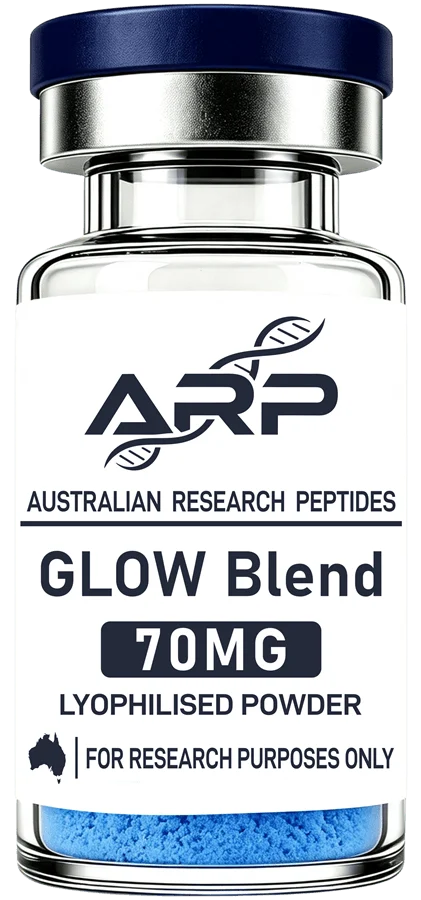
GLOW 70 mg is $159.99 at Australian Research Peptides, in stock and sent out the same business day if you pay before 12pm Sydney time. Each vial holds three peptides in one: about 50 mg of GHK-Cu, with the other 20 mg split between BPC-157 and TB-500. A published lab certificate confirms all three and how much of each is in the batch. It ships Australia-wide by tracked post. Australian Research Peptides supplies GLOW to laboratories and researchers, for in vitro research only.

Copper Peptide Research · Lyophilised Powder · Independently lab-tested · SKU 64918
In stock·
$159.99
1
Presentation
70 mg per vial
Grade
Research Grade
Form
Lyophilised Powder
Category
Copper Peptide Research
Same-day dispatch on business-day orders completed before 12pm Sydney time, Mon–Fri
Tracked shipping Australia-wide · typically 1–2 business days to most areas by Express Post · free post over $199, free Express over $299
Batch certificates — published in the COA library
For in vitro research purposes only. Not for human consumption. Not for animal consumption. This product is not a drug, food, cosmetic, or dietary supplement. No medical, therapeutic, or usage information is provided.
GLOW 70 mg
$159.99

About GLOW

GLOW brings together three peptides that are each well studied in the lab. BPC-157 is a chain of fifteen amino acids, studied in cell assays on VEGFR2 and nitric oxide signalling. TB-500 is a short section of the thymosin beta-4 protein, and in mouse studies this section on its own worked about as well as the full protein. GHK-Cu is a small peptide found naturally in the body, carrying a copper ion. All of this is lab and animal research, not results in people.

GLOW is a blend rather than a single compound: BPC-157, TB-500 and GHK-Cu, freeze-dried together in one vial. You may also see it written as GLOW 70, GLOW-70 or GLOW blend. Other sellers' GLOW can hold a different total, so the peptides listed and their milligram amounts are the fair thing to compare. Australian Research Peptides also sells each of the three on its own, and BPC-157 with TB-500 as a pair.

Each GLOW vial holds 70 mg in total: about 50 mg of GHK-Cu, with the other 20 mg split between BPC-157 and TB-500, as shown under "What is in the vial". The lab certificate in the CoA library names all three peptides and the measured amount of each in that batch. Australian Research Peptides supplies GLOW to laboratories and researchers for in vitro research purposes only.

What is in the vial

GLOW composition per vial
ComponentAmount per vial
BPC-157~10 mg
TB-500 — a fragment corresponding to the actin-binding region of thymosin beta-4~10 mg
GHK-Cu — the copper(II) complex of the GHK tripeptide~50 mg
Total70 mg per vial

GLOW specifications, storage and shipping

  • Compound: GLOW
  • Also known as: BPC-157, TB-500 and GHK-Cu combination
  • Class: Three-peptide blend
  • Appearance: Lyophilised powder
  • Quantity: 70 mg
  • SKU: 64918
  • Sizes & SKUs: 70 mg (64918)
  • Presentation: sealed glass vial
  • Form: Lyophilised Powder
  • Grade: Research grade
  • Testing: Independently lab-tested for identity and amount before release — the laboratory's report for this blend gives a measured amount for each peptide and no purity figure
  • Identity confirmation: Mass spectrometry
  • Certificates: issued by Janoshik, an independent laboratory, and published in the COA library
  • Classification: In vitro research purposes only — laboratory reference material

Lyophilised — long term
−20 °C to −80 °C — long-term storage
Lyophilised — short term
2–8 °C — refrigerated, for a few months
Reconstituted
2–8 °C — use within 8–12 weeks
Protect from light and moisture. Handle in accordance with standard laboratory safety practice, including appropriate PPE. This information is provided for laboratory handling only and is not a usage instruction of any kind.

GLOW is independently lab-tested for identity and amount. The full laboratory report is published in the COA library. GLOW is tested by Janoshik, an independent laboratory, commissioned by the manufacturer rather than by Australian Research Peptides.
  • GLOW 70 mg: measured content GHK-Cu 58.44 mg · TB-500 12.65 mg · BPC-157 12.46 mg · laboratory batch 2026-06 · analysed 23 June 2026

Business-day orders before 12pm Sydney time are dispatched the same day with tracked shipping. Standard delivery within Australia typically takes 2–5 business days. See Shipping & Delivery for details, and follow your parcel on the Track Order page.

For in vitro research purposes only. Not for human consumption. Not for animal consumption. Not a drug, food, cosmetic, or dietary supplement. No therapeutic or medical claims are made.

Questions about GLOW

This question guide from Australian Research Peptides covers GLOW in Australia: what the listing contains, live buying and delivery questions, research context, handling, testing and comparisons. Start with the quick answers, then open the topic group that matches your search.

Quick answers

Australian Research Peptides supplies GLOW peptide throughout Australia as one 70 mg vial combining BPC-157, TB-500 and GHK-Cu, listed under the GLOW code and found by searching "glow blend". Weekday orders confirmed before 12pm Sydney time are packed and posted from Sydney the same afternoon, so no parcel goes through customs. Express Post and standard tracked post reach every state and territory. GLOW is independently lab-tested for identity and amount, the certificate is published in the CoA library, and you can pay by PayID or bank transfer.

GLOW is a market label for a blend of three peptides, BPC-157, TB-500 and GHK-Cu, and the four letters are not short for any published name. Australian Research Peptides uses GLOW as a catalogue label, not an abbreviation. Because the name is not a specification, two products sold as GLOW may not match, so compare the compounds named and the total quantity.

No, you cannot buy GLOW at Chemist Warehouse, because it is not stocked there and none of its three research peptides is registered for supply in Australia. That means no pharmacy could dispense the blend or any of its parts. GLOW comes from Australian Research Peptides, which lists it as a single 70 mg research vial for laboratories and researchers.

Yes, GLOW is independently lab-tested before Australian Research Peptides supplies it, in testing commissioned by the manufacturer, and the report accounts for all three peptides in the vial. The laboratory reports identity and amount: each of the three peptides is named, with a measured milligram figure for each. The results apply only to the batch tested. A matching certificate is currently published for this product and strength. Open the 70 mg certificate.

One GLOW vial replaces three separate vials, so the fair comparison is its price against BPC-157, TB-500 and GHK-Cu bought individually from Australian Research Peptides. The trade-off is flexibility: the ratio of the three peptides is fixed in the vial, so it cannot be adjusted the way it can with three separate vials.

A GLOW order takes 2–5 business days to arrive by standard tracked post, or 1–2 business days by Express Post to the faster states. Because one 70 mg vial holds all three peptides, there is one parcel to track instead of three. Anything else on the same order, such as another vial, is packed in the same satchel with a single tracking number.

Buying, price and availability

It is unusual for a GLOW vial to look empty, because seventy milligrams of combined powder is plenty to see and its GHK-Cu tints the whole amount blue. Expect a coloured, chalky solid rather than a nearly invisible layer. The three peptides are dried together, so they do not show as separate bands. A cake that sits unevenly or has cracked during handling changes nothing about the contents.

You can get GLOW peptide online from Australian Research Peptides, which supplies the three-peptide vial from within Australia and takes orders through its website rather than by phone or in person. Payment is by PayID or bank transfer; digital wallets, buy-now-pay-later instalments and crypto are not accepted. Delivery is by domestic post to any Australian address.

Yes, a 70 mg GLOW vial needs more diluent than a single 10 mg peptide vial to reach the same concentration, because volume is worked out from milligrams and GLOW holds 70 of them. One GLOW vial replaces three, but it does not cut the amount of diluent needed, and Australian Research Peptides does not publish a fill volume for it.

Identity, names and exact format

GLOW has no single amino-acid count, because the vial holds three separate peptide chains of different lengths rather than one molecule. BPC-157 is a pentadecapeptide, meaning fifteen amino acids long (PubChem). The TB-500 fragment is seven amino acids long. The GHK part of GHK-Cu is three, and its copper is bound to that chain rather than counted as a fourth unit.

GLOW combines three peptides in one vial as a packaging choice, not because of any scientific finding, since no published study has examined the three together. Each compound has its own separate research literature. Australian Research Peptides does not claim the three behave any differently together than apart. What the format saves is handling: one vial to store and prepare instead of three.

GLOW is blue because of its GHK-Cu component, since copper complexes are coloured, which is unusual among peptides and often surprises people the first time they open a vial. Expect blue in the dry powder and blue once it is mixed. A GLOW solution with no colour at all is the one that raises questions about what is in it.

GLOW peptide should be stored dry, below -15 °C and away from direct light, and one set of storage conditions covers all three peptides because they share a vial. The copper complex is the light-sensitive part, and it makes up most of the powder. Peptides absorb moisture from the air, so let the vial warm up inside a desiccator, a sealed container with a drying agent, before opening it. Bachem advises splitting any solution into portions and freezing them rather than keeping it as one volume.

GLOW is supplied as one vial, not three, with all three peptides mixed together in the same freeze-dried powder rather than packed as a set of separate vials. The glass is sealed and tamper-evident. Because the peptides share a vial, there is one storage decision and one mixing step instead of three, and the proportions between them are fixed when they are blended.

GLOW contains a third peptide, GHK-Cu, that the BPC-157 + TB-500 vial does not, and the two products also hold different total amounts per vial. They are separate products with separate stock, not two sizes of the same thing. Compare them on the compounds listed and the milligrams in each vial rather than on which name sounds bigger.

Research context and evidence

GLOW is a ready-mixed blend of three peptides studied in cell-signalling and extracellular-matrix research, supplied by Australian Research Peptides to laboratories and researchers as a single 70 mg vial. Most of it by weight is GHK-Cu, a copper tripeptide found naturally in people (Maquart 1988) that gives the powder its blue colour. The rest is BPC-157, studied for inflammatory and blood-vessel signalling in animal models, and TB-500, studied for cell migration and new blood-vessel formation in mouse models. All of this work is in cells and animals, not people, and the milligram figures are the recipe the blend is made to, not a test of your vial.

GLOW 70 mg lyophilized peptide is the freeze-dried blend of three peptides, GHK-Cu, BPC-157 and TB-500, sealed in one vial and supplied by Australian Research Peptides for laboratory research. Lyophilised and lyophilized are the British and American spellings of the same word: the solution is frozen and the water removed under vacuum, leaving a dry cake that keeps until it is mixed. The 70 mg is the combined weight of all three peptides, not any one of them, so it cannot be compared directly with a 70 mg single-peptide vial. Listings also write it as GLOW 70 or GLOW-70.

GLOW has three mechanisms under study, one for each of its three peptides, and none of them has been settled by the published research so far. BPC-157 is studied in cell and animal work for how it interacts with VEGFR2 and nitric oxide signalling. TB-500 is the seven-amino-acid actin-binding section of thymosin beta-4, and versions missing part of that section were inactive in binding assays (Philp 2003). GHK-Cu holds a copper(II) ion within its three-amino-acid chain, with a binding strength the literature compares to the copper transport site on albumin.

GLOW's component studies measure what happens to cells, not people, and each of the three peptides has been studied separately for a different process. GHK-Cu is studied for signalling cultured fibroblasts, connective-tissue cells grown in the lab, to make collagen and elastin. BPC-157 is studied for inflammatory signalling in animal models, and TB-500 for cell migration and the formation of new blood vessels. The published work does not report a result in a person. GLOW is sold to laboratories and researchers as a research material, and no cosmetic or medical effect is claimed for it.

The research behind GLOW is three separate sets of studies, one for each peptide, and none of them tested the GLOW vial itself. BPC-157 has been studied in animal work on blood-vessel signalling. The TB-500 fragment has been studied in mice (Philp 2003). GHK-Cu has the longest record of the three, in cell and animal work on how collagen and elastin are made. No published study has tested all three together in one preparation, and Australian Research Peptides says so plainly rather than filling the gap.

Most of the 70 mg in a GLOW vial is GHK-Cu, about 50 mg, and the other 20 mg is shared equally by BPC-157 and TB-500, according to the recipe. These are the figures the blend is made to, not a measurement of the vial you receive, and the amount on the label is the combined total for all three. Where a batch certificate is published, it gives a measured milligram figure for each peptide, and for that batch the measured figure is the one that counts.

Australian Research Peptides sells GLOW in one size only, the 70 mg vial, so the comparison is with a smaller 50 mg blend bought elsewhere rather than a second listing on this site. Seventy milligrams holds more of each peptide than fifty, so there are fewer vials to prepare for the same amount and less chance of running short partway through a project. The vial uses the standard GLOW recipe, mostly the copper peptide with the rest split between the other two. GLOW is a market label, so a vial with that name elsewhere may hold a different total; check the milligrams before comparing.

No, GLOW is not a protein powder or any kind of food, but a milligram amount of three short synthetic peptides sealed in a laboratory vial. Protein powder is a bulk dietary product measured in grams and eaten. Australian Research Peptides supplies GLOW for in vitro research, and it is not for consumption by anyone.

Buy GHK-Cu on its own if the copper peptide is the only compound you want, and choose GLOW if you also want BPC-157 and TB-500 alongside it. Australian Research Peptides sells both, and a GHK-Cu vial holds more of that one peptide than GLOW does, because GLOW's 70 mg is shared three ways in proportions fixed when the powder is dried. They also differ under Australian law: GHK-Cu is the only one of the three that is not scheduled, so the blend carries a regulatory position that a single GHK-Cu vial does not.

Handling, storage and measurements

Reconstituting GLOW dissolves all three peptides at once, because they were freeze-dried together in the same vial, so only one mixing step is needed. Run the liquid down the side of the glass, never straight onto the powder. Swirl the vial gently rather than shaking it, and wait until the liquid is clear. Bachem notes that a peptide can occasionally take several hours to dissolve.

Australian Research Peptides sets no volume of diluent for a 70 mg GLOW vial, because that is a decision for the lab, and the 70 mg of powder stays the same whatever is added. Any concentration worked out from the volume is a combined figure for all three peptides, never the strength of one. One volume dissolves all three because they were dried together, and their proportions stay as blended.

Reconstituted GLOW should be used within twelve weeks and kept refrigerated at 2 to 8 degrees Celsius, which is Australian Research Peptides' general guideline rather than a measured figure. No published study has tracked three peptides sharing one vial. GLOW is also the only blend from Australian Research Peptides that puts a bound copper ion beside two plain peptide chains, which is a reason to aim for the shorter end.

GLOW can look hazy for a short time after mixing because its three peptides dissolve at different speeds, and shaking adds air bubbles on top of that, so allow ten quiet minutes before judging. The blue colour from GHK-Cu is normal and separate from clarity: the liquid should be blue but see-through. Cloudiness that does not clear is what signals a problem.

GLOW is dissolved in a diluent, a liquid that takes the dry powder into solution, and one volume of it covers all three of GLOW's peptides at once. A water-based diluent is the usual choice for this kind of work. The vial holds dry powder and nothing else, and no diluent is supplied with a GLOW vial.

Australian Research Peptides Pty Ltd, trading as ARP, supplies GLOW in Australia: a three-peptide blend of BPC-157, TB-500 and GHK-Cu in a single 70mg vial. The blend is independently lab-tested for identity and amount, and it is sent from within Australia, so nothing crosses a border. On a business day, orders confirmed before the 12pm Sydney time cut-off are posted that afternoon, by either postage service, to any address the carrier delivers to.

A GLOW vial has one Australian-dollar price that covers all three peptides at once, so comparing it with a single-peptide product is not a like-for-like comparison. The fairer comparison is another three-peptide blend with a clearly stated total quantity. Postage is charged on top and quoted separately.

Yes, one GLOW vial qualifies for free Standard tracked post in Australia on its own, which is true of only a handful of Australian Research Peptides products, because it holds three peptides rather than one. It does not reach the higher Express Post threshold, so choosing Express on a single-vial order still adds a fee. Adding a second product does not change the free Standard post.

Testing and batch documents

Yes, glow70, GLOW-70 and GLOW 70mg all mean the same 70 mg vial of three peptides, and the number is simply the total milligrams in the vial rather than part of a compound name. People also type gkp70, a near-miss for the GHK in GHK-Cu, the peptide that makes up most of the vial by weight. However it is typed, the contents are the ones named on this page: BPC-157, TB-500 and GHK-Cu.

Ordering, payment and Australian delivery

Pay for a GLOW order with the exact order total, to the cent, because a payment that does not match has to be sorted out by hand and a short payment cannot release the stock. A PayID or bank transfer is typed in by hand, so check the amount before you send it. If you have underpaid or overpaid, contact support with your order reference rather than sending a second transfer, which would create two unmatched payments instead of one.

No, GLOW is not FDA approved, because none of its three peptides has ever been licensed as a medicine, so the blend has no approval in the United States or anywhere else. Regulators assess a combination as a whole product, and no agency has assessed this one. Two of the three peptides are also scheduled under Australian law. The vial is a research reagent: unregistered, unreviewed and not for use in people.

Yes, GLOW is banned in sport, because two of its three peptides are: BPC-157 under the non-approved substances category S0, and TB-500 under S2 with the growth factors. GHK-Cu is not named in either, but that does not mean it is cleared. Sport Integrity Australia administers the list in Australia, and a blend is judged on every compound it contains.

GLOW is not registered as a medicine in Australia, and two of its three peptides are scheduled, which sets the legal position for the whole blend. That holds even though GHK-Cu, which is on neither list, makes up most of the vial by weight. No regulator has assessed the mixture as a product. Australian Research Peptides supplies GLOW to laboratories and researchers as unregistered research material and does not give legal advice.

Access and regulatory questions

Legally importing GLOW is not something an order from Australian Research Peptides involves, because the vials are already held in Australia and travel between two Australian addresses without crossing a border. Bringing a vial in from overseas is different, and a blend makes it harder, not easier: one parcel carries three compounds, two of them scheduled in Australia, and the personal importation rules apply to each compound, not the label on the box. Buying locally removes only the customs step; the compounds and the rules that apply to them stay the same.

GLOW has no single purity percentage because a single number cannot properly describe a vial that holds three different peptides at once. Instead, a blend analysis reports identity and amount: each compound named, with a measured milligram figure for it in the batch tested. A purity percentage suits a single-compound product, where there is one molecule to describe. Averaging the three, or borrowing one peptide's certificate, would give a figure no document supports, so Australian Research Peptides publishes neither. Treat any single purity percentage quoted for a three-peptide blend as a number with nothing behind it.

GLOW has no chemical synonym, because it is a market label rather than a compound name, and sellers write it as GLOW Blend, GLOW 70, GLOW-70 or GLOW 70mg. Australian Research Peptides uses GLOW as the catalogue code for its blend of BPC-157, TB-500 and GHK-Cu, and searching the compound names, BPC TB GHK, finds the same listing. Because GLOW is not a standard scientific name, products with that label can differ between suppliers, so compare the named components and quantities.