For laboratory research use only. Not for human or veterinary use.Lab research use only. Not for human or animal use.

Same-Day DispatchAustralian StockPremium Research GradePublished CoAsPayID · Clears in Seconds
Same-day dispatch on business-day orders before 12pm Sydney time.Same-day dispatch before 12pm Sydney timeFree standard post $199+Free std post $199+

Buy GHK-Cu Peptide 100 mg in Australia

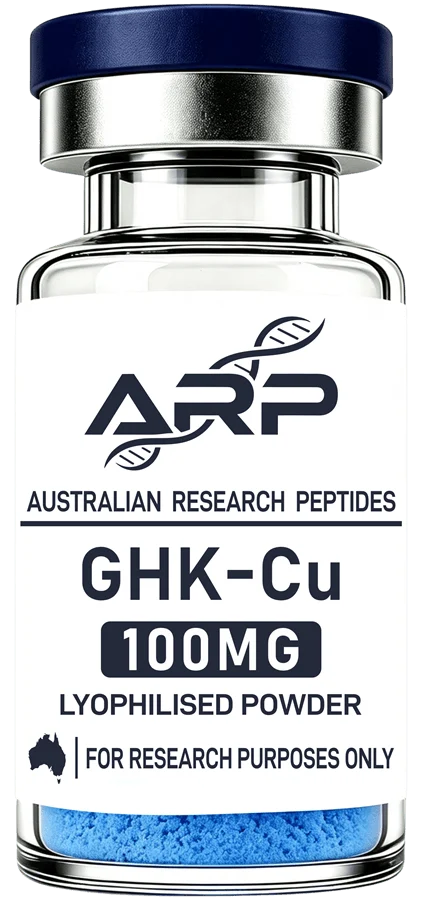
GHK-Cu peptide 100 mg, also written GHK Cu or GHKCu, costs A$139.99 a vial from Australian Research Peptides, which supplies laboratories and researchers across Australia and has it in stock, sending orders paid before 12pm Sydney time that business day. The GHK-Cu certificate records 99.912% HPLC purity for the 100 mg vial. It is freeze-dried copper peptide in a sealed vial, not a cosmetic serum or skincare cream. Its copper is bound inside a three-amino-acid chain of glycine, L-histidine and L-lysine. Studies compare its hold on copper with the copper transport site on albumin. In vitro research purposes only.

Copper Peptide Research · Lyophilised Powder · HPLC-tested · SKU 56342
In stock·99.912%
$139.99
1
Presentation
100 mg per vial
Grade
High-Purity Research Grade
Form
Lyophilised Powder
Category
Copper Peptide Research
Same-day dispatch on business-day orders completed before 12pm Sydney time, Mon–Fri
Tracked shipping Australia-wide · typically 1–2 business days to most areas by Express Post · free post over $199, free Express over $299
GHK-Cu 100 mg: 99.912% purity by HPLC, in a report by Janoshik, an independent laboratory commissioned by the manufacturer, analysed 23 June 2026. View the certificate, or every report in the COA library.
For in vitro research purposes only. Not for human consumption. Not for animal consumption. This product is not a drug, food, cosmetic, or dietary supplement. No medical, therapeutic, or usage information is provided.
GHK-Cu 100 mg
$139.99

About GHK-Cu

GHK-Cu has been researched since 1973, when GHK was first isolated from human plasma. Cell-culture studies look at it in relation to extracellular-matrix remodelling, the constant breakdown and rebuilding of the framework that holds cells in place. Reviews of that work list what those lab tests measure in cultured fibroblasts, including collagen, certain glycosaminoglycans and the proteoglycan decorin. Australian Research Peptides reports the literature and makes no claim about any reader.

GHK is a tripeptide, meaning a chain of three amino acids: glycine, L-histidine and L-lysine. GHK-Cu is that same chain carrying a copper(II) ion. The copper is bound into the molecule, not simply mixed in beside it, and GHK holds copper about as tightly as the copper transport site on albumin does. A listing that says GHK with no copper is a different product.

Compare vial sizes before you compare GHK-Cu prices. This category mixes 50 mg and 100 mg vials more than any other in the catalogue, so a cheaper page elsewhere is often just a smaller vial. Australian Research Peptides lists a single 100 mg GHK-Cu vial and no other size.

Australian Research Peptides sells GHK-Cu in Australia as a single 100 mg vial of freeze-dried copper peptide, sealed in a tamper-evident glass vial. People write and search for it as GHK-Cu, GHK Cu, ghkcu and copper peptide, and all of these mean the same copper-bound tripeptide. Stock is held locally and posted to every state and territory rather than imported to order. The peptide is tested by HPLC with its identity confirmed, and its certificate is published in the COA library.

BAC water (bacteriostatic water) is also sold by Australian Research Peptides.

Ordering more than 10 vials? Australian Research Peptides takes wholesale peptide orders from laboratories and researchers through its bulk enquiry form.

The peptide calculator works out the mg/mL concentration of a reconstituted vial.

GHK-Cu specifications, storage and shipping

  • Compound: GHK-Cu
  • Also known as: GHK-Cu (glycyl-L-histidyl-L-lysine copper(II) complex)
  • Class: Copper-binding tripeptide complex
  • Appearance: Lyophilised powder
  • Quantity: 100 mg
  • SKU: 56342
  • Sizes & SKUs: 100 mg (56342)
  • Presentation: sealed glass vial
  • Form: Lyophilised Powder
  • Grade: High-purity research grade
  • Purity verification: HPLC-assayed to a minimum of 99% purity — the measured result is stated on the published Certificate of Analysis
  • Identity confirmation: Mass spectrometry
  • Certificates: issued by Janoshik, an independent laboratory, and published in the COA library
  • Classification: In vitro research purposes only — laboratory reference material

Lyophilised — long term
−20 °C to −80 °C — long-term storage
Lyophilised — short term
2–8 °C — refrigerated, for a few months
Reconstituted
2–8 °C — use within 8–12 weeks
Protect from light and moisture. Handle in accordance with standard laboratory safety practice, including appropriate PPE. This information is provided for laboratory handling only and is not a usage instruction of any kind.

GHK-Cu is HPLC-tested for purity and confirmed by mass spectrometry for identity. The full laboratory report is published in the COA library. GHK-Cu is tested by Janoshik, an independent laboratory, commissioned by the manufacturer rather than by Australian Research Peptides.
  • GHK-Cu 100 mg: assayed purity 99.912% · measured content 104.91 mg · laboratory batch 2026-06 · analysed 23 June 2026

Business-day orders before 12pm Sydney time are dispatched the same day with tracked shipping. Standard delivery within Australia typically takes 2–5 business days. See Shipping & Delivery for details, and follow your parcel on the Track Order page.

For in vitro research purposes only. Not for human consumption. Not for animal consumption. Not a drug, food, cosmetic, or dietary supplement. No therapeutic or medical claims are made.

Questions about GHK-Cu

This question guide from Australian Research Peptides covers GHK-Cu in Australia: what the listing contains, live buying and delivery questions, research context, handling, testing and comparisons. Start with the quick answers, then open the topic group that matches your search.

Quick answers

Australian Research Peptides sells GHK-Cu in Australia to laboratories and researchers as a 100 mg vial at A$139.99, in stock and dispatched from Sydney, with 99.912% HPLC purity on its Janoshik certificate (June 2026). It ships by Express Post or standard tracked post. Orders placed before the 12pm Sydney time weekday cut-off are sent that afternoon. The parcel starts its journey in Australia and stays inside the country the whole way.

GHK-Cu is a copper peptide: the copper(II) complex of glycyl-L-histidyl-L-lysine, a short peptide made of just three amino acids, glycine, histidine and lysine. It is studied in extracellular-matrix research, including cell-culture experiments that measure collagen and other matrix materials made by fibroblasts. Another line of research looks at how tightly the peptide binds copper. These describe the published literature, not what happens in a person.

Yes, GHK-Cu 100 mg was analysed on 23 June 2026 by Janoshik, an independent laboratory commissioned by the manufacturer, which recorded 99.912% purity by HPLC. HPLC separates the sample into its parts and shows how much of it is the peptide. Mass spectrometry weighs the molecule to confirm it is the right one. A matching certificate is currently published for this product and strength. Open the 100 mg certificate.

A single 100 mg GHK-Cu vial does not reach the standard free-shipping threshold on its own, but adding a second vial, or pairing it with a companion compound from the range, takes the order over it. The free Express threshold is higher again. Eligibility is worked out on the subtotal of the goods, before any discount code is applied.

GHK-Cu comes in a 100 mg vial because lab work with this copper tripeptide uses far larger amounts than a 10 mg peptide, so a small vial would not hold enough to make a usable stock solution. That comes from the compound itself rather than being a bulk-buy choice, and it is also why GHK-Cu vial sizes vary so much between suppliers: there is no single standard strength.

GHK-Cu works by holding a copper(II) ion inside a short chain of three amino acids, and Pickart 2008 puts its hold on copper close to that of albumin, the blood protein that carries copper. Copper is a trace metal that connective-tissue enzymes depend on. The published work on how it works is chemistry and cell culture, so it describes behaviour in a dish rather than an effect in a person.

Buying, price and availability

GHK-Cu is supplied in Australia by Australian Research Peptides, an Australian business sending it to laboratories and researchers from Sydney as a single 100 mg vial, listed under Copper Peptide Research as code GHK. Weekday orders confirmed by 12pm Sydney time go out the same afternoon, by Express or tracked Standard Post to every state and territory. There is no border crossing and no customs desk. GHK-Cu is HPLC-tested, and payment is by PayID or bank transfer. Its published certificate of analysis records 99.912% HPLC purity, analysed 23 June 2026, and is in the COA library.

GHK-Cu costs A$139.99 for the 100 mg vial (in stock) at Australian Research Peptides, a single price in Australian dollars for its one vial size. The GLOW blend is a separate product with its own price. Weekday orders paid by 12pm Sydney time are on their way that afternoon. GLOW holds BPC-157, TB-500 and GHK-Cu together, and only about 50 mg of its nominal 70 mg is the copper tripeptide, so a GLOW price tells you nothing about the standalone vial.

GHK-Cu can be bought online direct from Australian Research Peptides, an Australian business that lists the copper tripeptide as a single 100 mg vial and supplies it from within Australia. Payment is by PayID or direct bank transfer quoting the order reference, and digital wallets are not offered. Orders are sent within Australia.

No, Chemist Warehouse does not sell the GHK-Cu research vial, which Australian Research Peptides supplies to laboratories and researchers as a 100 mg vial. Chemist Warehouse does sell cosmetic products, and copper tripeptide appears in some of them at very low levels, but that is a different kind of product and not the same purchase. The vial from Australian Research Peptides is listed under Copper Peptide Research.

A GHK-Cu vial can be sent now, because Australian Research Peptides has the 100 mg vial in stock and posts it within Australia. Only one vial size is sold, so a single price in Australian dollars covers the whole GHK-Cu listing, and it is shown in the product panel on this page. Nothing crosses a border, and the CoA library shows the certificate status of every strength Australian Research Peptides lists.

Identity, names and exact format

GHK-Cu stands for glycyl-L-histidyl-L-lysine copper(II) complex, where G, H and K are the one-letter codes for glycine, histidine and lysine, and Cu is the chemical symbol for copper. Described by its class, it is a copper-binding tripeptide complex, meaning a chain of three amino acids that holds copper.

GHK-Cu contains three amino acids, glycine, L-histidine and L-lysine, in that order, which is why the peptide part of the name is called a tripeptide. The copper is not a fourth amino acid. It is a metal ion bound to the three-unit chain, so the count stays at three whether the material is written GHK or GHK-Cu. The same sequence occurs naturally in human plasma.

No, GHK-Cu arrives dry, as a freeze-dried powder sealed in a tamper-evident glass vial at the amount Australian Research Peptides lists. Freeze-drying removes the water, and a dry peptide keeps far better than one sitting in liquid. It only becomes a solution once a researcher dissolves it, and GHK-Cu is not supplied ready-mixed.

GHK-Cu should be a distinct blue once dissolved, because its copper ion is coloured, and it is the one peptide in Australian Research Peptides’ range where blue is normal rather than a warning sign. The dry powder is blue too. A GHK-Cu solution that is colourless is the one worth questioning.

GHK-Cu is also known as copper peptide, GHK copper, Cu-GHK and copper tripeptide-1, which is the INCI name cosmetic chemists use. PubChem lists the same complex as prezatide copper, and in full as glycyl-L-histidyl-L-lysine copper(II) complex. GHK without copper is a different material, not a shorthand for GHK-Cu.

Yes, ghkcu, ghk cu and GHK-Cu are the same compound typed three ways: a copper ion bound inside the tripeptide glycine-histidine-lysine, which Australian Research Peptides sells as one 100 mg vial. The swapped spelling hgk-cu is a typo of the same name. Searching ghk on its own usually means this copper complex too, although GHK without copper is a separate material, and only the copper-bound form is listed here.

No, GHK-Cu from Australian Research Peptides is not a skincare product: it is a laboratory research material, and it is not made, tested or supplied for use on a person. Research on GHK-Cu asks whether the peptide signals cells directly and changes which genes they switch on, and published work reports it affecting the activity of more than 4,000 human genes. It is supplied to laboratories and researchers for in vitro research only.

Research context and evidence

GHK-Cu research is laboratory research, mostly in cell culture and animal models, and Pickart's 2015 review in BioMed Research International is the standard starting point for it. That review reports GHK levels in human plasma of around 200 ng/mL at age 20, falling to about 80 ng/mL by age 60. The literature it covers spans chemistry, cell culture and animal models. This answer reports the published research and does not claim any outcome for the reader.

GHK-Cu cell studies measure what cultured fibroblasts, the cells that make collagen and elastin, produce when the peptide is present, and whether that output goes up. The published work also includes tissue models in cell culture and in animals. What these studies record is an effect on cells in a dish, not a result in a person. Australian Research Peptides supplies GHK-Cu to laboratories and researchers for in vitro research only, and makes no claim that it is safe or effective for cosmetic or medical use.

Handling, storage and measurements

A GHK-Cu vial should not look empty, because it holds one hundred milligrams, ten times the usual peptide amount, and the copper gives the dried powder a clear blue colour. The result is a solid, plainly coloured cake that nobody mistakes for an empty vial. A GHK-Cu vial that really does look bare, or shows no blue at all, is worth raising with Australian Research Peptides.

GHK-Cu powder should be stored sealed, dry, cold and away from light, in a freezer for long-term storage or a fridge for shorter periods. It is a copper complex, meaning a metal bound into a peptide rather than a plain chain. Once dissolved, keep the solution in the fridge and in the dark, and do not refreeze it. Australian Research Peptides publishes a separate guide to how long a reconstituted GHK-Cu solution keeps.

GHK-Cu is reconstituted like any freeze-dried peptide, with one difference: the copper is already part of the molecule, so no metal is added at this step. A water-based diluent is the usual choice, a diluent being the liquid a dried powder is dissolved in. Let the vial warm up, then aim the liquid at the glass so it runs down the side. Swirl until it is clear, and never shake it. Australian Research Peptides publishes worked volume examples for the 100 mg vial.

Reconstituted GHK-Cu keeps for eight to twelve weeks at 2 to 8 °C under Australian Research Peptides' published window for HPLC Verified lines, and it is unusually stable in water for a peptide complex. Badenhorst's 2016 preformulation study found it stable in pH 4.5 to 7.4 buffers for two weeks at 60 °C, which is a stress test rather than a shelf life. Beyond that window, freeze single-use portions below -15 °C.

A 100 mg GHK-Cu vial takes whatever volume of diluent the work calls for, and Australian Research Peptides does not publish a set fill volume for it. As the largest single vial in the range, it needs more liquid than a 10 mg vial to reach the same concentration. The 100 mg of peptide in the vial stays the same however much liquid goes in.

GHK-Cu looking cloudy after mixing usually means too little diluent for one hundred milligrams of powder, but first check it is actually cloudy and not just blue, because a strong blue colour is normal. A good solution is strongly coloured but still see-through, because light passes through it. Cloudiness means light is being scattered, which shows as a dull look or visible specks. Too little liquid leaves powder undissolved rather than clumped together.

GHK-Cu arrives as a dry powder, so it has to be dissolved before any laboratory work can start, usually in a water-based diluent. The copper is already part of the molecule, which is what the -Cu in the name shows, so no metal needs to be added. No liquid comes with the vial, so the laboratory provides its own.

Yes, a 100 mg GHK-Cu vial needs about ten times the diluent of a 10 mg peptide to reach the same concentration, because the amount of liquid scales with the milligrams in the vial, not the number of vials. GHK-Cu is the largest vial in the catalogue, and Australian Research Peptides publishes no fill volume for it, so the volume is decided at the bench.

Testing and batch documents

GHK-Cu, often written GHK Cu without the hyphen, is supplied in Australia with a batch certificate of analysis, the testing laboratory's own report for the batch in the vial, showing an HPLC purity result and identity confirmation. Australian Research Peptides publishes the certificates it holds in its COA library, which you can search by product name or stock code. A certificate is only published for a product and strength where a real laboratory report backs it, so each figure belongs to the batch it was measured on, not to the listing as a whole.

GHK-Cu 100 mg from Australian Research Peptides is 99.912% pure by HPLC, the figure on its published certificate of analysis, dated 23 June 2026. That report is by Janoshik, an independent laboratory commissioned by the manufacturer rather than by Australian Research Peptides, and the figure applies to the batch it tested. The full certificate is in the COA library.

Ordering, payment and Australian delivery

A GHK-Cu order is paid with one transfer that covers the whole order, however many items are in it, so the vial and anything else ordered are a single amount against a single reference. Splitting one order across several transfers makes it harder to match, not easier, and it is the most common cause of a delayed dispatch.

GHK-Cu reaches most buyers 2–5 business days after it is posted by standard tracked post, and 1–2 days by Express Post where that service is quick in their state. No cold pack goes in the satchel and none is needed, because freeze-dried peptide holds up fine at room temperature in transit. Keeping it cold only matters once the vial arrives, and most of all after it has been mixed with liquid.

Access and regulatory questions

GHK-Cu is supplied in Australia by Australian Research Peptides as a laboratory research material, not as a medicine, a cosmetic or a supplement, and no therapeutic claim is made for it. It is not scheduled in Australia and is not an approved therapeutic good. Anyone with a regulatory question about their own work should put it to a qualified adviser.

GHK-Cu has no FDA approval, and the question fits awkwardly because this copper complex has spent most of its commercial life as a skincare ingredient. US regulators approve drugs, not cosmetic ingredients, and skincare is sold without approval before it reaches the market. So a copper-peptide serum on a shop shelf proves nothing about approval, and laboratory powder is unregistered too.

GHK-Cu is not named in any section of the prohibited list, but that is not the same as being cleared for sport. Category S0 covers any pharmacological substance without therapeutic approval from a government regulator, and being used as a cosmetic ingredient does not count as that approval. So a copper tripeptide supplied outside cosmetics is on genuinely uncertain ground, and only Sport Integrity Australia can answer the question for an Australian athlete.

Importing GHK-Cu into Australia is still governed by the TGA, because although it is not scheduled, it is not an approved therapeutic good either, and the answer depends on what the importer plans to do with it. That puts it in a quieter position than the peptides listed beside it, but quieter is not exempt. Buying from Australian Research Peptides avoids the question altogether, because nothing crosses a border.