
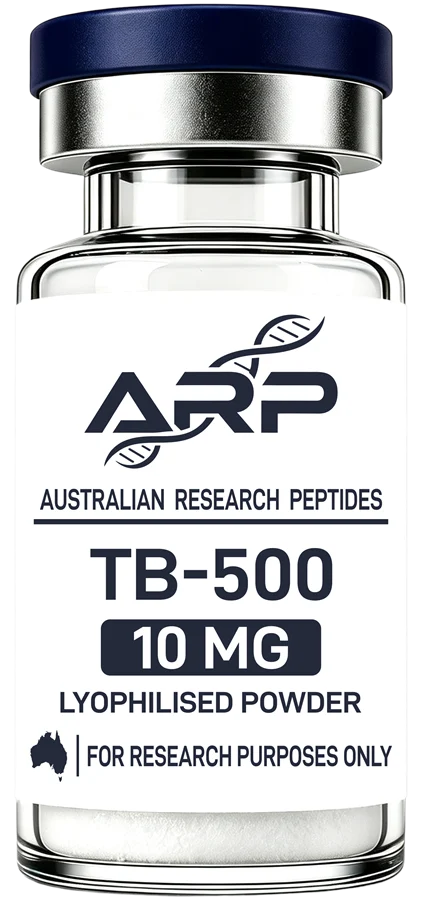
Buy TB-500 10 mg in Australia
Australian Research Peptides sells TB-500 10 mg to laboratories and researchers in Australia, where the tamper-sealed vial costs $119.99, but it is out of stock right now. The contents, independently lab-tested before release, are dried to a solid: Ac-Leu-Lys-Lys-Thr-Glu-Thr-Gln, a seven-amino-acid chain copied from thymosin beta-4 that binds free actin, matching positions 17 to 23 of the 43-residue parent protein. It is studied in cell-migration research as that protein's actin-binding piece and posted to every state and territory. Not for people or animals. In vitro research purposes only.
What we do have in stock
TB-500 is out of stock and we have not put a substitute in its place. These ship from our shelf in Australia today.
Browse all Cell Signalling Research
About TB-500
TB-500 is studied in actin-binding and cell-migration research, in cell-culture and preclinical models only. What the literature establishes is a property of the molecule: LKKTETQ is the actin-binding stretch of thymosin beta-4, and 2003 work in the FASEB Journal mapped the parent protein's assay activity to that seven-residue span rather than to the rest of the chain. Australian Research Peptides supplies the fragment for in vitro use only.
TB-500 — commonly written TB500 or TB 500 as well — is a heptapeptide, which means a chain of seven amino acids. The sequence is Leu-Lys-Lys-Thr-Glu-Thr-Gln, written LKKTETQ, with an acetyl cap on the N-terminal end. Those seven match positions 17 to 23 of thymosin beta-4. That distinction matters, because the two names get swapped in print and a study on the 43-amino-acid protein is not a study on this fragment.
Australian Research Peptides supplies TB-500 in one strength, as a freeze-dried powder sealed inside a tamper-evident glass vial. PubChem records the free acid form as C38H68N10O14, around 889 g/mol, under CAS 885340-08-9. Those values are not printed on this listing as a specification, because the salt and terminal form of the supplied material is not confirmed and both figures move with it. The certificate of analysis describes the batch in hand.
BAC water (bacteriostatic water) is also in our range.
The peptide calculator works out the mg/mL concentration of a reconstituted vial.
TB-500 specifications, storage and shipping
- Compound: TB-500
- Also known as: TB-500 (N-terminally acetylated thymosin beta-4 fragment 17-23)
- Class: Synthetic acetylated heptapeptide; actin-binding fragment of thymosin beta-4
- Appearance: White to off-white lyophilised powder
- Sizes & SKUs: 10 mg (40000)
- Presentation: sealed glass vial
- Form: Lyophilised Powder
- Grade: Research grade
- Testing: Independently lab-tested before release
- Identity confirmation: Mass spectrometry
- Classification: In vitro research purposes only — laboratory reference material
- Lyophilised — long term
- −20 °C to −80 °C — long-term storage
- Lyophilised — short term
- 2–8 °C — refrigerated, for a few months
- Reconstituted
- 2–8 °C — use within 8–12 weeks
Questions about TB-500
This question guide from Australian Research Peptides covers TB-500 in Australia: what the listing contains, live buying and delivery questions, research context, handling, testing and comparisons. Start with the quick answers, then open the topic group that matches your search.