
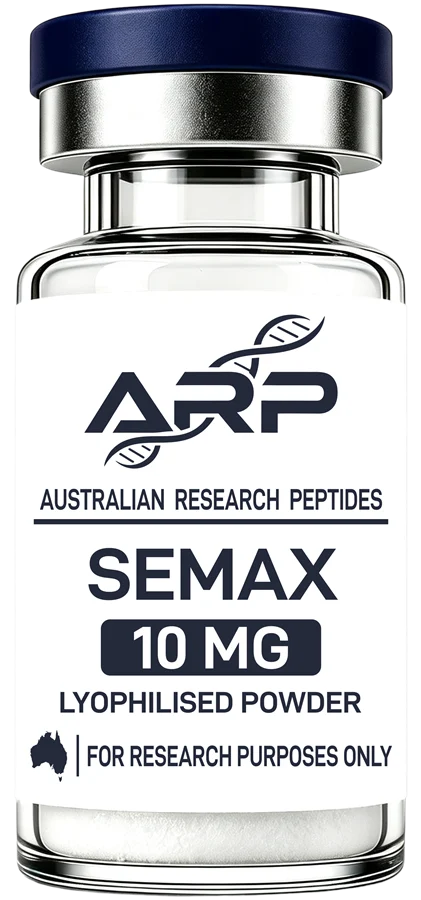
For laboratory research use only. Not for human or veterinary use.Lab research use only. Not for human or animal use.

Same-Day DispatchAustralian StockPremium Research GradeVerified CoAsPayID · Clears in Minutes
Same-day dispatch on business-day orders before 12pm Sydney time.Same-day dispatch before 12pm Sydney timeFree standard post $199+Free std post $199+

Buy Semax in Australia

Semax, in 10 mg and 30 mg strengths, is from $65.99 a vial in Australia at Australian Research Peptides, a supplier to laboratories and researchers, though it is currently out of stock. Semax is a seven-amino-acid chain, Met-Glu-His-Phe-Pro-Gly-Pro, built as a laboratory extension of an adrenocorticotropic hormone fragment: a synthetic proline-glycine-proline tail replaces the parent hormone's remaining amino acids. It is studied in neuroprotection and nootropic research, and is supplied dried to a solid under seal, independently lab-tested before it is released. For in vitro research purposes only.

Neuropeptide Research · Lyophilised Powder · Independently lab-tested · SKU 27464
Out of stock·
$65.99
Presentation
10 mg per vial
Grade
Research Grade
Form
Lyophilised Powder
Category
Neuropeptide Research
Currently out of stock — stocked lines dispatch same business day before 12pm Sydney time, Mon–Fri
Tracked shipping Australia-wide ·typically 1–2 business days to most areas by Express Post · free post over $199, free Express over $299
For in vitro research purposes only. Not for human consumption. Not for animal consumption. This product is not a drug, food, cosmetic, or dietary supplement. ARP gives no usage, medical or therapeutic guidance of its own.
Semax · 10 mg
$65.99

What we do have in stock

Semax is out of stock and we have not put a substitute in its place. These ship from our shelf in Australia today.

About Semax

Semax is studied in neuroprotection research, a field concerned with nerve-cell biology in culture and in animal models. The published literature on the compound is largely Russian-language and is built around which genes are active in brain tissue, most often those for nerve-growth proteins and for the Trk receptors they act on. Papers file the compound both as ACTH(4-7)PGP and as an analogue of ACTH(4-10). All of that work is preclinical, and none of it is a claim Australian Research Peptides makes for the vial.

Semax is a heptapeptide, which simply means a chain of seven amino acids. Written out it is Met-Glu-His-Phe-Pro-Gly-Pro, or MEHFPGP in single-letter code. The opening four are positions 4 to 7 of adrenocorticotropic hormone. The closing three, proline-glycine-proline, are synthetic, and the hormone does not carry them. Published papers file the compound both as ACTH(4-7)PGP and as an analogue of ACTH(4-10). Either way it is an analogue, so nothing proven about the hormone transfers to Semax.

Australian Research Peptides lists Semax under Neuropeptide Research, in a 10 mg and a 30 mg vial. Both hold the same chain and differ only in how much powder was weighed in. Its batches are independently lab-tested, by a laboratory the manufacturer commissions, before ARP sells them, and mass spectrometry confirms the mass matches a seven-amino-acid chain rather than the four-amino-acid fragment alone.

BAC water (bacteriostatic water) is also in our range.

The peptide calculator works out the mg/mL concentration of a reconstituted vial.

Semax specifications, storage and shipping

  • Compound: Semax
  • Also known as: Semax (Met-Glu-His-Phe-Pro-Gly-Pro; ACTH(4-7) with Pro-Gly-Pro)
  • Class: Synthetic heptapeptide; ACTH(4-7) analogue
  • Appearance: White to off-white lyophilised powder
  • Sizes & SKUs: 10 mg (27464), 30 mg (26462)
  • Presentation: sealed glass vial
  • Form: Lyophilised Powder
  • Grade: Research grade
  • Testing: Independently lab-tested before release
  • Identity confirmation: Mass spectrometry
  • Classification: In vitro research purposes only — laboratory reference material

Lyophilised — long term
−20 °C to −80 °C — long-term storage
Lyophilised — short term
2–8 °C — refrigerated, for a few months
Reconstituted
2–8 °C — use within 8–12 weeks
Protect from light and moisture. Handle in accordance with standard laboratory safety practice, including appropriate PPE. This information is provided for laboratory handling only and is not a usage instruction of any kind.

Semax is independently lab-tested before release. No laboratory report is published for this line yet. The COA library lists every product and strength, and says which reports are available.

This line is currently out of stock. Stocked lines ordered before 12pm Sydney time on a business day are dispatched the same day with tracked shipping. Standard delivery within Australia typically takes 2–5 business days. See Shipping & Delivery for details, and follow your parcel on the Track Order page.

For in vitro research purposes only. Not for human consumption. Not for animal consumption. Not a drug, food, cosmetic, or dietary supplement. No therapeutic or medical claims are made.

Questions about Semax

This question guide from Australian Research Peptides covers Semax in Australia: what the listing contains, live buying and delivery questions, research context, handling, testing and comparisons. Start with the quick answers, then open the topic group that matches your search.

Buying, price and availability

Semax, indexed as ACTH 4-7, is sold in Australia by Australian Research Peptides Pty Ltd, which posts every parcel from Sydney — no border crossing, no customs queue. Stock code SEMAX runs in two vial sizes, 10 mg and 30 mg, within the Neuropeptide Research range. The shelf is empty for now, and a returning batch picks the 12pm Sydney time weekday cut-off back up; Express delivery reaches all states and territories. Payment is by PayID or bank transfer.

Semax in solution is refrigerated at 2 to 8 degrees and given a life of eight weeks to twelve by Australian Research Peptides' published condition. Semax opens on a methionine — MEHFPGP places the most oxidation-prone residue first, at an unblocked N-terminus — so light and dissolved air deserve as much attention as the calendar. The 30 mg vial is likelier to outlast that window.

Semax spends 2–5 business days in the standard tracked post network, or 1–2 in the Express Post one for most addresses. A delivery address can be corrected up until the parcel is packed, so tell support as soon as you spot a typo and they will fix it before it goes out. Once a tracking number is issued the address is with the carrier.

Yes, for the same concentration: a 30 mg Semax vial takes three times the diluent of a 10 mg one, so the volume follows the strength rather than the product. Australian Research Peptides supplies Semax as a freeze-dried powder for reconstitution in the laboratory, not as a ready-made solution, and nothing else ships with the vial.

Semax has no listing of its own in any prohibited category. Whether the residual S0 heading reaches it turns on one point: Russia's health ministry registered Semax as a medicine in 1994, and S0 excludes anything a government regulator has approved somewhere. Whether an anti-doping panel accepts a Russian registration is untested, so Australian athletes should ask Sport Integrity Australia.

Identity, names and exact format

Semax is a synthetic peptide of seven amino acids — four of them a fragment of adrenocorticotropic hormone, the other three a laboratory-added tail. That fragment was chosen because it carries none of the parent hormone's hormonal activity. Semax was developed in Moscow and is studied in cognition and neuroprotection research, largely in Russian-language literature.

Research on Semax is preclinical and largely Russian-language, and it sits in two named areas: neuroprotection and cognition. The endpoints are molecular — transcription of neurotrophin genes and their receptors, and markers of intracellular signalling in brain tissue. Nothing in that literature goes beyond those model systems, and Australian Research Peptides makes no claim for the compound beyond its identity and its assay.

Semax is built from seven amino acids in one chain, which makes it a heptapeptide. In order they are Met-Glu-His-Phe-Pro-Gly-Pro, shortened to MEHFPGP (PubChem). Met-Glu-His-Phe is a stretch of adrenocorticotropic hormone, positions four through seven. The last three are a synthetic addition the hormone itself does not have. The count of seven belongs to Semax itself, so both vial sizes contain the identical chain.

The two Semax listings differ only in how much peptide the vial holds. The 30 mg carries three times the 10 mg. Both hold the same chain, MEHFPGP, and both share one class, appearance and packaging specification. Both figures state peptide mass, not liquid volume, so choosing the larger size buys more material rather than a different compound.

Research context and evidence

Published Semax research centres on three measured endpoints: information-processing speed, sustained attention under high cognitive load, and memory formation. That work is laboratory and animal research, not effects recorded in people. In rodent anxiety models, studies report fewer anxiety-like behaviours without measurable sedation. Because BDNF is raised, the compound is also examined in neuroprotection research: how brain cells in culture and in animal models respond to oxidative stress. Australian Research Peptides supplies Semax to laboratories and researchers for in vitro research only.

Semax is described in molecular terms rather than by outcome. It is an analogue of the ACTH(4-7) fragment, and the literature examines it against neurotrophin gene transcription — BDNF, nerve growth factor and their Trk receptors — in brain tissue (Stavchansky 2011). The compound is not a hormone: the synthetic Pro-Gly-Pro tail replaces the residues carrying the parent's corticotropic activity. Every measurement reported for it is preclinical.

Australian Research Peptides supplies Semax as one freeze-dried solid in a sealed vial. That solid is the chain MEHFPGP, at the milligram weight printed on the label. The powder runs white to off-white inside sealed, tamper-evident glass. There is no filler, no carrier, no second peptide and no liquid. Four of the seven amino acids reproduce part of adrenocorticotropic hormone, and the closing proline-glycine-proline is added in the lab.

Semax is short-lived in serum, and no clean stability figure has been printed for it. Chromatographic work on the peptide in serum describes aminopeptidase — an enzyme that trims amino acids off the front of a chain — removing the first two and leaving shorter fragments of the same chain. Methionine sits at the front of Semax and is the amino acid most exposed to that, which is also why the dry powder is kept sealed, cold and dark rather than held in solution.

Semax has an unusually long paper trail for a research peptide: it has been a registered product in Russia since 1994 and carries decades of Russian-language literature behind it. That record has not been reproduced in Western work, which is the main reason the compound remains unfamiliar elsewhere. Australian Research Peptides supplies it as a research chemical and makes no claim about what it does.

Semax has no set volume and Australian Research Peptides publishes none. It is listed in 10 mg and 30 mg vials, and the same volume of diluent gives a very different solution in each, so the two are not interchangeable at the bench. What the diluent changes is the solution, never the peptide mass sealed in the glass.

A Semax payment can come from an account in a different name to the order — a partner's account, a joint account — provided the order reference is in the description, because it is the reference rather than the name that does the matching. Without it, a mismatched name is exactly the case that cannot be resolved automatically.

A Semax restock alert from Australian Research Peptides is a notification, not a reservation. It reports that stock has landed; it holds no vial, and returning stock is sold first come, first served. Acting on the email promptly matters most where a strength returns in small quantities.

Store the sealed Semax vial frozen, dry and out of the light. GenScript flags cysteine, methionine and tryptophan as prone to oxidation, and Semax opens with a methionine, which is why light and air matter. Bachem keeps freeze-dried peptides below minus 15 degrees Celsius in a closed container, and GenScript's own figure is minus 20, away from bright light. Warm a frozen vial fully before you break the seal, so moisture does not condense inside. Peptide in solution is far less stable than the dry powder.

Handling, storage and measurements

Semax comes in two quantities and they look markedly different. Ten milligrams leaves a faint dusting easily read as an empty container; thirty milligrams is three times as much solid and forms a properly visible cake. Neither holds a bulking agent, so what sits inside the glass is peptide alone. Comparing the two strengths explains most confusion about the smaller one.

Most cloudy Semax reports come down to bubbles worked in during mixing, and they lift out within minutes of the vial being set down. The thirty-milligram strength dissolves more slowly than the ten, having three times as much material to take up, so patience beats extra agitation. Once warmed and rested a proper preparation is clear; lasting milkiness or floating specks are not normal.

Semax is dissolved in an aqueous diluent, because the vial contains dry peptide and nothing wet. Diluent is the standard term for whatever a dry compound dissolves into. Semax comes in two vial sizes, both equally dry, so each vial is dissolved on its own.

Semax reaches Australian labs through Australian Research Peptides, a Sydney company posting domestically, so nothing is imported to order or held at customs. The Neuropeptide Research listing covers 10mg and 30mg vials, and searches for ACTH 4-7, MEHFPGP or a mistyped name arrive at the same ARP record. Express Post reaches all states and territories, tracked standard alongside it, and the same-day rule for anything in by 12pm Sydney time applies again from the next batch. Independent lab testing precedes release, and the CoA library marks each strength as published or still to come. Payment is by PayID or bank transfer.

Semax is priced per vial by Australian Research Peptides, with a separate Australian-dollar figure for the 10 mg and the 30 mg. Neither figure is fixed in writing; both are read from the current catalogue at the moment they are quoted. Semax is listed as a research peptide, which is how Australian Research Peptides separates it from a consumable or a supply item.

Semax is listed by Australian Research Peptides in two vial sizes, 10 mg and 30 mg, both awaiting a returning batch before dispatch resumes. What each size costs is quoted live from the catalogue on this page rather than written into the text. Everything ARP sells is posted from inside Australia, and its CoA library lists each Semax strength as published or pending.

The two Semax sizes answer this differently. Two of the 30 mg vials pass the free Standard tracked post mark, while the 10 mg vial takes four. Express Post is waived a step higher and needs a third of the larger vial. Semax and Selank are commonly ordered together, and that combination usually clears the standard threshold on its own.

Semax is listed by Australian Research Peptides in two vial sizes, 10 mg and 30 mg, dispatched from Sydney. The business takes PayID and bank transfer, both paid from the buyer's own bank; wallets are not offered. Bank details reach the buyer with the order confirmation, and stock is reserved while the transfer clears.

Testing and batch documents

Semax and Selank are different molecules that share one feature. Both are seven-amino-acid chains ending in proline-glycine-proline, but their opening four amino acids come from unrelated parents. Semax opens with a fragment of adrenocorticotropic hormone. Selank opens with tuftsin. The research fields differ too: Semax is studied for neuroprotection, Selank for signalling between nerve cells and for inflammation-linked genes. Neither substitutes for the other.

Semax and Selank come from the same Russian research programme but derive from different parents — Semax from an ACTH fragment, Selank from tuftsin — and their published literatures sit in different research areas, Semax in neuroprotection and Selank in nerve-cell signalling and inflammation-linked gene expression. They are complementary rather than competing, which is why researchers frequently hold both.

Ordering, payment and Australian delivery

Reconstituting Semax means adding sterile liquid to the dry vial and letting the powder dissolve. Bring the glass up to room temperature first. Tilt it, and let the liquid enter against the side rather than falling onto the solid. Swirl gently or roll the vial. Do not shake it. Seven amino acids is a short chain, so Semax normally dissolves without heat or organic solvent.

Semax has never been approved in the United States. It is approved somewhere, however: Russia's health ministry registered it as a medicine in 1994. A registration granted in one country is not a worldwide licence, and no Western agency has assessed the Russian-language clinical record standing behind it. Freeze-dried research powder is not that registered product in any case.

Semax is sold as a registered medicine in Russia and has never been registered in Australia, so a personal import runs straight into the Personal Importation Scheme's conditions. Those limit quantity, require the goods be for the importer's own use, and do not waive the TGA's controls on unapproved goods. An Australian Research Peptides order is packed and posted inside Australia, so it is not an import and waits on no clearance — which is also why it arrives sooner than a consignment sent from abroad. That is a statement about the parcel, not about the substance or about what its holder is responsible for.

Semax is independently lab-tested before supply, with mass spectrometry reading the molecular mass and comparing it against what the sequence predicts. For Semax that check matters, because it separates a seven-amino-acid chain from the shorter ACTH(4-7) fragment it opens with. No matching certificate is currently published for this product at any strength.

Access and regulatory questions

Testing on Semax settles which of three similarly named molecules is in the vial. Plain Semax, N-Acetyl Semax and the amidated form have different molecular formulas, so each has a different mass. Mass spectrometry reads that mass. Semax is supplied to laboratories and researchers for in vitro research purposes only.

Semax is also known as ACTH(4-7)PGP (Sudarkina 2021), as MEHFPGP in single-letter code, and by its written sequence Met-Glu-His-Phe-Pro-Gly-Pro; some papers file it as an analogue of ACTH(4-10) (Eremin 2005). Replacing the last three amino acids with Pro-Gly-Pro is what strips out the hormone action that ACTH carries, so it is an analogue, a modified copy, rather than a piece of ACTH itself. N-Acetyl Semax and the amidated version are related molecules with their own database records, not alternative names. Whichever term you typed, the vial ships from Australian Research Peptides, warehoused locally and independently lab-tested, with the CoA library showing where a certificate is already published.

Se max, semak and seamax are all ways people type Semax, the seven-amino-acid chain Met-Glu-His-Phe-Pro-Gly-Pro, and every one of them means this compound rather than another. Semax nasal spray is searched too, and it is not a form Australian Research Peptides supplies — ARP's listing is freeze-dried powder in a sealed 10 mg or 30 mg vial, with no spray, drops or pre-mixed solution in the range.

Plain Semax is not the same as N-Acetyl Semax Amidate. Australian Research Peptides supplies plain Semax, unmodified at both ends of the chain, with a free amino group at one end and a free acid at the other. N-Acetyl Semax Amidate carries an acetyl group at one end and an amide at the other, changes intended to alter stability. It is a different molecule with a different molecular formula, held as a separate record in the public databases, and suppliers do not always make the distinction clear. ARP states which of the two it supplies in its published specifications.