
For laboratory research use only. Not for human or veterinary use.Lab research use only. Not for human or animal use.

Same-Day DispatchAustralian StockPremium Research GradePublished CoAsPayID · Clears in Seconds
Same-day dispatch on business-day orders before 12pm Sydney time.Same-day dispatch before 12pm Sydney timeFree standard post $199+Free std post $199+

Buy KPV Peptide 10 mg in Australia

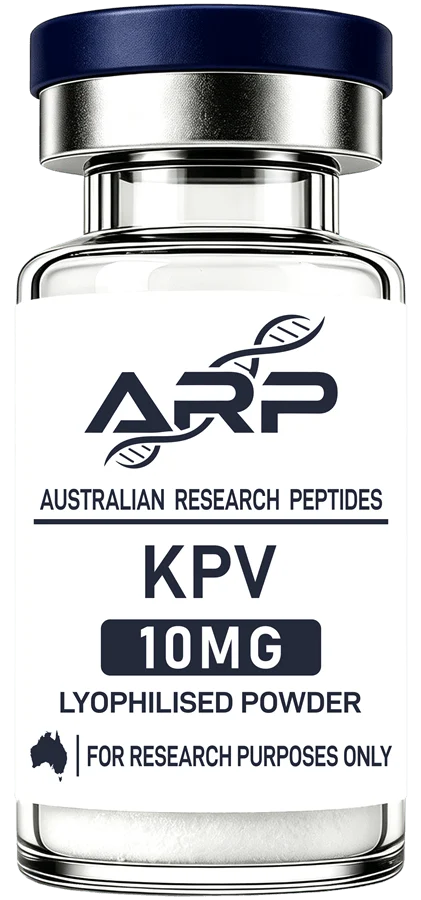
KPV peptide 10 mg sells for A$89.99 in Australia through Australian Research Peptides, which serves laboratories and researchers; KPV is out of stock for now. KPV is a dried, off-white tripeptide in a tamper-sealed vial: lysine, proline and valine, the last three amino acids of alpha-melanocyte-stimulating hormone (alpha-MSH). It is studied in inflammation research, where laboratories look at PepT1, the transporter that lets it into cells, and at NF-kappaB and MAP kinase, switches that turn inflammation on. It is independently lab-tested. In vitro research purposes only.

Cell Signalling Research · Lyophilised Powder · Independently lab-tested · SKU 50663
Out of stock·
$89.99

KPV 10 mg is sold out for now. Leave your email and ARP will send you one email the day it is back. Nothing else.

Presentation
10 mg per vial
Grade
Research Grade
Form
Lyophilised Powder
Category
Cell Signalling Research
This strength is not in stock — stocked lines dispatch same business day before 12pm Sydney time, Mon–Fri
Tracked shipping Australia-wide · typically 1–2 business days to most areas by Express Post · free post over $199, free Express over $299
For in vitro research purposes only. Not for human consumption. Not for animal consumption. This product is not a drug, food, cosmetic, or dietary supplement. No medical, therapeutic, or usage information is provided.
KPV 10 mg
$89.99
Notify Me

In stock in the same research category: BPC-157 10 mg

KPV is out of stock at Australian Research Peptides. BPC-157 is in the same research category and is in stock now.

View BPC-157 10 mg

About KPV

Nearly all published KPV research is in inflammation. The most studied area is the gut, using human intestinal epithelial (lining) cell lines, a human T-cell line and two mouse models. Other papers used rodent models and cultured macrophages, or looked at signalling in cultured human skin cells called keratinocytes. All of this is preclinical work in cells and animals.

KPV is short for Lys-Pro-Val, the three amino acids in the chain. They are the last three of the thirteen amino acids in alpha-melanocyte-stimulating hormone, which is why chemical databases list the tripeptide as alpha-MSH(11-13) and also as ACTH-(11-13). Adrenocorticotropic hormone (ACTH) comes from the same parent protein, pro-opiomelanocortin, and has the same three amino acids in that position.

Australian Research Peptides lists KPV in a single strength as a freeze-dried powder in a tamper-evident sealed glass vial. The powder is independently lab-tested before it is listed, including a check that confirms the molecule's identity. It is a laboratory reference compound and is not an approved medicine in Australia.

Australian Research Peptides lists KPV in Australia as a single 10 mg vial, and people search for it as KPV, KPV peptide, or by its database names alpha-MSH(11-13) and ACTH-(11-13). Stock is held locally and posted to every state and territory, so an order never waits on an overseas shipment or an import step. The peptide is independently lab-tested before listing, and the CoA library shows which strengths have a certificate published.

BAC water (bacteriostatic water) is also sold by Australian Research Peptides.

The peptide calculator works out the mg/mL concentration of a reconstituted vial.

KPV specifications, storage and shipping

  • Compound: KPV
  • Also known as: KPV (Lys-Pro-Val; alpha-MSH 11-13)
  • Class: Tripeptide; C-terminal fragment of alpha-melanocyte-stimulating hormone
  • Appearance: White to off-white lyophilised powder
  • Quantity: 10 mg
  • SKU: 50663
  • Sizes & SKUs: 10 mg (50663)
  • Presentation: sealed glass vial
  • Form: Lyophilised Powder
  • Grade: Research grade
  • Testing: Independently lab-tested by Janoshik
  • Identity confirmation: Mass spectrometry
  • Classification: In vitro research purposes only — laboratory reference material

Lyophilised — long term
−20 °C to −80 °C — long-term storage
Lyophilised — short term
2–8 °C — refrigerated, for a few months
Reconstituted
2–8 °C — use within 8–12 weeks
Protect from light and moisture. Handle in accordance with standard laboratory safety practice, including appropriate PPE. This information is provided for laboratory handling only and is not a usage instruction of any kind.

KPV is independently lab-tested by Janoshik. No laboratory report is published for this strength yet. The COA library lists every product and strength, and says which reports are available.

This strength is not in stock today. Stocked lines ordered before 12pm Sydney time on a business day are dispatched the same day with tracked shipping. Standard delivery within Australia typically takes 2–5 business days. See Shipping & Delivery for details, and follow your parcel on the Track Order page.

For in vitro research purposes only. Not for human consumption. Not for animal consumption. Not a drug, food, cosmetic, or dietary supplement. No therapeutic or medical claims are made.

Questions about KPV

This question guide from Australian Research Peptides covers KPV in Australia: what the listing contains, live buying and delivery questions, research context, handling, testing and comparisons. Start with the quick answers, then open the topic group that matches your search.

Quick answers

KPV is sold in Australia to laboratories and researchers by Australian Research Peptides, as one 10 mg vial for A$89.99, out of stock at the moment. The tripeptide Lys-Pro-Val comes in one strength, freeze-dried under a tamper-evident seal, and is posted within Australia, so a vial never goes through customs on its way to the lab. Payment is by PayID or bank transfer, with no wallets, instalment plans or crypto. Once a vial is available, weekday orders placed before 12pm Sydney time are sent out the same day, by Express Post if the work is urgent.

A KPV vial holds one substance only, dried lysine-proline-valine, with no second peptide, no blend partner and no liquid, in a glass vial with a tamper-evident seal. The weight of powder, in milligrams, is printed on the label. KPV is a single-compound listing, not a multi-peptide blend.

Yes, KPV is independently lab-tested, and mass spectrometry confirms the molecule is the three-amino-acid peptide rather than the full-length alpha-MSH hormone. The two differ by ten amino acids, so the difference in mass is large and easy to read. No matching certificate is currently published for this product and strength.

A KPV order needs three vials to qualify for free Standard tracked post in Australia, and four vials for free Express Post. KPV is also often ordered alongside BPC-157 for gut research, which reaches the free-post threshold faster than ordering KPV alone. Free shipping is judged on the goods subtotal, before any discount code.

Yes, KPV, BPC-157 and TB-500 are sold together with GHK-Cu in the 80 mg KLOW blend from Australian Research Peptides. Buying them as separate vials lets you vary each one independently, while KLOW fixes the ratio and dissolves as a single mix. No published study has tested either option.

KPV works by entering cells through PepT1, a transporter that carries peptides of two or three amino acids, and inside the cell it is studied in relation to NF-kappaB and MAP kinase signalling. PepT1 is found in the small intestine and is increased in colon tissue in the inflammation models where gut researchers first studied it. KPV appears not to need the melanocortin receptors that its parent hormone binds.

Buying, price and availability

You'll know when KPV is back in stock through a KPV stock alert, which sends one message and is then finished, so there is nothing to unsubscribe from afterwards. The record only exists until that message is sent. To be told again next time, sign up again, which matters because KPV can go out of stock more than once.

Australian Research Peptides, trading as ARP, is the Australian supplier of KPV, sending it from a local address to buyers in every state and territory. Delivery is by tracked post, with Express Post available when a result is waiting on it. KPV, the three-amino-acid tail of alpha-MSH, is listed in one strength.

KPV costs A$89.99 for the 10 mg vial (out of stock) at Australian Research Peptides, and that one strength covers everything sold under the name in Australia. KPV is listed as a research peptide, which is how Australian Research Peptides separates it from consumables and supply items. KPV can be posted again once a new batch is in.

KPV can be bought online from Australian Research Peptides, which lists the tripeptide in one strength and keeps its availability up to date. Payment is by PayID or bank transfer into the company's account, with no wallet or crypto options. Delivery is by post within Australia, from Sydney, so a KPV vial never goes through customs.

No, Chemist Warehouse does not sell KPV and no other Australian pharmacy stocks it; KPV is supplied by Australian Research Peptides. The tripeptide has no Australian registration and no approved formulation, so there is nothing for a pharmacy to dispense or order in. Australian Research Peptides lists it as a 10 mg research vial for laboratory use.

KPV is out of stock at Australian Research Peptides in its single 10 mg strength, and the stock alert on this page will tell you when it returns. With one strength there is one price per vial in Australian dollars, shown above rather than repeated here. Every parcel is posted within Australia, and Australian Research Peptides' CoA library shows the certificate position for each listing.

No, KPV is not sold in microgram sizes, as Australian Research Peptides lists it in one size only, a 10 mg vial. The units are a thousand apart: 10 mg of dried Lys-Pro-Val is 10,000 micrograms. The label and the listing show only the total amount of KPV sealed in the vial.

Identity, names and exact format

KPV stands for Lys-Pro-Val, which are the standard three-letter short forms that chemists use for the three amino acids lysine, proline and valine. The letters follow the order of the chain, so lysine is at one end and valine at the other. Written out in full, the same molecule is L-lysyl-L-prolyl-L-valine.

KPV is made of three amino acids, lysine, proline and valine joined in that order, which is exactly what the word tripeptide means. Alpha-MSH, the parent peptide, has thirteen, and KPV is its last three. The number on the vial label is the weight of powder in milligrams, not a count of amino acids.

KPV is also known as Lys-Pro-Val, lysyl-prolyl-valine or, written out in full, L-lysyl-L-prolyl-L-valine, and databases also list it as alpha-MSH(11-13) and ACTH-(11-13). Those database names come from the fact that the same three amino acids end two hormones made from pro-opiomelanocortin. Its CAS number is 67727-97-3. None of these names refers to a different compound.

KPV is a short peptide of just three amino acids that occurs naturally in the body as a fragment of a larger hormone involved in immune responses. Published KPV research is mostly in lab models of gut and skin inflammation, where the tripeptide is studied in relation to specific pathways (NF-kappaB and MAP kinase signalling, and the PepT1 transporter) rather than broad immune suppression. Australian Research Peptides does not repeat outcomes from that work: KPV is supplied to laboratories and researchers for in vitro research only.

Research context and evidence

Yes, most published KPV research is about the gut, carried out in cultured human intestinal cell lines, a human T-cell line and two chemically induced mouse models of colon inflammation. That work looks at KPV in relation to NF-kappaB and MAP kinase signalling and to PepT1, the transporter that carries the tripeptide into intestinal cells. None of it is a study in people, and Australian Research Peptides sells KPV to laboratories and researchers for in vitro work only.

Published KPV research is preclinical, meaning it was done in cells and animals, and nearly all of it is in inflammation research. Dalmasso 2008 studied KPV in human intestinal and T-cell lines in relation to NF-kappaB and MAP kinase signalling, and the same team extended the work into two mouse models. Elliott 2004 reported that in cultured keratinocytes, the main cells of the skin surface, KPV raised calcium inside the cells but not cyclic AMP. The published record stops there.

No, the clearance of KPV has not been characterised, because there is no published pharmacokinetic profile of any kind: no half-life, no clearance figure, nothing. Its evidence comes from cell and rodent work, and in cultured cells there is no circulation or elimination to measure. Short peptides are widely expected to break down quickly, but an expectation about a class is not a measurement of this tripeptide, and any duration quoted for it came from a seller, not a laboratory.

KPV has been studied mostly in mouse gut models, alongside cultured human intestinal epithelial (lining) cells and a human T-cell line, which together are the best-covered part of the KPV research. Reported measures include tissue histology, which means examining tissue under a microscope, and myeloperoxidase activity in colon tissue. Every one of these is a laboratory or animal system, and nothing in them establishes anything about a person.

Handling, storage and measurements

Yes, it is normal for a KPV vial to look almost empty, because ten milligrams of this three-amino-acid peptide dries into a thin dust that is genuinely hard to see through glass. At that scale, judging the amount by eye doesn't work. Tilt the vial and look for loose particles moving instead. Very small peptides also tend to spread up the sides rather than settling in one neat layer.

KPV should be stored as a sealed, dry powder below -15 °C, letting the vial reach room temperature before opening because the powder draws in moisture. That applies even though KPV contains none of the five amino acids that Bachem's guide singles out as unstable in solution: asparagine, glutamine, cysteine, methionine and tryptophan. KPV has only lysine, proline and valine.

Reconstituting KPV means dissolving the dried tripeptide in a sterile laboratory diluent, running it down the side of the vial rather than straight onto the powder, then swirling gently instead of shaking. Shaking whips air in and causes foam. Wait until the liquid runs clear. For storage, the solution can be split into portions (aliquots) and frozen.

Reconstituted KPV keeps for eight to twelve weeks in the fridge at 2–8 °C, the life Australian Research Peptides publishes, though a preserved diluent can reach the end of its own in-use period first. KPV's lysine, proline and valine include none of the five amino acids Bachem names as shortening a peptide's life in water, so the peptide's chemistry is not the limit.

There is no single correct volume of diluent for a 10 mg KPV vial, and Australian Research Peptides doesn't publish one, because the volume only changes the concentration. The 10 mg of peptide in the glass stays the same. KPV is only three amino acids and dissolves readily, so it doesn't need coaxing into solution.

Early cloudiness in KPV after mixing is nearly always air from the mixing, seen as fine bubbles near the surface, because KPV takes up water easily. The bubbles clear on their own. A vial taken straight from the freezer can look the same until it warms up. If a KPV preparation is still not clear after ten minutes standing, undissolved material or clumping (aggregation) is the likely explanation.

KPV ships as a dry tripeptide and is dissolved in a diluent, usually a water-based (aqueous) one, before laboratory bench work. The vial holds Lys-Pro-Val on its own, with no second powder and no liquid. A diluent is simply whatever liquid a dried compound is dissolved in.

Yes, a 10 mg KPV vial is normally dissolved in one step, because KPV is only three amino acids and goes into solution easily, and the volume added sets the concentration. The vial holds only the peptide, with no diluent or measuring equipment packed with it.

Testing and batch documents

Analytical testing on KPV establishes the length of the chain much more reliably than the order of its three amino acids. Mass spectrometry clearly separates the tripeptide from alpha-MSH, because their masses are nowhere near each other. It cannot tell lysine-proline-valine apart from the same three amino acids in a different order. KPV is supplied to laboratories and researchers for in vitro research purposes only.

Ordering, payment and Australian delivery

You can pay for KPV by PayID or bank transfer, and if a payment is going to be late, contact support before the payment window closes rather than after. The reservation lapses automatically at the deadline and the stock is released, and because KPV is often unavailable, there is no guarantee it can be reserved again.

KPV takes 2–5 business days to arrive in Australia by standard tracked post and 1–2 business days by Express Post for much of the country. If a parcel hasn't arrived or tracking has stalled, report it within seven days of the expected delivery date, which gives support the best chance of sorting it out with the carrier. Keep the tracking number emailed when the parcel is lodged, because any investigation starts from it.

Access and regulatory questions

KPV is not an approved medicine in Australia, as it is not on the Australian Register of Therapeutic Goods, so the TGA has not assessed it for safety, quality or effectiveness. Australian Research Peptides supplies KPV as a laboratory reference compound and makes no medical claim about it. The TGA publishes guidance for anyone importing or supplying unapproved peptide products.

No, KPV is not approved by the US Food and Drug Administration (FDA), and no country anywhere registers a KPV medicine. Melanocortin peptides aren't all unapproved as a class, since afamelanotide reached the market, but this three-amino-acid fragment of alpha-melanocyte-stimulating hormone has never been submitted anywhere. Its published work is in cell lines and rodent models, which is where evidence starts, not where a regulator makes a decision.

KPV has no named entry on the WADA Prohibited List of substances banned in sport, but category S0 covers any substance with no current approval as a medicine anywhere, and no regulator has approved KPV. So not being named doesn't mean KPV is allowed. Sport Integrity Australia is the Australian authority on that list.

Importing KPV into Australia means bringing in a product the TGA has never assessed for safety, quality or effectiveness, because KPV is not on the Australian Register of Therapeutic Goods. So an importer isn't bringing in a rejected product but an unexamined one, and the rules on unapproved goods cover it either way. The TGA publishes guidance for anyone importing peptides. An order from Australian Research Peptides is domestic and involves no import.