
For laboratory research use only. Not for human or veterinary use.Lab research use only. Not for human or animal use.

Same-Day DispatchAustralian StockPremium Research GradePublished CoAsPayID · Clears in Seconds
Same-day dispatch on business-day orders before 12pm Sydney time.Same-day dispatch before 12pm Sydney timeFree standard post $199+Free std post $199+

Buy Semaglutide 10 mg in Australia

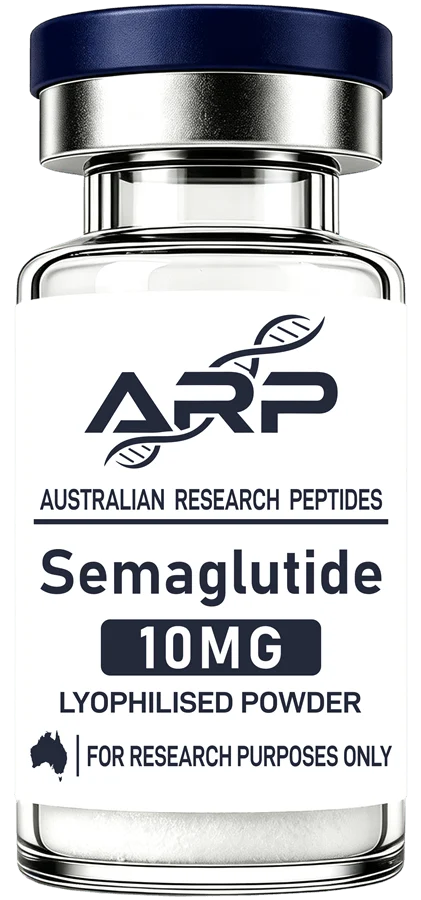
Semaglutide 10 mg, a GLP-1 peptide, costs A$119.99 a vial in Australia, supplied by Australian Research Peptides to laboratories and researchers, and it is in stock, with business-day orders paid before 12pm Sydney time posted the same day. Its 10 mg certificate shows 99.262% purity. Studied in metabolic research, semaglutide is a lab-made copy of GLP-1, a hormone released by the gut, with two of its 31 amino acids swapped and a fatty chain attached so it lasts longer. In vitro research purposes only.

Metabolic Research · Lyophilised Powder · HPLC-tested · SKU 78441
In stock·99.262%
$119.99
1
Presentation
10 mg per vial
Grade
High-Purity Research Grade
Form
Lyophilised Powder
Category
Metabolic Research
Same-day dispatch on business-day orders completed before 12pm Sydney time, Mon–Fri
Tracked shipping Australia-wide · typically 1–2 business days to most areas by Express Post · free post over $199, free Express over $299
Semaglutide 10 mg: 99.262% purity by HPLC, in a report by Janoshik, an independent laboratory commissioned by the manufacturer, analysed 27 May 2026. View the certificate, or every report in the COA library.
For in vitro research purposes only. Not for human consumption. Not for animal consumption. This product is not a drug, food, cosmetic, or dietary supplement. No medical, therapeutic, or usage information is provided.
Semaglutide 10 mg
$119.99

About Semaglutide

Semaglutide is studied in metabolic research, in cell culture and in animal models. It is described as acting at a single receptor, the GLP-1 receptor, where a receptor is the docking point on a cell that a hormone fits into. That single target is the quickest way to tell it apart from retatrutide, which Australian Research Peptides lists as a three-receptor peptide.

Semaglutide is a modified copy of GLP-1 (glucagon-like peptide-1), a hormone released by cells in the gut. Two of its amino acids are swapped compared with the natural hormone, and a fatty chain is attached to it. Published work says that chain is there to grip albumin, the most common protein in blood, and to hold off the enzymes that break peptides down.

Lau 2015, the paper that first described semaglutide, measured how tightly it binds the GLP-1 receptor in a laboratory test at 0.38 nM, about three times weaker than liraglutide, an earlier GLP-1 copy. The fatty chain is what sets it apart from the natural hormone. Australian Research Peptides supplies semaglutide as a reference material for in vitro research, meaning work in glassware and cell culture.

Australian Research Peptides lists semaglutide in Australia as a single 10 mg vial of freeze-dried powder, supplied strictly as a reference material for in vitro research and not as a medicine. People search for it as semaglutide, sema and semaglutide peptide. Vials are held and posted within Australia rather than imported to order. The peptide is tested by HPLC, which separates a sample to measure its purity, and by mass spectrometry, which weighs the molecule to confirm its identity, with the measured figures published on its certificate in the COA library.

BAC water (bacteriostatic water) is also sold by Australian Research Peptides.

Ordering more than 10 vials? Australian Research Peptides takes wholesale peptide orders from laboratories and researchers through its bulk enquiry form.

The peptide calculator works out the mg/mL concentration of a reconstituted vial.

Content reviewed

Further reading: Where Is the Best Place to Buy Peptides in Australia?

Semaglutide specifications, storage and shipping

  • Compound: Semaglutide
  • Also known as: Semaglutide
  • Class: Acylated GLP-1 receptor agonist peptide
  • Appearance: White to off-white lyophilised (freeze-dried) powder
  • Quantity: 10 mg
  • SKU: 78441
  • Sizes & SKUs: 10 mg (78441)
  • Presentation: sealed glass vial
  • Form: Lyophilised Powder
  • Grade: High-purity research grade
  • Purity verification: HPLC-assayed to a minimum of 99% purity — the measured result is stated on the published Certificate of Analysis
  • Identity confirmation: Mass spectrometry
  • Certificates: issued by Janoshik, an independent laboratory, and published in the COA library
  • Classification: In vitro research purposes only — laboratory reference material

Lyophilised — long term
−20 °C to −80 °C — long-term storage
Lyophilised — short term
2–8 °C — refrigerated, for a few months
Reconstituted
2–8 °C — use within 8–12 weeks
Protect from light and moisture. Handle in accordance with standard laboratory safety practice, including appropriate PPE. This information is provided for laboratory handling only and is not a usage instruction of any kind.

Semaglutide is HPLC-tested for purity and confirmed by mass spectrometry for identity. The full laboratory report is published in the COA library. Semaglutide is tested by Janoshik, an independent laboratory, commissioned by the manufacturer rather than by Australian Research Peptides.
  • Semaglutide 10 mg: assayed purity 99.262% · measured content 11.32 mg · analysed 27 May 2026

Business-day orders before 12pm Sydney time are dispatched the same day with tracked shipping. Standard delivery within Australia typically takes 2–5 business days. See Shipping & Delivery for details, and follow your parcel on the Track Order page.

For in vitro research purposes only. Not for human consumption. Not for animal consumption. Not a drug, food, cosmetic, or dietary supplement. No therapeutic or medical claims are made.

Questions about Semaglutide

This question guide from Australian Research Peptides covers Semaglutide in Australia: what the listing contains, live buying and delivery questions, research context, handling, testing and comparisons. Start with the quick answers, then open the topic group that matches your search.

Quick answers

Semaglutide is available in Australia from Australian Research Peptides, which sells it to laboratories and researchers as a 10 mg vial at A$119.99, in stock and dispatched from Sydney, with 99.262% HPLC purity on its Janoshik certificate (May 2026). It sits in the Metabolic Research range as freeze-dried powder, posted from within Australia so nothing crosses a border, and can also be found by searching sema or semag. Business-day orders paid before the same-day cut-off go out that afternoon by Express Post or tracked post, to every state and territory. Orders can be paid by PayID or bank transfer.

Semaglutide is a laboratory-made peptide, a short chain of 31 amino acids, modelled on GLP-1, a hormone the gut releases, with two amino acids swapped and a fatty chain attached to make it last longer. Chemistry databases list it as ChEBI:167574 and DrugBank DB13928. Australian Research Peptides sells it as freeze-dried powder for laboratory research.

Yes, Semaglutide 10 mg was analysed on 27 May 2026 by Janoshik, an independent laboratory commissioned by the manufacturer, which recorded 99.262% purity by HPLC. HPLC purity is the share of the sample in the main peak. Identity is the harder part for semaglutide, because the attached fatty chain has to show up in the measured weight. A matching certificate is currently published for this product and strength. Open the 10 mg certificate.

Two semaglutide vials qualify for free standard tracked post in Australia, but only just, clearing the threshold by the smallest margin of any product Australian Research Peptides stocks, so it is worth checking the order total. One vial does not qualify. Free Express Post starts at a higher amount that two vials do not reach. The check uses the goods total before any discount code, so a code cannot push the order back under.

Semaglutide is sold by Australian Research Peptides in one strength only, a 10 mg vial, while retatrutide and tirzepatide in the same Metabolic Research range each come in three sizes. Having one size means there is no price-per-milligram comparison to work out before ordering. If another strength were added, it would appear as a second option on the same listing.

In laboratory tests, semaglutide binds one receptor, the GLP-1 receptor, and switches it on, a receptor being the docking point on a cell that a hormone fits into. GLP-1 is the gut hormone semaglutide copies, and it belongs to the incretins, gut hormones released after food. Lau 2015, the Journal of Medicinal Chemistry paper that first described semaglutide, measured its grip on that receptor at 0.38 nM, three times weaker than liraglutide, an earlier GLP-1 copy. That figure comes from a laboratory binding test, not a result in anybody.

Buying, price and availability

Semaglutide is supplied in Australia by Australian Research Peptides Pty Ltd, an Australian company based in Sydney that posts stock it already holds rather than shipping vials in from overseas. It is tested by Janoshik, an independent laboratory, using HPLC, a test that separates a sample and reports its purity, and the CoA library shows which strengths have a published certificate. Orders are paid by PayID or bank transfer, with no wallets, instalment plans or crypto.

Semaglutide costs A$119.99 for the 10 mg vial (in stock) at Australian Research Peptides, one fixed price per vial with no per-milligram rate, because there is only one strength. That price is final, not provisional. Paid weekday orders received before 12pm Sydney time ship the same day. Postage is extra and depends on the delivery option chosen for the order.

Semaglutide can be ordered online from Australian Research Peptides, which sells it in Australia as one 10 mg vial of freeze-dried powder and takes orders online only. Payment is by PayID or direct bank transfer, and digital wallets, buy-now-pay-later and crypto are not accepted. Stock is held in Australia rather than imported to order, so the parcel travels domestically and is sent once a vial is on hand and the payment has been matched to the order.

Identity, names and exact format

Yes, semiglutide is a common misspelling of semaglutide, and both spellings mean the same GLP-1-based research peptide, because the extra 'i' comes from how the word sounds, not from a different compound. The plural, semiglutides, is typed just as often. Australian Research Peptides lists the correct spelling and supplies the freeze-dried vial to laboratories and researchers in Australia, so the product, the batch certificate and the listing are the same whichever way it is typed.

An acylated analogue is a copy of a peptide with a fatty chain added to it: 'analogue' means the copy, and 'acylated' is the chemists' word for attaching that chain. For semaglutide, the copied peptide is GLP-1, a gut hormone, and the chain is a fatty diacid (a fatty acid with an acid group at each end) attached to the lysine at position 26. The published reason for adding it is to grip albumin, the most common protein in blood, and resist the enzymes that break peptides down. That describes how the molecule was built to last, not an effect.

Semaglutide has 31 amino acids, the building blocks of a peptide chain, and differs from the human GLP-1 hormone it copies at only two of them. Position 8 has Aib, an amino acid not found in human proteins, and position 34 has arginine. The fatty chain attached at position 26 is not an amino acid, so it does not add to the count. Australian Research Peptides does not publish a full letter-by-letter sequence for semaglutide.

Semaglutide is known by its own generic name almost everywhere, with no separate compound name and no development code in the records Australian Research Peptides checked. Chemistry databases list the same molecule as ChEBI:167574 and DrugBank DB13928. People also search sema and semag, and the site search finds semaglutide under both. GLP-1 is the hormone semaglutide copies, not another name for it. Australian Research Peptides holds the peptide locally and tests it by HPLC, and its CoA library names the strengths covered by a published certificate.

Research context and evidence

Semaglutide is studied in metabolic research, and Gabery's 2020 study in JCI Insight is a frequently cited example, mapping in rodents where the GLP-1 receptor sits in the brain and which areas the molecule reaches. Australian Research Peptides supplies the vial as freeze-dried powder for laboratory work and draws no conclusions of its own from that research.

Handling, storage and measurements

Yes, it is normal for a semaglutide vial to look empty, because ten milligrams of freeze-dried powder spreads over the base of the vial as little more than a pale smear. Freeze-drying removes the water under vacuum and leaves a fragile, airy cake that often collapses into a ring or slides to one side in the post. At this amount, a vial that looks almost empty is normal, and an unbroken seal is the check that matters.

Semaglutide should be stored as freeze-dried powder at -20 °C, sealed and away from light and moisture, as published peptide handling guidance advises. Its fatty chain was built to survive in blood, not on a warm shelf. Before opening, let the cold vial warm to room temperature inside a closed, dry container so moisture does not condense on the powder. Any solution made from it is best frozen, and thawed as few times as possible.

Semaglutide is reconstituted, meaning dissolved back into a liquid, by adding a suitable diluent to the freeze-dried powder in its vial before any laboratory work. Run the liquid down the inside of the glass rather than straight onto the powder, then rock the vial gently, without shaking, until nothing solid is left. The amount of liquid you add sets how strong the finished solution is.

Reconstituted semaglutide, meaning the powder once dissolved, has no published stability study behind it, so Australian Research Peptides' handling guide applies: a fridge at 2–8 °C, with twelve weeks the outer limit and eight the comfortable one. The amino acid swapped in at position 8 was designed to resist an enzyme in blood, which is a different problem from sitting in a vial on a cold shelf. Thawed material should not be refrozen.

Semaglutide that looks cloudy straight after mixing is usually just full of tiny air bubbles from shaking the vial too hard, since it dissolves easily, and left to stand it clears from the top down. Haze that does not clear is a different matter, and suggests powder that never dissolved or peptide that has clumped together. A finished solution should be clear and colourless with nothing floating in it.

Semaglutide is dissolved in a water-based diluent for laboratory work, because it arrives as a dry, white to off-white freeze-dried powder. No liquid comes with the vial. The laboratory chooses the diluent to suit its own method, and the volume it adds sets the concentration of the finished solution.

Ordering, payment and Australian delivery

Semaglutide takes 1–2 business days to arrive by Express Post for much of Australia and 2–5 business days by standard tracked post, counted from when payment is matched, not when the order is placed. A bank transfer still in transit overnight has not started that clock, while PayID usually clears in minutes. Dispatch is when the parcel leaves, and delivery is when the carrier arrives.

PayID and bank transfer are the two ways to pay for a semaglutide order, both sent from your own banking app, so no bank login or card details are ever entered on Australian Research Peptides' website. PayID payments and bank transfers are matched by hand against the reference shown on the order.

A semaglutide vial comes with nothing else, holding only dry powder, with no diluent, no measuring equipment and no second compound inside the sealed glass. The liquid a laboratory dissolves it in, and how it measures the solution, depend on its own method and the work being done.

Access and regulatory questions

Semaglutide is sold in Australia by Australian Research Peptides as a laboratory research material, not as a medicine, and only for in vitro research, meaning work in glassware and cell culture, not for human or veterinary use. Because it ships from within Australia, the buyer imports nothing and no customs declaration is involved. Anyone ordering it is responsible for following the rules that apply to their own laboratory.

Semaglutide is approved in the United States as an ingredient of registered prescription medicines, but not in the form a research supplier sells, which is unregistered freeze-dried powder. The Food and Drug Administration first approved a finished prescription product containing semaglutide in 2017, with more in 2019 and 2021, each with a label, a set strength and a manufacturer standing behind it. Laboratory powder has none of those things.

Semaglutide is not banned in sport, as the World Anti-Doping Agency (WADA) prohibited list does not name it in any category, although it is on WADA's Monitoring Program, which collects usage data without penalising anyone. Because it is an approved medicine in many countries, it also falls outside the catch-all ban on unapproved experimental substances. Sport Integrity Australia holds the current position for Australian athletes.

Semaglutide shipped from an overseas seller can be stopped at the border, and a parcel stopped there is usually lost for good, money and material both. Semaglutide from Australian Research Peptides does not face that risk, because it is posted from within Australia rather than imported to order, so it travels domestically to the buyer. The Australian Border Force publishes the kinds of goods it acts against.

No, semaglutide from Australian Research Peptides is not a registered medicine and is not sold as one, because it is supplied only as a reference material for in vitro laboratory research. It is not offered as a substitute for any registered product, and no such product is named for comparison. The vial holds freeze-dried powder for laboratory work.

Chemist Warehouse does dispense the registered semaglutide medicines on prescription, so in that sense the answer is yes, but what Australian Research Peptides sells is a different product. It supplies semaglutide as a research compound, freeze-dried in a vial for in vitro laboratory work. The molecule is the same, but the product, the way it is supplied and what it may be used for are not.

More questions

Semaglutide 10 mg from Australian Research Peptides is 99.262% pure by HPLC, the figure on its published certificate of analysis, dated 27 May 2026. That report is by Janoshik, an independent laboratory commissioned by the manufacturer rather than by Australian Research Peptides, and the figure applies to the batch it tested. The full certificate is in the COA library.