
Same-Day DispatchAustralian StockDiscreet DeliveryPremium Research GradeVerified CoAs
Same-day dispatch on business-day orders before 12pm AEST.Same-day dispatch before 12pm AESTFree post $199+

Buy Selank in Australia

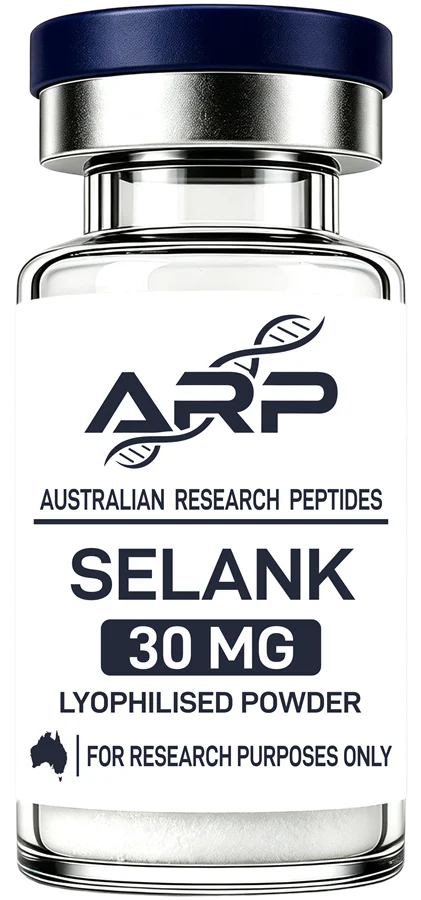
Selank is supplied in Australia by Australian Research Peptides in one 30 mg size, freeze-dried and tamper-sealed, and it calms by tuning the GABA system, the brain's own braking signal. Russian clinical work has compared Selank against benzodiazepines, and in animals it shifted BDNF in the hippocampus and quietened inflammation-linked genes. The molecule is tuftsin, a fragment cut from an antibody, extended with a Pro-Gly-Pro tail that slows its breakdown. For in vitro research purposes only.

Nootropic Peptides · Lyophilised Powder · Batch-tested · SKU ARP-SELANK-30
Out of stock·
$149.99

2+ vials: 5% off — applied automatically in the cart

Presentation
30 mg per vial
Grade
High-Purity Research Grade
Form
Lyophilised Powder
Category
Nootropic Peptides
Currently out of stock — stocked lines dispatch same business day before 12pm AEST, Mon–Fri
Tracked shipping Australia-wide ·typically 1–2 business days to most areas by Express Post · free post over $199, free Express over $299
For in vitro research purposes only. Not for human consumption. Not for animal consumption. This product is not a drug, food, cosmetic, or dietary supplement. Any amounts shown are reported from published studies, with the species or trial population named. ARP gives no dosing, medical or therapeutic guidance of its own.
Selank · 30 mg
$149.99

Frequently Bought Together

About Selank

Most Selank research is animal and cell work on nerve-cell signalling. In rats, Selank given into the nose changed the activity of genes handling GABA transmission in the frontal cortex. In mice, it shifted the activity of inflammation-related genes in the spleen. It also altered BDNF expression in rat hippocampus. Every study named here is listed in the sources below.

Selank is a heptapeptide, meaning one chain of seven amino acids: Thr-Lys-Pro-Arg-Pro-Gly-Pro. The first four are tuftsin, a short natural peptide cut from the heavy chain of human immunoglobulin G. The last three, Pro-Gly-Pro, were added in the laboratory to slow the molecule's breakdown and lengthen how long it lasts. That makes Selank an analogue of tuftsin, not tuftsin itself, and nothing established about one carries automatically to the other.

Australian Research Peptides stocks Selank in one vial size, 30 mg. It is a freeze-dried solid, white through to off-white, sealed in glass under a tamper-evident closure. Whether that solid is the free peptide or its diacetate salt has not been confirmed by the supplier, which is why the specification table carries no molecular mass. Material is sold for in vitro research purposes only.

Content reviewed

Further reading: Semax vs Selank: What Is the Difference?

Selank specifications, storage and shipping

  • Compound: Selank
  • Also known as: Selank (Thr-Lys-Pro-Arg-Pro-Gly-Pro; TP-7)
  • Class: Synthetic heptapeptide; tuftsin analogue
  • Appearance: White to off-white lyophilised powder
  • Sizes & SKUs: 30 mg (ARP-SELANK-30)
  • Presentation: sealed glass vial
  • Form: Lyophilised Powder
  • Grade: High-purity research grade
  • Purity verification: HPLC-assayed on every batch to a minimum of 99% purity — the measured result for your batch is stated on its Certificate of Analysis
  • Identity confirmation: Mass spectrometry
  • Classification: In vitro research purposes only — laboratory reference material

Lyophilised — long term
−20 °C to −80 °C — long-term storage
Lyophilised — short term
2–8 °C — refrigerated, for a few months
Reconstituted
2–8 °C — use within 8–12 weeks
Protect from light and moisture. Handle in accordance with standard laboratory safety practice, including appropriate PPE. This information is provided for laboratory handling only and is not a usage instruction of any kind.

Every batch undergoes HPLC purity analysis and mass-spectrometry identity confirmation. No laboratory report is published for this line yet. The COA library lists every product and strength, and says which reports are available.

This line is currently out of stock. Stocked lines ordered before 12pm AEST on a business day are dispatched the same day with tracked, discreet shipping. Standard delivery within Australia typically takes 2–5 business days. See Shipping & Delivery for details, and follow your parcel on the Track Order page.

For in vitro research purposes only. Not for human consumption. Not for animal consumption. Not a drug, food, cosmetic, or dietary supplement. No therapeutic or medical claims are made.

Questions about Selank

This question guide from Australian Research Peptides covers Selank in Australia: what the listing contains, live buying and delivery questions, research context, handling, testing and comparisons. Start with the quick answers, then open the topic group that matches your search.

Buying, price and availability

Australian Research Peptides sells Selank in Australia, listing it under Nootropic Peptides as one 30 mg freeze-dried vial. ARP dispatches Monday to Friday — Selank itself cannot be sent today, and the before-12pm-AEST rule resumes with the next batch. Express Post runs right across the country, so territory addresses are covered alongside the capitals, and both postal services are tracked. Every Selank batch is HPLC-tested, and ARP's CoA library sets out, strength by strength, which certificates have been published so far.

If a Selank restock sells through before you order, registering again re-arms the alert for the next one; the first notification does not carry over. Small returning batches can move within a day, so an alert that arrives while you are asleep may already be behind the stock by morning.

Selank is supplied in Australia by Australian Research Peptides — ARP — posting domestically, so no parcel meets a customs officer. The listing runs to a single 30 mg vial, stock code SELANK, in the nootropic range, and searches for TP-7 or a mistyped name land on it. HPLC testing backs every lot, and the CoA library says which listings a certificate has been published against. Selank is unavailable today, and the weekday cut-off applies again once a batch lands, Express or tracked standard, to any state or territory. PayID or bank transfer.

Selank is sold in one 30 mg vial, and Australian Research Peptides sets a single Australian-dollar figure for it. That figure is quoted from the live catalogue rather than fixed in text. As a peptide line it attracts the automatic multi-vial discount on a second vial, no code required. Delivery is quoted on top.

Selank is ordered online from Australian Research Peptides, which lists it in a single 30 mg vial and ships everything it sells from inside Australia. The two payment methods are PayID and bank transfer, so no card details exist to enter anywhere. Instructions for paying follow once an order is placed, and the vial is held against it until the money is matched.

Selank comes from Australian Research Peptides, not from Chemist Warehouse, which cannot dispense it. Like Semax it is registered in Russia and nowhere else, so there is no local registration to supply against. ARP supplies it as a 30 mg research vial under Nootropic Peptides.

Identity, names and exact format

Selank is a synthetic peptide of seven amino acids, built by adding a three-residue tail to the whole of tuftsin, a short human immune peptide, so that the molecule lasts longer than tuftsin does on its own. It was developed at the Institute of Molecular Genetics in Moscow and is studied in anxiety and cognition research.

Australian Research Peptides supplies Selank as one freeze-dried peptide in a sealed vial, not as a liquid nasal product. No carrier, no filler, no second ingredient. The solid is white to off-white, freeze-dried, and sealed in tamper-evident glass at the milligram amount printed on the label. The chain inside is Thr-Lys-Pro-Arg-Pro-Gly-Pro. One property of that solid remains open: whether it is the free peptide or the diacetate salt has not been established by the supplier.

Selank is a heptapeptide, so it has seven amino acids in a single chain. Written out, that chain is Thr-Lys-Pro-Arg-Pro-Gly-Pro. It divides four and three. Thr-Lys-Pro-Arg is the whole of tuftsin, and Pro-Gly-Pro is the tail added in the laboratory. That split is why Selank is classed as a tuftsin analogue, meaning a molecule built on the structure of another.

Selank is also known as TP-7 and Selank diacetate, the salt PubChem lists on the same record under CAS 129954-34-3. Its sequence name is Thr-Lys-Pro-Arg-Pro-Gly-Pro. Chemists describe Selank as a tuftsin analogue, but tuftsin itself is a different, shorter peptide rather than another name for Selank.

Research context and evidence

Selank is studied mainly for its effect on the GABA system, the brain's calming signal. Volkova 2016 gave male Wistar rats one 300 microgram per kilogram dose into the nose, and genes running GABA transmission in their frontal cortex then shifted, inside an 84-gene panel. Filatova 2017 found that in cultured IMR-32 nerve cells Selank changed nothing alone, yet blunted the changes GABA caused by itself. Both studies measured gene activity, not behaviour.

Selank research runs across cells, rodents and several published human trials. Zozulia 2008, a Russian randomised study, put 62 patients with generalised anxiety disorder or neurasthenia on Selank or medazepam, and anxiety-scale effects came out similar across the arms. Kolomin 2014 found Selank shifted spleen genes tied to inflammation in mice, including a three-fold fall in C3 messenger RNA at thirty minutes. Inozemtseva 2008 reported altered BDNF expression in rat hippocampus.

Rat studies of Selank have mostly used 300 micrograms per kilogram, given into the nose. Volkova 2016 gave male Wistar rats one such dose and read gene activity at one and three hours. Kasian 2017 repeated the same amount once a day for fourteen days. Skrebitsky's 2016 Russian-language review describes larger repeated amounts, 1000 to 2000 micrograms per kilogram, in WAG/Rij rats. Every figure quoted is a rat figure.

Selank's human dosing comes from Russia, where it is sold as 0.15 percent nasal drops. The approved Russian package instruction, reproduced independently by two pharmacies, gives 1.5 mg of selank diacetate in every millilitre and two drops in each nostril, three times a day, across a fourteen-day course. Uchakina 2008 separately reports patients with anxiety and neurasthenia receiving Selank for fourteen days. Australian Research Peptides' vial is research material and is not that product.

Selank comes apart rapidly in blood, and no half-life value has been published for it. Zolotarev's 2006 tritium-labelling work in Bioorganicheskaia Khimiia identified the pentapeptide TKPRP, the tripeptide TKP and the dipeptides RP and GP as its principal breakdown products. Naming what a molecule turns into is a different task from timing how long it lasts, and for this heptapeptide only the first has been done.

Selank has a Russian clinical literature behind it in anxiety settings, where it has been a registered product for years, and animal studies supporting an anxiolytic profile without the sedation associated with benzodiazepines. That evidence has not been replicated in large regulator-reviewed Western trials, so it is real published work with limited independent confirmation.

Selank's published studies describe effects on a scale of hours rather than weeks, which is what distinguishes its literature from that of compounds requiring accumulation. Its clinical work ran over defined short courses. There is no controlled long-run trial establishing what continuous use does over months.

Selank's Russian registration describes a course with an end date rather than open-ended use: the approved 0.15 percent nasal product runs over fourteen days. What follows such a course has never been documented in literature any Western regulator has assessed, so no rebound, tolerance or withdrawal effect is described — and none is ruled out either. An unreported effect and an absent one look identical from outside.

The central claim in Selank's Russian clinical literature is an absence — anxiolytic activity without the sedation, tolerance, dependence and withdrawal that characterise benzodiazepines. An absence reported in studies no Western regulator has assessed is weak ground for calling something safe, and the registered product is a nasal spray rather than this powder.

Selank was developed in Russia, registered there as a medicine, and studied almost entirely by the institutions that developed it — which is why a literature search returns Russian-language journals and few Western trials. That is a fact about where the work was done rather than about its quality, but it does mean much of the evidence is hard to read in English and has not been independently replicated abroad.

Handling, storage and measurements

A Selank vial takes whatever volume the work needs, and that choice sets the strength. Divide the milligrams in the glass by the millilitres of liquid. Two millilitres into the 30 mg vial leaves 15 mg in each millilitre. Six millilitres into the same vial leaves 5 mg per millilitre. Australian Research Peptides' reconstitution guide has a calculator for any other volume.

Selank is supplied as thirty milligrams of freeze-dried heptapeptide, a larger quantity than most single peptides carry, so a completely bare-looking vial would be unusual. Expect a modest white cake or an even layer across the base. Even at this weight the solid takes up a fraction of the container's volume, since a vial is sized for the liquid it will later hold.

Store sealed Selank powder in a freezer, below minus 15 degrees Celsius, and keep it dry. Selank's own sequence works in its favour. It contains none of the five amino acids Bachem names as shelf-life limiting, so Thr-Lys-Pro-Arg-Pro-Gly-Pro has no fragile link. Protect it from light, and let the vial warm to room temperature before opening, because peptides draw in water. Solutions keep far less well. Bachem advises freezing aliquots and not storing any peptide in solution long term.

Add the diluent slowly and let Selank dissolve without force. Aim the stream at the glass so it trickles down, instead of striking the powder head-on. Swirl gently, or roll the vial between your fingers. Never shake it, because foaming and agitation damage peptides. Selank's short chain carries charged residues, so a water-based diluent works without any organic solvent. Australian Research Peptides publishes worked examples of volume against strength for the 30 mg vial.

Selank keeps twelve weeks at the outside once dissolved, held cold at 2–8 °C, which is the condition Australian Research Peptides applies to every reconstituted vial rather than anything measured on Selank. Its chain, TKPRPGP, contains none of the five residues handling guides single out as unstable in water — but a favourable sequence does not extend a published window.

Selank's thirty milligrams of solid takes a little time to vanish completely, and the liquid can look unsettled while that happens. Bubbles from handling look identical to turbidity and clear by themselves. Judge the result only once the vial has reached room temperature and stood undisturbed for around ten minutes — at that point the preparation should be transparent, with no residue on the base.

Freeze-dried Selank needs a diluent before laboratory use, and bacteriostatic water is the usual choice. The liquid chosen to do that is the diluent. One sealed vial of it can be drawn from repeatedly without spoiling, which is why researchers prefer it. Australian Research Peptides keeps it in Lab Supplies as an item of its own. The Selank vial itself holds nothing but the peptide.

A 30 mg Selank vial yields one hundred draws at 300 mcg, sixty at 500 mcg or thirty at 1 mg. Selank is listed in a 30 mg vial rather than the usual 10 mg because it is used at amounts that would empty a smaller vial quickly.

Testing and batch documents

Selank is tested lot by lot before Australian Research Peptides sells any of it. HPLC reports what share of the sample is actually the seven-residue chain. Mass spectrometry then weighs that peak against the mass expected for a seven-residue chain. That second check is what tells Selank apart from plain tuftsin, which is three residues shorter. No matching certificate is currently published for this product and strength.

Ordering, payment and Australian delivery

Two Selank vials meet both bars in one step: free Standard tracked post, and the higher Express Post waiver as well. That is unusual across Australian Research Peptides' range, and follows from Selank being a large single-size vial. One vial on its own reaches neither. Pairing Selank with Semax gets an order over the standard mark without a second Selank vial.

Selank is posted within Australia only, on a domestic timetable of 1–2 business days by Express Post in the better-connected states, up to four elsewhere, with standard tracked post running 2–5. Australian Research Peptides does not ship to any other country, which is deliberate: a domestic parcel never enters a customs process, never accrues an import assessment, and cannot be seized at a border.

Reminder emails go out across the payment window on a Selank order — starting shortly after it is placed, then at intervals, and a last call with hours still left to act. They exist so an unpaid order lapses only when someone has genuinely decided not to pay, never because they forgot. Payment is by PayID or bank transfer.

Selank ships as a 30 mg vial, three times a standard peptide listing, so work the diluent volume out on Australian Research Peptides’ calculator before choosing between the 3 mL and 10 mL bacteriostatic water vials rather than defaulting to the small one. Syringes are separate. Nothing needed for reconstitution travels inside the peptide vial.

Access, approval and sport questions

Selank is sold by Australian Research Peptides strictly as a laboratory research chemical, never as a medicine. ARP does not offer it as a supplement or a veterinary product either, and claims no approval for any such use. The Therapeutic Goods Administration decides what may be supplied as a medicine in Australia. Anyone who needs a ruling on their own situation should ask the TGA or a lawyer.

Selank holds no American approval and has never been examined by the Food and Drug Administration. Russia registered it for clinical use in 2009, supplied as 0.15 percent nasal drops, which makes it licensed there and unapproved everywhere else. That distinction matters, because sellers frequently describe it as simply approved. Freeze-dried research powder is not the registered Russian article regardless.

Selank is named by no prohibited category. The residual heading S0 covers compounds that no state health regulator has approved, and Russia registered Selank for clinical use in 2009, which arguably takes it outside that heading — though no ruling has tested the argument. Competitors under the Australian code should check with Sport Integrity Australia rather than rely on it.

Selank cannot be prescribed in Australia, because prescribing requires a medicine registered with the TGA and Selank has never been registered here. Its Russian registration carries no weight in an Australian pharmacy. Australian Research Peptides supplies it as laboratory research material, a category that no prescription covers and no pharmacist dispenses.

Selank is registered as a medicine in Russia and nowhere else, which puts an importer in the position of bringing in a foreign-approved product that Australia has never assessed. The TGA sets what may enter as an unapproved good and Border Force decides on arrival. An order from Australian Research Peptides is a domestic parcel and raises none of it, since nothing crosses the border.