Same-Day DispatchAustralian StockDiscreet DeliveryPremium Research GradeVerified CoAs
Same-day dispatch on business-day orders before 12pm AEST.Same-day dispatch before 12pm AESTFree post $199+

Buy Retatrutide in Australia

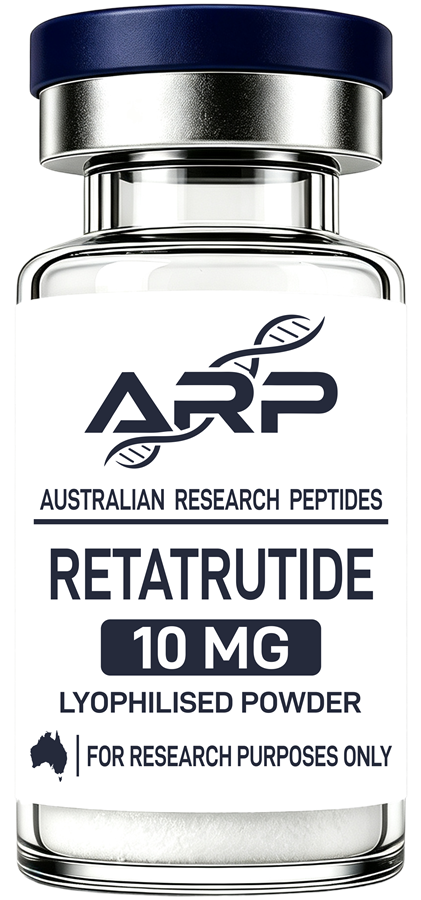
Retatrutide can be bought in Australia from Australian Research Peptides, in HPLC-tested 10 mg, 20 mg and 30 mg vials of freeze-dried powder sealed in glass, shipped to every state and territory. It is studied in weight loss research: its phase 3 obesity trial reported body weight down 25.0% against 3.9% on placebo, with blood-glucose effects arriving earlier still. The molecule engages the GIP, GLP-1 and glucagon receptors at once, so obesity and type 2 diabetes research follows it closely. In vitro research purposes only.

Metabolic Research · Lyophilised Powder · Batch-tested · SKU ARP-RET-10
In stock·99.861%
$139.99
1

2+ vials: 5% off — applied automatically in the cart

Presentation
10 mg per vial
Grade
High-Purity Research Grade
Form
Lyophilised Powder
Category
Metabolic Research
Same-day dispatch on business-day orders placed before 12pm AEST, Mon–Fri
Tracked shipping Australia-wide ·typically 1–2 business days to most areas by Express Post · free post over $199, free Express over $299
Batch certificates — published in the COA library
For in vitro research purposes only. Not for human consumption. Not for animal consumption. This product is not a drug, food, cosmetic, or dietary supplement. Any amounts shown are reported from published studies, with the species or trial population named. ARP gives no dosing, medical or therapeutic guidance of its own.
Retatrutide · 10 mg
$139.99

Frequently Bought Together

About Retatrutide

Retatrutide is studied in obesity, type 2 diabetes and liver research. Eli Lilly developed the molecule and has carried it from early safety work to large late-stage studies. In laboratory receptor assays it binds the GIP, GLP-1 and glucagon receptors. That triple action separates it from semaglutide, which acts at GLP-1 alone, and from tirzepatide, which acts at two.

The molecule is one continuous chain of 39 amino acids, engineered from a GIP peptide backbone. The chain carries a C20 fatty di-acid, meaning a twenty-carbon fatty group bonded onto it. That group binds albumin in blood, which is the design feature that makes the molecule long-acting.

Australian Research Peptides supplies retatrutide as a freeze-dried solid, white to off-white, sealed in a tamper-evident glass vial. It is also written and searched as reta or retat. The material is a laboratory reference compound, characterised for benchwork in glassware and cell culture rather than for any use in a living subject.

Retatrutide specifications, storage and shipping

  • Compound: Retatrutide
  • Also known as: Retatrutide (LY3437943)
  • Class: Synthetic peptide; GIP / GLP-1 / glucagon receptor triple agonist
  • Appearance: White to off-white lyophilised powder
  • Sizes & SKUs: 10 mg (ARP-RET-10), 20 mg (ARP-RET-20), 30 mg (ARP-RET-30)
  • Presentation: sealed glass vial
  • Form: Lyophilised Powder
  • Grade: High-purity research grade
  • Purity verification: HPLC-assayed on every batch to a minimum of 99% purity — the measured result for your batch is stated on its Certificate of Analysis
  • Identity confirmation: Mass spectrometry
  • Batch traceability: every batch is tested, with its certificate published in the COA library
  • Classification: In vitro research purposes only — laboratory reference material

Lyophilised — long term
−20 °C to −80 °C — long-term storage
Lyophilised — short term
2–8 °C — refrigerated, for a few months
Reconstituted
2–8 °C — use within 8–12 weeks
Protect from light and moisture. Handle in accordance with standard laboratory safety practice, including appropriate PPE. This information is provided for laboratory handling only and is not a usage instruction of any kind.

Every batch undergoes HPLC purity analysis and mass-spectrometry identity confirmation. The full laboratory report is published in the COA library.

Business-day orders before 12pm AEST are dispatched the same day with tracked, discreet shipping. Standard delivery within Australia typically takes 2–5 business days. See Shipping & Delivery for details, and follow your parcel on the Track Order page.

For in vitro research purposes only. Not for human consumption. Not for animal consumption. Not a drug, food, cosmetic, or dietary supplement. No therapeutic or medical claims are made.

Questions about Retatrutide

This question guide from Australian Research Peptides covers Retatrutide in Australia: what the listing contains, live buying and delivery questions, research context, handling, testing and comparisons. Start with the quick answers, then open the topic group that matches your search.

Buying, price and availability

Australian Research Peptides supplies Retatrutide within Australia, and orders in before 12pm AEST on a business day go out the same afternoon. Three vial strengths are listed, each with its own RET stock code. Express Post or standard tracked post covers every state and territory.

Australian Research Peptides Pty Ltd, trading as ARP, is the supplier of retatrutide in Australia, an Australian company dispatching from Sydney. The compound is catalogued under Metabolic Research by its development code LY3437943. Every batch is HPLC-tested. PayID and bank transfer are the only two routes accepted — no cards, wallets or crypto.

Retatrutide is priced per vial in Australian dollars, with a separate figure for each of the three strengths. Australian Research Peptides holds all three figures in its live catalogue record, so the current one governs rather than any number fixed in prose. The 20 mg and 30 mg vials each clear the free standard-post threshold on their own. Retatrutide holds the HPLC Verified grade, and it is that grade rather than the category which brings a line of two or more inside the automatic multi-vial discount.

Retatrutide's cost per milligram falls as the vial gets larger, so the 30 mg vial is the cheapest per milligram and the 10 mg the dearest. Each strength's figure is rendered live from Australian Research Peptides' catalogue data. Against that, a larger vial holds more solution once mixed and takes longer to work through, which matters because reconstituted peptide has a shelf life.

Retatrutide is sold online in Australia by Australian Research Peptides, a domestic supplier that lists the compound in three vial strengths. The only two payment routes are PayID and a bank transfer, so no card number ever changes hands. Every parcel travels inside Australia.

Retatrutide comes from Australian Research Peptides, not from Chemist Warehouse: it holds no Australian registration, so no pharmacy chain here can stock it, dispense it or write a script against it, and there is no approved pen or pre-filled device version in this country. ARP lists it as a research compound — freeze-dried powder in a sealed vial, supplied for in vitro research purposes only.

Identity, names and exact format

Retatrutide is a synthetic peptide of 39 amino acids, developed by Eli Lilly under the code LY3437943 and studied in obesity and type 2 diabetes research. It reaches the GIP, GLP-1 and glucagon receptors together, where single- and dual-receptor designs are the norm. The chain is one engineered molecule rather than a mixture of separate peptides, built on a GIP backbone with a twenty-carbon fatty di-acid bonded onto it. That fatty group is the part that makes it long-acting.

A retatrutide vial holds one substance and nothing else. No carrier, no second peptide, no liquid. It is a freeze-dried solid, white to off-white, behind a tamper-evident seal. The C20 fatty di-acid is chemically bonded into the peptide chain rather than added alongside it, which is why the dry contents count as a single compound. The milligram figure on the listing is peptide weight.

Retatrutide has 39 amino acids in one continuous synthetic chain. It is a single engineered molecule, not a blend of separate peptides mixed together. The chain is built from a GIP peptide backbone with a C20 fatty di-acid attached to it. No residue-by-residue sequence appeared in the public records checked. The milligram figure on the vial is weight, not a residue count.

Retatrutide is also known by Eli Lilly's development code LY3437943 and is indexed under that code in trial registries and NIH MeSH record C000729679. It is sometimes nicknamed "Triple G" because it acts at GIP, GLP-1 and glucagon receptors; that nickname is informal, not a separate compound name. The label "GLP-3" is a misnomer rather than a synonym because Retatrutide does not involve a third GLP peptide.

Research context and evidence

Retatrutide switches on three different receptors at the same time. In laboratory assays gathered by Goldney's 2025 review, it is 8.9 times more potent at the GIP receptor than human GIP itself. It is 2.5 times less potent than GLP-1 at the GLP-1 receptor, and 2.9 times less potent than glucagon at the glucagon receptor. That same review puts the measured half-life at roughly six days, stretched by the C20 fatty di-acid binding albumin.

Retatrutide has run through phase 1, phase 2 and phase 3 trials in obesity and type 2 diabetes. Jastreboff 2023, in the New England Journal of Medicine, ran the phase 2 obesity trial over 48 weeks in 338 adults. Average body weight fell 24.2% on the 12 mg weekly dose against 2.1% on placebo. Phase 3 TRIUMPH-1 ran 80 weeks in 2,339 adults and reported 25.0% against 3.9% on placebo. The material described in those trials is not the material sold on this page.

Retatrutide cut tumour growth in obese mice, in work published in 2025 as PMID 40094000. Marathe and colleagues injected 30 nmol/kg under the skin every second day into diet-induced obese C57BL/6J mice. Pancreatic tumours established in 70% of mice instead of all, and volume fell 14-fold against vehicle, where semaglutide managed 4-fold. In the lung model engraftment halved and volume fell 17-fold. Mouse findings, not human ones.

Retatrutide was given once a week by injection in its obesity trials. Jastreboff 2023 used the subcutaneous route, with 1, 4, 8 and 12 mg arms across 338 adults for 48 weeks. TRIUMPH-1 ran 4, 9 and 12 mg in 2,339 adults, each stepped up from 2 mg every four weeks. Those are study parameters, not instructions, and Australian Research Peptides supplies material for in vitro research purposes only.

Retatrutide clears slowly, with Goldney's 2025 review reporting a mean half-life close to six days. A week-long persistence means concentrations build across the first month of repeated administration before levelling off. That number describes one thing only: how long the molecule stays measurable in blood. The obesity trials read their results at 48 and 80 weeks instead, and rival listings routinely offer the first figure as though it answered the second.

Retatrutide has cleared phase 1, phase 2 and phase 3 trials in obesity with placebo-controlled results published in peer-reviewed journals, which is a stronger evidence base than most peptides listed on this site can claim. The limits are equally real. No regulator has approved it, no study has run beyond two years, and none of the published work used research-grade material of the kind sold here. The evidence is strong and narrow at the same time.

Retatrutide's published trial dosed weekly for 48 weeks and escalated gradually, with the largest weight changes accumulating over the full period rather than in the first weeks. Blood-glucose effects appeared earlier than weight changes. The trial ran no shorter arm, so there is no published answer for what happens in two or four weeks — that figure simply was not measured.

The published Retatrutide trials measured participants while treatment continued and reported no arm that followed anyone after it stopped, so no trial answer to this exists. Studies of the wider GLP-1 class have generally found body weight returning once treatment ends, but that is a different molecule under a different protocol, and reading it across is inference rather than measurement. For retatrutide itself the question has not been studied.

Retatrutide's reported side effects in its phase 2 obesity trial were mostly gastrointestinal — nausea, diarrhoea, vomiting and constipation — and they rose with dose, which is why the trial escalated slowly rather than starting high. They were graded mild to moderate. This is trial data in supervised participants, not a safety profile for unsupervised use, and no regulator has reviewed it.

Handling, storage and measurements

Yes — Retatrutide is freeze-dried, and ten milligrams of dried peptide occupies almost no space: commonly a thin white disc, or a faint film on the glass base that overhead lighting washes out entirely. Tilting the container slowly against a dark surface usually reveals it. The 20 mg and 30 mg strengths carry two and three times that solid, so they read as an obvious cake. Weight rather than visible bulk is what batch analysis records.

Retatrutide should be kept sealed, cold and dry, away from moisture. The freeze-dried powder pulls water out of the air, so let a cold vial reach room temperature before you break the seal. Bachem's peptide handling guidance puts lyophilised material below -15 C for long-term storage and 4 C for short periods. Colder is better, and that guidance prefers -50 C or lower for long holdings.

Retatrutide is reconstituted with bacteriostatic water added straight into the sealed vial. Angle the needle so the liquid runs down the inside glass wall rather than onto the powder. Swirl until clear and never shake. Volume sets strength: 2 mL into a 10 mg vial gives 5 mg/mL, and 3 mL into a 30 mg vial gives 10 mg/mL. Australian Research Peptides' reconstitution calculator handles any other pairing.

Reconstituted retatrutide keeps at 2 to 8 °C for eight to twelve weeks. That is the storage condition Australian Research Peptides publishes for every HPLC Verified line it sells. Keep the solution dark, and never refreeze one that has thawed. For holds longer than that, Bachem and GenScript both advise splitting it into single-use aliquots and freezing them below -15 °C.

Retatrutide is listed in three strengths, so the answer depends on which vial is in front of you: the water sets the concentration and never the amount of peptide. One millilitre into the 10 mg vial gives 10 mg per mL, two millilitres gives 5 mg per mL, four gives 2.5 mg per mL. The 20 mg and 30 mg vials double and triple each of those figures at the same volume. Divide milligrams by millilitres for any pairing not listed.

Trapped air explains almost every cloudy Retatrutide vial. Directing the stream onto the cake, or shaking rather than swirling, whips microbubbles through the liquid and they scatter light exactly as turbidity does, then rise and disperse within a few minutes at rest. Cold glass slows dissolution as well. Haze still present after ten minutes at room temperature points instead to undissolved solid or aggregation, and the 30 mg strength takes longest because it holds three times the material.

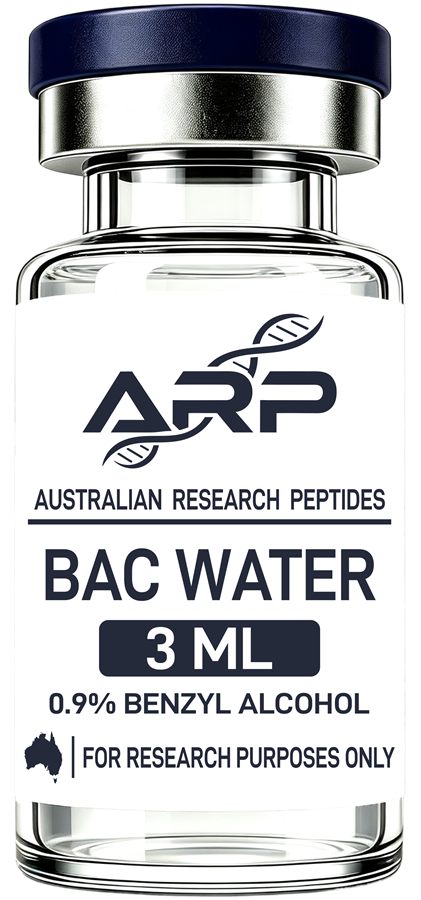
Yes — retatrutide arrives as a dry solid and needs a liquid to bring it into solution for laboratory work, and bacteriostatic water is the diluent normally used for that. Diluent is simply the word for whatever liquid dissolves a dried solid back into solution. Nothing in the vial is already wet, because the fatty group is bonded to the chain rather than floating loose. Australian Research Peptides lists bacteriostatic water separately under Lab Supplies.

Retatrutide's phase 2 trial arms in Jastreboff 2023 ran at 1, 4, 8 and 12 mg weekly, so a single 10 mg vial does not even cover one week at the highest arm — the 20 mg and 30 mg listings exist for that reason. At smaller amounts the arithmetic opens up: forty draws at 250 mcg, twenty at 500 mcg.

Testing and batch documents

Every Retatrutide batch Australian Research Peptides supplies goes through two separate analyses before it is sold, one measuring purity and the other confirming identity. HPLC produces the purity figure. Mass spectrometry then establishes that the molecule really is retatrutide and not something that presents identically as a dry powder. Identity is the one that matters here, because a shortened chain or a stripped fatty group still looks like white powder.

A Retatrutide document applies only to the exact vial strength it names, not to the parent listing or a sibling strength. Never substitute a 10 mg, 20 mg or 30 mg document for another strength. A matching certificate is currently published for 10 mg, 20 mg and 30 mg. Open the 10 mg, 20 mg or 30 mg certificate.

Retatrutide analytical testing can establish two things and no more. A chromatographic purity figure reports how much of the sample sits under the main peak, using the stated method. A mass result says whether that peak weighs what Retatrutide should weigh. Neither result covers sterility or endotoxin, and neither makes the material fit for use in a person or an animal.

Ordering, payment and Australian delivery

Retatrutide is one of the few lines where a single vial can qualify for free post: the two larger strengths each clear the Standard tracked post threshold unaided, and only the largest also reaches the separate, higher Express Post one. Two of the smallest vials together clear the standard threshold as well. Australian Research Peptides judges every order against both thresholds on its pre-discount goods value.

Retatrutide ships from within Australia, so there is no customs leg. Express Post runs 1–2 business days to ACT, NSW, VIC and SA, 1–3 to Queensland, and 2–4 to WA, Tasmania and the Northern Territory. Standard tracked post runs 2–5. Those are capital-city transit times counted after lodgement, and regional addresses sit beyond them.

Retatrutide is paid for by PayID or bank transfer, and by nothing else. There is no card checkout, no PayPal, no Apple or Google Pay, no Afterpay or Zip, and no cryptocurrency. That is a deliberate design: with no card facility anywhere in the business, there is no card number to store, leak or have stolen.

A Retatrutide vial contains peptide and nothing else — no diluent, no syringe, no needle, no swab. Two things turn it into something you can draw from: bacteriostatic water to reconstitute it, and insulin syringes. Australian Research Peptides stocks both as their own catalogue lines and recommends them with every retatrutide order.

Bacteriostatic water and syringes, and neither travels with a Retatrutide vial. How far the water goes is decided by volume rather than strength: at 1 mL per vial a 3 mL bacteriostatic water vial covers three reconstitutions, whether those vials hold 10, 20 or 30 mg. Anyone mixing to a lower concentration gets through it faster and may prefer the 10 mL. Diluent keeps roughly 28 days from first puncture, so a surplus is only worth having if the next reconstitution falls inside that window, and syringes are the consumable that runs out first.

Access, approval and sport questions

Retatrutide is not approved for therapeutic use by the TGA, or by any other regulator worldwide. Eli Lilly describes it as an investigational molecule, legally available only to people enrolled in its own clinical trials. Australian Research Peptides supplies it as a laboratory research chemical, not as a medicine, and not for use in people or animals. Check your own obligations before handling it.

Retatrutide holds no approval from the US Food and Drug Administration, nor from any other medicines regulator anywhere. Eli Lilly still describes it as an investigational molecule. Its phase 3 obesity programme, TRIUMPH-1, reported 80-week topline results in 2,339 adults during 2026, which marks progress toward a submission rather than a licence. Research-grade powder sits a further step removed, assessed by no one at all.

No launch date for retatrutide has been published, and nobody can honestly supply one. Eli Lilly has reported phase 3 topline results, but a regulator must still receive a complete dossier, review it and decide, and refusal remains possible at that point. Any seller naming a specific year is guessing. Until some authority grants a licence, the compound stays investigational.

Retatrutide is banned for any tested athlete. Still in Phase 3 trials with no approval from a government health regulator, it falls inside category S0 — the sweep capturing investigational molecules — and that ban runs year-round, not merely on competition day. Australian competitors are governed by Sport Integrity Australia, where a positive sample counts whatever the athlete intended.

Retatrutide cannot be bought from an Australian pharmacy. No regulator anywhere has approved it, so no pharmacist can dispense it on prescription and no compounding pharmacy can lawfully make it up. There is no approved pen or pre-filled device version of it in this country. What Australian Research Peptides supplies is the research compound, a dry powder in a glass vial.

Retatrutide crossing the Australian border raises obligations for the importer, not the seller — the Therapeutic Goods Administration sets the rules covering unapproved goods and Border Force enforces them at the frontier. Australian Research Peptides removes the question by dispatching from Sydney rather than shipping across the border, so a customer's parcel never leaves the country. Anyone importing separately should read the TGA's guidance first.