For laboratory research use only. Not for human or veterinary use.Lab research use only. Not for human or animal use.
Cart is empty
Same-Day DispatchAustralian StockPremium Research GradeVerified CoAsPayID · Clears in MinutesSame-Day DispatchAustralian StockPremium Research GradeVerified CoAsPayID · Clears in Minutes
Same-day dispatch on business-day orders before 12pm Sydney time.Same-day dispatch before 12pm Sydney timeFree standard post $199+Free std post $199+
Why order from ARP
Same-Day Dispatch
Australian Stock
Premium Research Grade
Verified CoAs
PayID · Clears in Minutes
Buy Retatrutide 20 mg in Australia
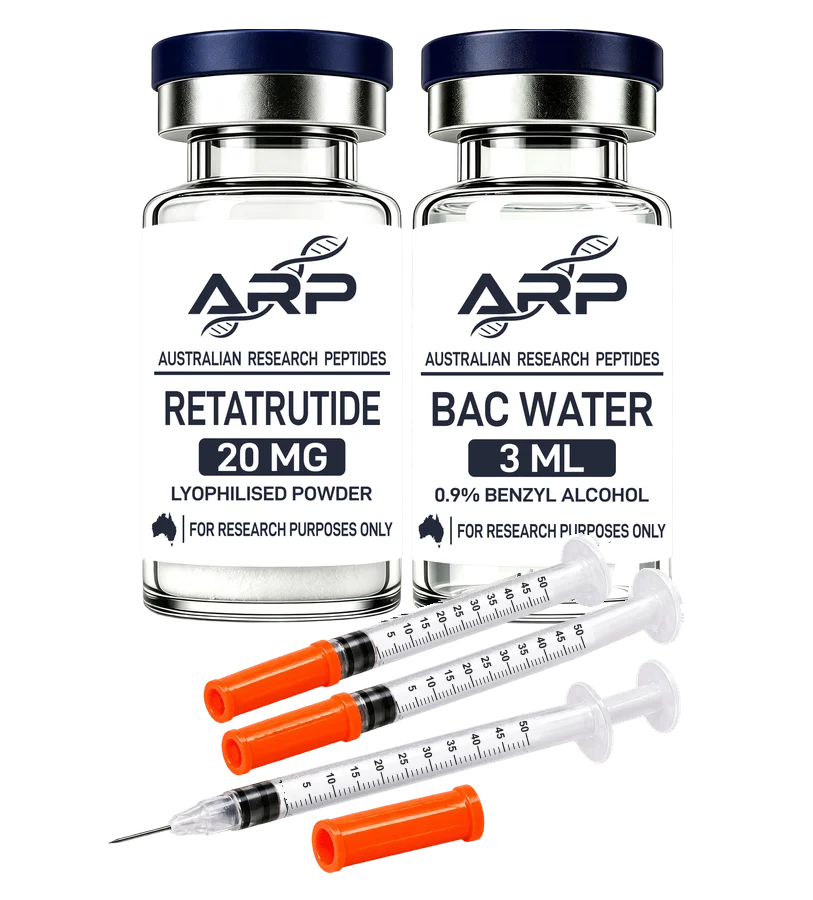
Retatrutide 20 mg is a research-grade peptide that is studied in metabolic research, supplied in Australia by Australian Research Peptides to laboratories and researchers. It is the middle of three strengths ARP lists. The 20 mg vial is HPLC-tested and its certificate is published. Retatrutide is a laboratory-made peptide studied at three hormone receptors: GLP-1, GIP and glucagon. This 20 mg vial costs $219.99 and is in stock now, dispatched the same business day when paid before 12pm Sydney time, to all states and territories. For in vitro research purposes only.
Metabolic Research · Lyophilised Powder · HPLC-tested · SKU 33410
For in vitro research purposes only. Not for human consumption. Not for animal consumption. This product is not a drug, food, cosmetic, or dietary supplement. No medical, therapeutic, or usage information is provided.
A single engineered chain of 39 amino acids reaching three separate receptor targets, where most peptides of the same structural family reach one or two. This is the 20 mg Retatrutide vial, the middle of three, listed as 33410.
99.735% is what the 20 mg lot measured. Every size is assayed by itself, so that number belongs to this one.
In vitro metabolic research purposes only. Australian Research Peptides does not supply Retatrutide for human or veterinary use.
Retatrutide is studied in metabolic research. Eli Lilly developed the molecule and has carried it from early work through large late-stage studies. In laboratory receptor assays it binds the GIP, GLP-1 and glucagon receptors. That triple target separates it from the single-receptor GLP-1 analogues, which act at GLP-1 alone, and from the dual GIP/GLP-1 agonists, which act at two.
The molecule is one continuous chain of 39 amino acids, engineered from a GIP peptide backbone. The chain carries a C20 fatty di-acid, meaning a twenty-carbon fatty group bonded onto it. That group is described as binding albumin in blood, which is the design feature reported to make the molecule long-acting.
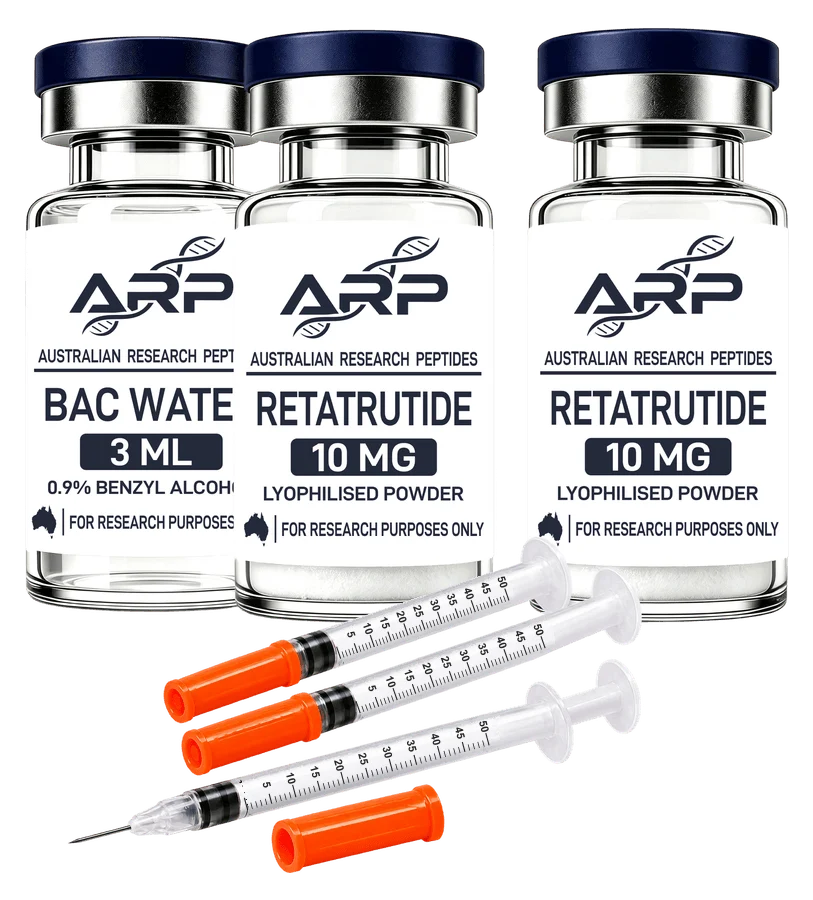
Australian Research Peptides supplies retatrutide as a freeze-dried solid, white to off-white, sealed in a tamper-evident glass vial. It is also written and searched as reta or retat. The material is a laboratory reference compound, characterised for benchwork in glassware and cell culture rather than for any use in a living subject.
In Australia, retatrutide is listed by Australian Research Peptides in three vial strengths — 10 mg, 20 mg and 30 mg — each with its own stock code and its own batch certificate. Anyone searching retatrutide Australia, reta peptide, or the numeric R3ta will land on the same triple-agonist compound under all of those names. Vials are held and posted domestically rather than shipped in from overseas, so an order is not waiting on international freight. Purity is assayed by HPLC, and the measured figure is published on each strength's own certificate rather than as a blanket claim about the line.
Retatrutide 20 mg specifications, storage and shipping
Compound: Retatrutide
Quantity: 20 mg
SKU:33410
Presentation: sealed glass vial
Form: Lyophilised Powder
Grade: High-purity research grade
Purity verification: HPLC-assayed to a minimum of 99% purity — the measured result is stated on the published Certificate of Analysis
Identity confirmation: Mass spectrometry
Certificates: issued by Janoshik, an independent laboratory, and published in the COA library
Classification: In vitro research purposes only — laboratory reference material
Lyophilised — long term
−20 °C to −80 °C — long-term storage
Lyophilised — short term
2–8 °C — refrigerated, for a few months
Reconstituted
2–8 °C — use within 8–12 weeks
Protect from light and moisture. Handle in accordance with standard laboratory safety practice, including appropriate PPE. This information is provided for laboratory handling only and is not a usage instruction of any kind.
Retatrutide is HPLC-tested for purity and confirmed by mass spectrometry for identity. The full laboratory report is published in the COA library. Retatrutide is tested by Janoshik, an independent laboratory, commissioned by the manufacturer rather than by Australian Research Peptides.
Business-day orders before 12pm Sydney time are dispatched the same day with tracked shipping. Standard delivery within Australia typically takes 2–5 business days. See Shipping & Delivery for details, and follow your parcel on the Track Order page.
For in vitro research purposes only. Not for human consumption. Not for animal consumption. Not a drug, food, cosmetic, or dietary supplement. No therapeutic or medical claims are made.
Questions about Retatrutide 20 mg
This Retatrutide 20 mg question guide from Australian Research Peptides is specific to the exact listing, with live buying details, size comparisons, concentration calculations, storage, testing and the inherited product background grouped separately. Start with the quick answers or jump to the topic you need.
Exact strength, quantity and listing fit
Retatrutide's 30 mg vial is $299.99, $80.00 more than this 20 mg Retatrutide one. Two of these cost $439.98, 10 mg to spare, so the bigger vial saves $139.99.
Per milligram, Retatrutide 20 mg works out to about $11.00 — $219.99 across 20 mg. The 30 mg Retatrutide vial works out to about $10.00 a milligram.
Twenty milligrams of lyophilised retatrutide, twice the entry listing's fill, sealed dry with no diluent, supplied by Australian Research Peptides. Freeze-dried peptide is light, so a doubled mass still forms only a small cake.
One seal instead of two, one reconstitution instead of two, and a single batch to record rather than a pair. The per-milligram rate shown on each listing settles the money half of that choice.
Middle-scale work: enough peptide for an extended run without committing to the largest listing, and a mass that divides evenly into halves, quarters and tenths. Three millilitres of diluent still fits within one small water vial.
Live price, stock and Australian buying
Australian Research Peptides (ARP) sells Retatrutide 20 mg in Australia under 33410, at $219.99. Standard tracked post and Express Post carry Retatrutide 20 mg to all states and territories.
Retatrutide 20 mg is $219.99 a vial (33410). Two 20 mg vials come to $439.98.
On Standard tracked post, yes. One Retatrutide 20 mg vial at $219.99 passes $199 unaided. Free Express Post starts at $299, which this vial misses by $79.01.
$219.99 delivered in Australia. Retatrutide 20 mg is $219.99, over $199, so 33410 posts free by Standard tracked post. Express Post makes 33410 $236.98.
Two vials of Retatrutide. At $219.99 each, two 20 mg vials make $439.98 — past $299, so 33410 ships free by Express Post, costing $439.98.
Reconstitution and concentration calculations
Australian Research Peptides publishes no fill volume for 33410, so the amount is a decision for the work rather than one the listing sets. 33410 is 20 mg of dry Retatrutide: what the diluent changes is the solution, never the 20 mg sealed in the glass.
It does. Twice the mass still forms a light freeze-dried cake and goes into solution on the same gentle swirl. Run the diluent down the glass shoulder rather than onto the cake, and never shake the vial.
Product identity and research background
Retatrutide is a synthetic peptide of 39 amino acids, developed by Eli Lilly under the code LY3437943 (Coskun 2022) and studied in metabolic research. It is described as reaching the GIP, GLP-1 and glucagon receptors together, where single- and dual-receptor designs are the norm. The chain is one engineered molecule rather than a mixture of separate peptides, built on a GIP backbone with a twenty-carbon fatty di-acid bonded onto it. That fatty group is the part that makes it long-acting.
Retatrutide reaches three receptor targets at once. Published laboratory work describes the molecule binding at the GIP, GLP-1 and glucagon receptors, a combination that single- and dual-receptor designs do not have. Bonded onto the chain is a C20 fatty di-acid — a twenty-carbon fatty tail — and it binds albumin, the most common protein in blood, which is the structural feature the molecule was engineered around. Every statement here describes binding measured in glassware, not anything occurring in a living subject.
Retatrutide has 39 amino acids in one continuous synthetic chain. It is a single engineered molecule, not a blend of separate peptides mixed together. The chain is built from a GIP peptide backbone with a C20 fatty di-acid attached to it. No residue-by-residue sequence appeared in the public records checked. The milligram figure on the vial is weight, not a residue count.
Yes — Retatrutide is freeze-dried, and ten milligrams of dried peptide occupies almost no space: commonly a thin white disc, or a faint film on the glass base that overhead lighting washes out entirely. Tilting the container slowly against a dark surface usually reveals it. The 20 mg and 30 mg strengths carry two and three times that solid, so they read as an obvious cake. Weight rather than visible bulk is what batch analysis records.
Storage, condition and testing
Trapped air explains almost every cloudy Retatrutide vial. Directing the stream onto the cake, or shaking rather than swirling, whips tiny air bubbles through the liquid, and they scatter light exactly as real cloudiness does, then rise and disperse within a few minutes at rest. Cold glass slows the powder dissolving as well. Haze still present after ten minutes at room temperature points instead to solid that has not dissolved, or to peptide that has clumped together, and the 30 mg strength takes longest because it holds three times the material.
Retatrutide reaches three receptors and the dual agonists reach two. The dual agonists act at the GIP and GLP-1 receptors. Retatrutide adds glucagon receptor activity on top of those two, and that third target is the entire difference between them. Australian Research Peptides lists Retatrutide for laboratories and researchers.
Strength comparisons, aliases and related products
Retatrutide comes from Australian Research Peptides, not from Chemist Warehouse: it holds no Australian registration, so no pharmacy chain here can stock it, dispense it or write a script against it. ARP lists it as a research compound — freeze-dried powder in a sealed vial, supplied to laboratories and researchers for in vitro research purposes only.
Delivery, payment and access questions
Retatrutide batches supplied by Australian Research Peptides go through two separate analyses at an independent laboratory, commissioned by the manufacturer, before they are sold, one measuring purity and the other confirming identity. HPLC produces the purity figure. Mass spectrometry then establishes that the molecule really is retatrutide and not something that presents identically as a dry powder. Identity is the one that matters here, because a shortened chain or a stripped fatty group still looks like white powder.
Retatrutide is also known by Eli Lilly's development code LY3437943 and is indexed under that code in trial registries and NIH MeSH record C000729679. It is commonly shortened to "Reta" in everyday use, which is a contraction of the same name rather than a different compound. It is sometimes nicknamed "Triple G" because it acts at GIP, GLP-1 and glucagon receptors; that nickname is informal, not a separate compound name. The label "GLP-3" is a misnomer rather than a synonym because Retatrutide does not involve a third GLP peptide.
More questions
Retatrutide has a published research literature in metabolic science, developed by Eli Lilly and reported in peer-reviewed journals (Jastreboff 2023). Australian Research Peptides publishes none of those figures on this page, because the material described in that literature is not the material in this vial. What ARP publishes instead is the batch's own certificate: identity and assay purity, measured by HPLC and confirmed by mass spectrometry, with the document itself in the CoA library.
A retatrutide vial holds one substance and nothing else. No carrier, no second peptide, no liquid. It is a freeze-dried solid, white to off-white, behind a tamper-evident seal. The C20 fatty di-acid is chemically bonded into the peptide chain rather than added alongside it, which is why the dry contents count as a single compound. The milligram figure on the listing is peptide weight.
Retatrutide should be kept sealed, cold and dry, away from moisture. The freeze-dried powder pulls water out of the air, so let a cold vial reach room temperature before you break the seal. Bachem's peptide handling guidance puts lyophilised material below -15 C for long-term storage and 4 C for short periods. Colder is better, and that guidance prefers -50 C or lower for long holdings.
Reconstituted retatrutide keeps at 2 to 8 °C for eight to twelve weeks. That is the storage condition Australian Research Peptides publishes for every HPLC Verified line it sells. Keep the solution dark, and never refreeze one that has thawed. For holds longer than that, Bachem and GenScript both advise splitting it into single-use aliquots and freezing them below -15 °C.
Australian Research Peptides Pty Ltd, trading as ARP, is the supplier of retatrutide in Australia, an Australian company dispatching from Sydney. The compound is catalogued under Metabolic Research by its development code LY3437943, and its purity is tested by HPLC. PayID and bank transfer are the routes accepted — no buy-now-pay-later and no crypto.
Retatrutide is not approved for therapeutic use by the TGA, or by any other regulator worldwide. Eli Lilly describes it as an investigational molecule, legally available only to people enrolled in its own clinical trials. Australian Research Peptides supplies it as a laboratory research chemical, not as a medicine, and not for use in people or animals. Check your own obligations before handling it.
Retatrutide holds no approval from the US Food and Drug Administration, nor from any other medicines regulator anywhere. Eli Lilly still describes it as an investigational molecule. Its development programme is still running, which is a step toward a submission rather than a licence in itself. Research-grade powder sits a further step removed, assessed by no one at all.
Retatrutide is banned for any tested athlete. Still investigational, with no approval from a government health regulator, it falls inside category S0 — the sweep capturing investigational molecules — and that ban runs year-round, not merely on competition day. Australian competitors are governed by Sport Integrity Australia, where a positive sample counts whatever the athlete intended.
Retatrutide remains an investigational molecule rather than an approved commercial medicine on sale to the Australian public. Australian Research Peptides does not supply it as a compounded prescription item or a pharmacy medicine, and because no regulator has approved it, no Australian compounding pharmacy can lawfully make it up either — what ARP supplies is research-grade freeze-dried powder for lawful in vitro laboratory work only. Eli Lilly still describes the molecule as investigational with its development programme running, so commercial release would depend on that programme finishing and a regulator then granting approval. No launch date has been published.
Retatrutide is described as acting at three receptors and the single-receptor GLP-1 peptides at one. Retatrutide is described in the literature as a triple agonist, at the GIP, GLP-1 and glucagon receptors. The GLP-1-only class is described as working at the GLP-1 receptor alone. They are separate molecules with different sequences and different weights, and Australian Research Peptides catalogues Retatrutide rather than that class.
The three Retatrutide listings hold the same material in different quantities. The number is milligrams of peptide sitting in the glass. Colour, container, closure and the testing method do not change between them. Australian Research Peptides gives every strength its own page and its own stock code, and all three sit under one parent listing.