Same-Day DispatchAustralian StockDiscreet DeliveryPremium Research GradeVerified CoAs
Same-day dispatch on business-day orders before 12pm AEST.Same-day dispatch before 12pm AESTFree post $199+

Buy MOTS-C in Australia

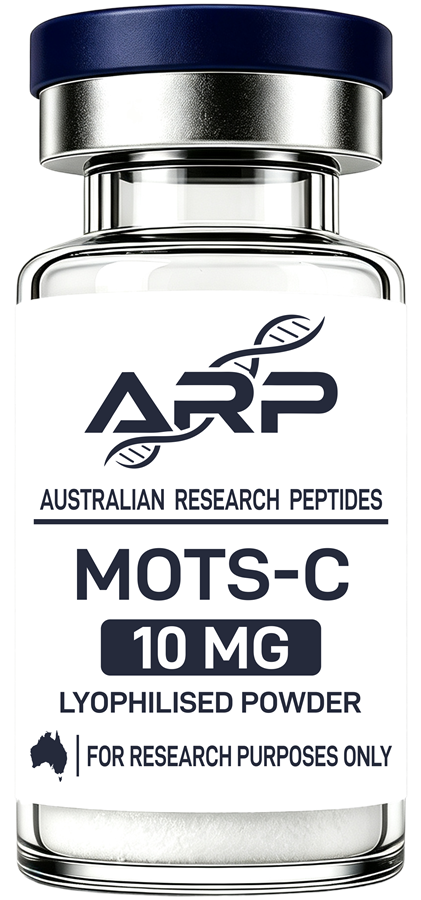
MOTS-C is supplied in Australia by Australian Research Peptides, a sixteen-amino-acid chain coded inside mitochondria rather than the nucleus and freeze-dried into sealed 10 mg and 20 mg vials. It flips on AMPK, the switch a cell throws when its fuel runs low, driving skeletal muscle to burn energy rather than store it. That action links the peptide to better insulin sensitivity, less fat gained on a rich diet and more physical capacity with age. ARP ships from within Australia to every state and territory. In vitro research purposes only — never for human or animal use.

Mitochondrial Research · Lyophilised Powder · Batch-tested · SKU ARP-MOTSC-10
Out of stock·
$89.99

2+ vials: 5% off — applied automatically in the cart

Presentation
10 mg per vial
Grade
High-Purity Research Grade
Form
Lyophilised Powder
Category
Mitochondrial Research
Currently out of stock — stocked lines dispatch same business day before 12pm AEST, Mon–Fri
Tracked shipping Australia-wide ·typically 1–2 business days to most areas by Express Post · free post over $199, free Express over $299
For in vitro research purposes only. Not for human consumption. Not for animal consumption. This product is not a drug, food, cosmetic, or dietary supplement. Any amounts shown are reported from published studies, with the species or trial population named. ARP gives no dosing, medical or therapeutic guidance of its own.
MOTS-C · 10 mg
$89.99

Frequently Bought Together

About MOTS-C

MOTS-C is studied in relation to energy metabolism, meaning how cells make and spend energy. Published work in mice and in cell culture reports it switching on AMPK, a protein that senses when a cell is short of fuel. Skeletal muscle looks like its main target tissue. This page names the research field and the measurements taken, and reports no outcome in a person.

The peptide is coded by a short stretch of the 12S ribosomal RNA gene, which sits inside mitochondrial DNA rather than in the nucleus. Peptides coded that way are grouped together as mitochondrial-derived peptides. Humanin was the first of the group to be described, and MOTS-C followed it. The name is written and searched as MOTS-C, MOTSc and MOTS C.

Lee and colleagues reported MOTS-C in 2015 in Cell Metabolism. Their mouse experiments looked at insulin sensitivity and at body weight on a high-fat diet. ARP reports that published record and claims nothing about the material in its own vials.

Content reviewed

Further reading: MOTS-C Research: What Studies Show and What Is Still Unknown

MOTS-C specifications, storage and shipping

  • Compound: MOTS-C
  • Also known as: MOTS-c (mitochondrial ORF of the 12S rRNA type-c)
  • Class: Mitochondrial-derived peptide; sixteen residues
  • Appearance: White to off-white lyophilised powder
  • Sizes & SKUs: 10 mg (ARP-MOTSC-10), 20 mg (ARP-MOTSC-20)
  • Presentation: sealed glass vial
  • Form: Lyophilised Powder
  • Grade: High-purity research grade
  • Purity verification: HPLC-assayed on every batch to a minimum of 99% purity — the measured result for your batch is stated on its Certificate of Analysis
  • Identity confirmation: Mass spectrometry
  • Classification: In vitro research purposes only — laboratory reference material

Lyophilised — long term
−20 °C to −80 °C — long-term storage
Lyophilised — short term
2–8 °C — refrigerated, for a few months
Reconstituted
2–8 °C — use within 8–12 weeks
Protect from light and moisture. Handle in accordance with standard laboratory safety practice, including appropriate PPE. This information is provided for laboratory handling only and is not a usage instruction of any kind.

Every batch undergoes HPLC purity analysis and mass-spectrometry identity confirmation. No laboratory report is published for this line yet. The COA library lists every product and strength, and says which reports are available.

This line is currently out of stock. Stocked lines ordered before 12pm AEST on a business day are dispatched the same day with tracked, discreet shipping. Standard delivery within Australia typically takes 2–5 business days. See Shipping & Delivery for details, and follow your parcel on the Track Order page.

For in vitro research purposes only. Not for human consumption. Not for animal consumption. Not a drug, food, cosmetic, or dietary supplement. No therapeutic or medical claims are made.

Questions about MOTS-C

This question guide from Australian Research Peptides covers MOTS-C in Australia: what the listing contains, live buying and delivery questions, research context, handling, testing and comparisons. Start with the quick answers, then open the topic group that matches your search.

Buying, price and availability

Buy MOTS-C in Australia direct from Australian Research Peptides, who list it under code MOTSC as the Mitochondrial Research entry — searchable as MOTS or mitochondrial derived peptide. Pick the 10 mg or 20 mg lyophilised vial. Neither strength can ship at the moment; restocked vials resume the 12pm AEST weekday cut-off on tracked Standard or Express Post, reaching all states and territories. Parcels travel domestically only, never through customs, and each batch carries an HPLC certificate on request.

The 10 mg and 20 mg MOTS-C listings are tracked as separate lines, so an alert registered against one says nothing about the other. If either strength would do, register on both — a strength can return on its own, and frequently does.

MOTS-C reaches Australian buyers through Australian Research Peptides, which opens its Mitochondrial Research category with this peptide: stock code MOTSC, in 10mg and 20mg vials, and reachable by searching mots c or mitochondrial derived peptide. Nothing posts until a batch arrives, after which a weekday order before 12pm AEST is packed and posted that day, and Express or tracked Standard Post covers every state and territory. No import leg, no customs queue. HPLC certificates issued on request; PayID or bank transfer.

MOTS-C is priced by the vial in Australian dollars, with one figure for the 10 mg and a separate one for the 20 mg. Australian Research Peptides keeps both in the peptide's live catalogue entry, so neither is a number frozen into prose. The HPLC Verified grade means more than one vial on a line takes the multi-vial discount automatically. Postage is charged on top.

MOTS-C is ordered directly from Australian Research Peptides rather than from a marketplace stall or a reseller. The 10 mg and 20 mg vials are listed and tracked as separate lines, so one can be available while the other is not. Everything is packed and posted within Australia, which is why no MOTS-C order clears customs, and payment is settled by PayID or bank transfer.

Australian Research Peptides lists MOTS-C; Chemist Warehouse does not stock it, and no pharmacy in any market does. The mitochondrial-derived peptide is not registered as a medicine anywhere in the world, which forecloses retail pharmacy supply everywhere rather than only in Australia. ARP offers it in two research vial sizes, 10 mg and 20 mg.

Identity, names and exact format

MOTS-C is a peptide of sixteen amino acids that mitochondria code for themselves. Almost every other peptide in a cell is coded by DNA in the nucleus. This one is coded by DNA inside the mitochondrion, the compartment that generates most of a cell's energy. Researchers first described it in 2015. Australian Research Peptides supplies it as a dry cake, for laboratory work only.

MOTS-C stands for mitochondrial open reading frame of the 12S ribosomal RNA type-c. The name records a position in the genome rather than a chemical description. An open reading frame is a run of genetic code that can be read as instructions for a peptide, and MOTS-C is classed as a mitochondrial-derived peptide.

A MOTS-C vial holds freeze-dried peptide and nothing beside it. The solid is white to off-white, and all of it is the peptide rather than peptide spread through a filler. The glass is sealed under a tamper-evident cap. Nothing is dissolved, blended or split before dispatch, and the seal stays closed until a laboratory opens it.

MOTS-C is sixteen amino acids long, and the sequence PubChem records for CID 146675088 runs Met-Arg-Trp-Gln-Glu-Met-Gly-Tyr-Ile-Phe-Tyr-Pro-Arg-Lys-Leu-Arg. Gao's 2023 review in Metabolites reports the first eleven positions as highly conserved between species. Residue is the technical word for one amino-acid unit in a chain, so sixteen residues and sixteen amino acids describe the same thing. Both Australian Research Peptides vial sizes hold that identical chain.

MOTS-C has no separate development code or trade name. Registries index it under CAS 1627580-64-6, as a mitochondrial-derived peptide (MDP), and by its single-letter sequence MRWQEMGYIFYPRKLR. It is sometimes nicknamed "exercise in a bottle" in headlines; that phrase is informal and does not establish a result, especially because nearly all the research described here is in rodents and the human studies measured the body's own MOTS-C.

The 20 mg MOTS-C vial is cheaper per milligram and the 10 mg is the smaller commitment. The deciding factor is usually shelf life rather than price: once reconstituted, a vial has a limited refrigerated window, so a 20 mg vial only saves money if it is actually worked through in time.

Research context and evidence

MOTS-C acts through AMPK, the switch a cell throws when energy runs short. Lee's 2015 Cell Metabolism report describes it blocking part of the folate cycle, which builds up a molecule called AICAR, and AICAR turns AMPK on. Kim 2018, in the same journal, found that under metabolic stress the peptide also moves into the nucleus within about thirty minutes, binding antioxidant response elements and changing how strongly stress-response genes are read. These are findings in cells and in mice.

Most MOTS-C research uses mice and cell culture. Lee and colleagues reported in Cell Metabolism in 2015 that treatment prevented insulin resistance caused by age and a high-fat diet, and prevented diet-induced obesity in mice. Reynolds 2021, in Nature Communications, described better physical capacity and healthspan in old mice and measured an 11.9-fold rise in MOTS-C in the muscle of ten human volunteers after exercise. Those findings do not establish a result for the research material on this page.

Reynolds and colleagues injected mice with MOTS-C at 15 mg per kilogram per day, into the abdominal cavity. Middle-aged and old C57BL/6N mice took a treadmill test after two weeks of daily injections. A separate group started late in life, at 23.5 months of age, and was injected three times weekly. Every figure there is measured in mice, and Australian Research Peptides publishes no amount for a person.

Nobody has published how quickly MOTS-C is cleared. Santhanam's 2026 rat-heart paper in Naunyn-Schmiedeberg's Archives of Pharmacology closes by calling for pharmacokinetic studies, which is an admission that none exist. Reynolds' 2021 human observations point elsewhere on timing: muscle levels rose almost twelve-fold with exercise and remained raised four hours afterwards, so the signal outlives any brief spell in blood.

MOTS-C produced clear metabolic effects in mice — improved insulin sensitivity and resistance to diet-induced weight gain in the studies that first characterised it. It is a genuinely interesting mitochondrial peptide with a real literature behind it. That literature is almost entirely preclinical, and no controlled human trial has tested any of it.

No published study answers this question for a person, because MOTS-C has no completed human trial for anyone to answer it from. The animal literature measures metabolic changes over days to weeks of repeated administration rather than after a single one, and cell-culture work reports effects within hours in a dish, which is a different question again. Any specific timeframe quoted for people is invented.

The literature holds no answer for MOTS-C, because no study has observed anything once administration finished. Work on this mitochondrial peptide is barely a decade old and confined largely to mice and cultured cells, all measured during treatment. No rebound, no dependence and no lasting effect has been documented. The candid position is that cessation has never been examined.

MOTS-C has no published controlled human trial, so there is no human side-effect data for it at all. The mouse studies behind it reported no overt toxicity at the doses and durations used, which is a narrow finding from a short study in a different species rather than a safety profile.

Handling, storage and measurements

Yes — MOTS-C at ten milligrams presents as a slight pale deposit that plenty of buyers overlook completely, while the twenty-milligram vial holds double and reads far more obviously as a cake. Sixteen amino acids of dried peptide simply do not fill much volume. Neither strength has filler or carrier added, which is precisely why so little sits there to look at.

MOTS-C carries two methionines and a tryptophan, and those amino acids oxidise more readily than the others. Bachem's handling guidance keeps a lyophilisate dry and tightly closed below -15 °C, and prefers colder again for the long term. Cold glass pulls water out of the air. Stand the sealed vial in a desiccator until it is no longer cold, then unseal it. Solutions keep poorly, so freeze them in single-use aliquots.

Add bacteriostatic water to a MOTS-C vial and let the powder dissolve fully. Run the liquid in slowly and never shake the glass. The volume you add sets the strength. One millilitre into the 10 mg vial gives 10 mg/mL. Two millilitres into the 20 mg vial gives that same 10 mg/mL, and 4 mL gives 5 mg/mL. MOTS-C is a basic peptide, so a mildly acidic buffer helps if water alone is slow. Australian Research Peptides publishes a reconstitution calculator guide that works out any other combination.

Once dissolved, MOTS-C gets a 2–8 °C fridge and no more than twelve weeks in it under Australian Research Peptides' storage panel. MOTS-C holds two methionines plus a tryptophan, among the residues most readily oxidised, so it has more to lose to air and light than a shorter chain. Keep it dark throughout, and divide it rather than entering one vial repeatedly.

Air is the ordinary culprit in a cloudy MOTS-C vial. Swirling or inverting it repeatedly forces bubbles through the liquid, and those scatter light indistinguishably from real turbidity before dispersing once everything is left alone. The twenty-milligram strength needs longer to finish clearing than the ten does, being twice the solid. Anything opaque beyond that, or grit which will not shift, is not simply bubbles.

Yes, bacteriostatic water is the diluent normally used with a MOTS-C vial. In this context a diluent turns dry powder into something a pipette can move. Dry powder is all that sits inside the glass, with no water and no carrier beside it. Australian Research Peptides catalogues the two apart, MOTS-C under Mitochondrial Research and the water under Lab Supplies.

No week count can be given for a MOTS-C vial, and no Australian Research Peptides page will invent one. Published human work measured the body's own MOTS-C after exercise and administered none. What is fixed is the mass in the glass, 10 mg or 20 mg. Once mixed, the number of portions is the total volume divided by the portion size. Two millilitres at 5 mg/mL gives twenty portions of 0.1 mL.

The reason to compare the two MOTS-C vials is shelf life rather than arithmetic. A 10 mg vial gives ten draws at 1 mg and the 20 mg gives twenty, but a reconstituted vial has a limited refrigerated window — so the larger vial only saves money if it is genuinely worked through before that window closes.

Testing and batch documents

Testing settles two things about MOTS-C and leaves others open. It shows what proportion of a batch sits under the main HPLC peak, and it shows the molecule weighs what the recorded sequence should weigh. It does not measure microbial or endotoxin content. The class descriptor mitochondria-derived peptide names where a peptide comes from, not what it is built from, so the mass check does real work on MOTS-C.

No MOTS-C batch is sold untested. HPLC measures how pure the peptide is. Mass spectrometry checks that the mass matches a sixteen-amino-acid chain, and a chain missing even one amino acid weighs something different. No salt form is published, because it is not confirmed for this material. No matching certificate is currently published for this product at any strength.

Ordering, payment and Australian delivery

One reference belongs to one order, not to one product. A MOTS-C order containing both strengths, plus water and syringes, is a single reference and a single transfer. Reusing an old reference from a previous order sends the payment to the wrong place and needs manual unpicking before anything can be dispatched.

That depends which MOTS-C vial you choose. Two of the larger strength clear the free Standard tracked post threshold; the smaller strength needs three. Neither reaches the Express Post waiver at those quantities — that bar sits higher and takes one vial more again. The subtotal is read before the automatic multi-vial discount comes off, so earning the discount can never cost you the free post.

MOTS-C is usually delivered 1–2 business days after lodgement when Express Post is selected, or 2–5 on standard tracked post. Ordering both strengths still produces one parcel, one tracking number and one postage charge — items are not shipped separately or from different locations. That also means the whole order waits on the slowest line in it.

Water need differs between the two MOTS-C strengths, so this is not one answer. A 10 mg vial at 1 mL sits well inside a 3 mL bacteriostatic water vial; a 20 mg vial at the same concentration takes twice that, and two of them exceed a 3 mL. Syringes are required either way.

Access, approval and sport questions

Australian Research Peptides sells MOTS-C for in vitro research purposes only, and not as a medicine. It is not supplied for use in people or in animals, and no ARP material describes such use. MOTS-C is a research compound rather than an approved treatment, and it has not been assessed for that purpose. Anyone buying it takes responsibility for the rules that govern their own work.

MOTS-C has been approved by no drug regulator in any country, and no registered medicine contains it. Lee and colleagues only described this mitochondrial-encoded peptide in 2015, so its scientific record is short and almost wholly preclinical, and none of it has been submitted for review. A vial of it is unregistered material intended for laboratory experiments.

MOTS-C is banned in sport and, unusually, is spelled out in full. The list names mitochondrial open reading frame of the 12S rRNA-c at section S4.4.1, grouping it with AICAR as an AMPK activator among the metabolic modulators. Prohibition applies in and out of competition alike. Sport Integrity Australia oversees testing for Australian athletes.

MOTS-C has never been submitted to a medicines regulator anywhere, so an importer is bringing in a substance no agency has assessed rather than a foreign-approved product — the TGA's unapproved-goods rules apply and Border Force enforces them on arrival. Ordering from Australian Research Peptides does not put anyone in that position, since ARP supplies MOTS-C from Sydney.