Same-Day DispatchAustralian StockDiscreet DeliveryPremium Research GradeVerified CoAs
Same-day dispatch on business-day orders before 12pm AEST.Same-day dispatch before 12pm AESTFree post $199+

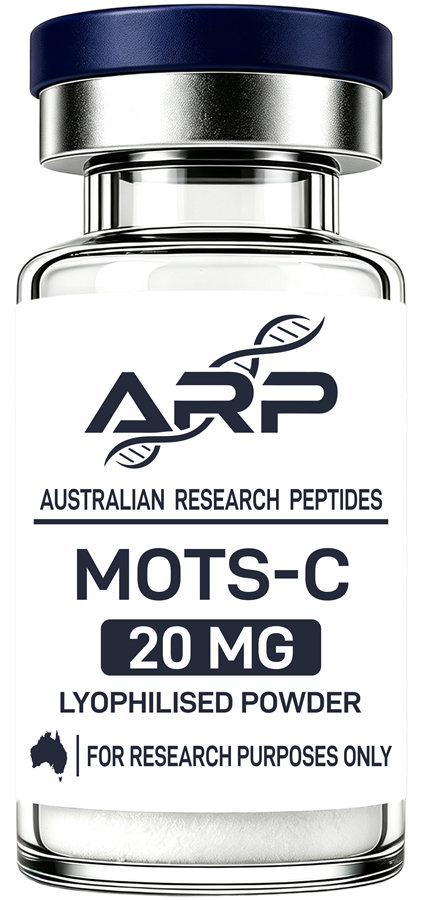
MOTS-C 20 mg

MOTS-C 20 mg is a research-grade peptide that flips on the AMPK fuel switch, supplied in Australia by Australian Research Peptides (ARP). Every batch is HPLC-tested; no certificate is published for this strength yet. This 20 mg vial is out of stock today; ARP ships from within Australia to all states and territories. For in vitro research purposes only.

Mitochondrial Research · Lyophilised Powder · Batch-tested · SKU ARP-MOTSC-20
10 mg20 mg
Out of stock·
$119.99

2+ vials: 5% off — applied automatically in the cart

Presentation
20 mg per vial
Grade
High-Purity Research Grade
Form
Lyophilised Powder
Category
Mitochondrial Research
This strength is not in stock — stocked lines dispatch same business day before 12pm AEST, Mon–Fri
Tracked shipping Australia-wide · typically 1–2 business days to most areas by Express Post · free post over $199, free Express over $299
For in vitro research purposes only. Not for human consumption. Not for animal consumption. This product is not a drug, food, cosmetic, or dietary supplement. No medical, therapeutic, or dosing information is provided.

Frequently Bought Together

About MOTS-C 20 mg

Coded inside mitochondria rather than the nucleus, its sixteen-amino-acid chain is studied against insulin sensitivity and physical capacity with age. This is the 20 mg MOTS-C vial, the larger of two, listed as ARP-MOTSC-20.

Nothing is published for the 20 mg size yet — MOTS-C lots go through HPLC, and the certificate follows.

In vitro energy metabolism research purposes only. Australian Research Peptides does not supply MOTS-C for human or veterinary use.

MOTS-C 20 mg specifications, storage and shipping

  • Compound: MOTS-C
  • Quantity: 20 mg
  • SKU: ARP-MOTSC-20
  • Presentation: sealed glass vial
  • Form: Lyophilised Powder
  • Grade: High-purity research grade
  • Purity verification: HPLC-assayed on every batch to a minimum of 99% purity — the measured result for your batch is stated on its Certificate of Analysis
  • Identity confirmation: Mass spectrometry
  • Classification: In vitro research purposes only — laboratory reference material

Lyophilised — long term
−20 °C to −80 °C — long-term storage
Lyophilised — short term
2–8 °C — refrigerated, for a few months
Reconstituted
2–8 °C — use within 8–12 weeks
Protect from light and moisture. Handle in accordance with standard laboratory safety practice, including appropriate PPE. This information is provided for laboratory handling only and is not a usage instruction of any kind.

Every batch undergoes HPLC purity analysis and mass-spectrometry identity confirmation. No laboratory report is published for this strength yet. The COA library lists every product and strength, and says which reports are available.

This strength is not in stock today. Stocked lines ordered before 12pm AEST on a business day are dispatched the same day with tracked, discreet shipping. Standard delivery within Australia typically takes 2–5 business days. See Shipping & Delivery for details, and follow your parcel on the Track Order page.

For in vitro research purposes only. Not for human consumption. Not for animal consumption. Not a drug, food, cosmetic, or dietary supplement. No therapeutic or medical claims are made.

Questions about MOTS-C 20 mg

This MOTS-C 20 mg question guide from Australian Research Peptides is specific to the exact listing, with live buying details, size comparisons, concentration calculations, storage, testing and the inherited product background grouped separately. Start with the quick answers or jump to the topic you need.

Exact strength, quantity and listing fit

Two 10 mg MOTS-C vials cost $170.98; one 20 mg vial is $119.99 — $50.99 less, and one fewer vial to store.

Per milligram, MOTS-C 20 mg works out to about $6.00 — $119.99 across 20 mg. The 10 mg MOTS-C vial works out to about $9.00 a milligram.

Twenty milligrams of dry MOTS-C, double the smaller listing, held under one seal by Australian Research Peptides. The two vials differ only in fill mass; the compound and the lyophilised presentation are the same.

Twenty thousand micrograms sit in this vial. Reconstituted to two millilitres, forty 0.05 mL portions each hold five hundred micrograms, and twenty 0.1 mL portions each hold a milligram — double the smaller listing throughout.

Twenty milligrams arrives under one seal instead of two, with one make-up and one lot number. The per-milligram figure on each MOTS-C page answers the money half; the handling half is simply fewer vials.

Longer or repeated series, where opening a second vial partway through would introduce a second lot and a second storage history. It also leaves headroom to make up a weaker solution without running short.

Live price, stock and Australian buying

Australian Research Peptides (ARP) sells MOTS-C 20 mg in Australia under ARP-MOTSC-20, at $119.99. Standard tracked post and Express Post carry MOTS-C 20 mg to all states and territories.

MOTS-C 20 mg is $119.99 a vial (ARP-MOTSC-20). Two 20 mg vials come to $227.98 after MOTS-C's 5% multi-vial discount, $12.00 off.

Not on its own. MOTS-C 20 mg is $119.99, $79.01 under $199. MOTS-C clears it with two 20 mg vials. MOTS-C's 10 mg vial falls short too.

$132.98 delivered in Australia. MOTS-C 20 mg is $119.99, plus $12.99 for ARP-MOTSC-20 by Standard tracked post. Express Post makes ARP-MOTSC-20 $136.98.

Three vials of MOTS-C. At $119.99 each, three 20 mg vials make $359.97 — past $299, so ARP-MOTSC-20 ships free by Express Post, costing $341.97.

Australian Research Peptides lists MOTS-C; Chemist Warehouse does not stock it, and no pharmacy in any market does. The mitochondrial-derived peptide is not registered as a medicine anywhere in the world, which forecloses retail pharmacy supply everywhere rather than only in Australia. ARP offers it in two research vial sizes, 10 mg and 20 mg.

Reconstitution and concentration calculations

Add bacteriostatic water to a MOTS-C vial and let the powder dissolve fully. Run the liquid in slowly and never shake the glass. The volume you add sets the strength. One millilitre into the 10 mg vial gives 10 mg/mL. Two millilitres into the 20 mg vial gives that same 10 mg/mL, and 4 mL gives 5 mg/mL. MOTS-C is a basic peptide, so a mildly acidic buffer helps if water alone is slow. Australian Research Peptides publishes a reconstitution calculator guide that works out any other combination.

Once dissolved, MOTS-C gets a 2–8 °C fridge and no more than twelve weeks in it under Australian Research Peptides' storage panel. MOTS-C holds two methionines plus a tryptophan, among the residues most readily oxidised, so it has more to lose to air and light than a shorter chain. Keep it dark throughout, and divide it rather than entering one vial repeatedly.

Yes, bacteriostatic water is the diluent normally used with a MOTS-C vial. In this context a diluent turns dry powder into something a pipette can move. Dry powder is all that sits inside the glass, with no water and no carrier beside it. Australian Research Peptides catalogues the two apart, MOTS-C under Mitochondrial Research and the water under Lab Supplies.

MOTS-C at 20 mg/mL needs 1 mL; MOTS-C at 10 mg/mL needs 2 mL. ARP-MOTSC-20 is 20 mg dry: water sets ARP-MOTSC-20 strength, never its mass.

Twenty milligrams meets one millilitre at 20 mg/mL, two millilitres at 10 mg/mL and four millilitres at 5 mg/mL. Repeating the smaller vial's two-millilitre make-up therefore doubles the concentration rather than the volume.

Product identity and research background

MOTS-C is a peptide of sixteen amino acids that mitochondria code for themselves. Almost every other peptide in a cell is coded by DNA in the nucleus. This one is coded by DNA inside the mitochondrion, the compartment that generates most of a cell's energy. Researchers first described it in 2015. Australian Research Peptides supplies it as a dry cake, for laboratory work only.

MOTS-C stands for mitochondrial open reading frame of the 12S ribosomal RNA type-c. The name records a position in the genome rather than a chemical description. An open reading frame is a run of genetic code that can be read as instructions for a peptide, and MOTS-C is classed as a mitochondrial-derived peptide.

MOTS-C acts through AMPK, the switch a cell throws when energy runs short. Lee's 2015 Cell Metabolism report describes it blocking part of the folate cycle, which builds up a molecule called AICAR, and AICAR turns AMPK on. Kim 2018, in the same journal, found that under metabolic stress the peptide also moves into the nucleus within about thirty minutes, binding antioxidant response elements and changing how strongly stress-response genes are read. These are findings in cells and in mice.

Most MOTS-C research uses mice and cell culture. Lee and colleagues reported in Cell Metabolism in 2015 that treatment prevented insulin resistance caused by age and a high-fat diet, and prevented diet-induced obesity in mice. Reynolds 2021, in Nature Communications, described better physical capacity and healthspan in old mice and measured an 11.9-fold rise in MOTS-C in the muscle of ten human volunteers after exercise. Those findings do not establish a result for the research material on this page.

A MOTS-C vial holds freeze-dried peptide and nothing beside it. The solid is white to off-white, and all of it is the peptide rather than peptide spread through a filler. The glass is sealed under a tamper-evident cap. Nothing is dissolved, blended or split before dispatch, and the seal stays closed until a laboratory opens it.

Reynolds and colleagues injected mice with MOTS-C at 15 mg per kilogram per day, into the abdominal cavity. Middle-aged and old C57BL/6N mice took a treadmill test after two weeks of daily injections. A separate group started late in life, at 23.5 months of age, and was injected three times weekly. Every figure there is measured in mice, and Australian Research Peptides publishes no amount for a person.

Nobody has published how quickly MOTS-C is cleared. Santhanam's 2026 rat-heart paper in Naunyn-Schmiedeberg's Archives of Pharmacology closes by calling for pharmacokinetic studies, which is an admission that none exist. Reynolds' 2021 human observations point elsewhere on timing: muscle levels rose almost twelve-fold with exercise and remained raised four hours afterwards, so the signal outlives any brief spell in blood.

MOTS-C is sixteen amino acids long, and the sequence PubChem records for CID 146675088 runs Met-Arg-Trp-Gln-Glu-Met-Gly-Tyr-Ile-Phe-Tyr-Pro-Arg-Lys-Leu-Arg. Gao's 2023 review in Metabolites reports the first eleven positions as highly conserved between species. Residue is the technical word for one amino-acid unit in a chain, so sixteen residues and sixteen amino acids describe the same thing. Both Australian Research Peptides vial sizes hold that identical chain.

MOTS-C produced clear metabolic effects in mice — improved insulin sensitivity and resistance to diet-induced weight gain in the studies that first characterised it. It is a genuinely interesting mitochondrial peptide with a real literature behind it. That literature is almost entirely preclinical, and no controlled human trial has tested any of it.

No published study answers this question for a person, because MOTS-C has no completed human trial for anyone to answer it from. The animal literature measures metabolic changes over days to weeks of repeated administration rather than after a single one, and cell-culture work reports effects within hours in a dish, which is a different question again. Any specific timeframe quoted for people is invented.

The literature holds no answer for MOTS-C, because no study has observed anything once administration finished. Work on this mitochondrial peptide is barely a decade old and confined largely to mice and cultured cells, all measured during treatment. No rebound, no dependence and no lasting effect has been documented. The candid position is that cessation has never been examined.

MOTS-C has no published controlled human trial, so there is no human side-effect data for it at all. The mouse studies behind it reported no overt toxicity at the doses and durations used, which is a narrow finding from a short study in a different species rather than a safety profile.

Storage, condition and testing

Yes — MOTS-C at ten milligrams presents as a slight pale deposit that plenty of buyers overlook completely, while the twenty-milligram vial holds double and reads far more obviously as a cake. Sixteen amino acids of dried peptide simply do not fill much volume. Neither strength has filler or carrier added, which is precisely why so little sits there to look at.

MOTS-C carries two methionines and a tryptophan, and those amino acids oxidise more readily than the others. Bachem's handling guidance keeps a lyophilisate dry and tightly closed below -15 °C, and prefers colder again for the long term. Cold glass pulls water out of the air. Stand the sealed vial in a desiccator until it is no longer cold, then unseal it. Solutions keep poorly, so freeze them in single-use aliquots.

Air is the ordinary culprit in a cloudy MOTS-C vial. Swirling or inverting it repeatedly forces bubbles through the liquid, and those scatter light indistinguishably from real turbidity before dispersing once everything is left alone. The twenty-milligram strength needs longer to finish clearing than the ten does, being twice the solid. Anything opaque beyond that, or grit which will not shift, is not simply bubbles.

No MOTS-C batch is sold untested. HPLC measures how pure the peptide is. Mass spectrometry checks that the mass matches a sixteen-amino-acid chain, and a chain missing even one amino acid weighs something different. No salt form is published, because it is not confirmed for this material. No matching certificate is currently published for this product and strength.

Delivery, payment and access questions

Australian Research Peptides sells MOTS-C for in vitro research purposes only, and not as a medicine. It is not supplied for use in people or in animals, and no ARP material describes such use. MOTS-C is a research compound rather than an approved treatment, and it has not been assessed for that purpose. Anyone buying it takes responsibility for the rules that govern their own work.

MOTS-C has been approved by no drug regulator in any country, and no registered medicine contains it. Lee and colleagues only described this mitochondrial-encoded peptide in 2015, so its scientific record is short and almost wholly preclinical, and none of it has been submitted for review. A vial of it is unregistered material intended for laboratory experiments.

MOTS-C is banned in sport and, unusually, is spelled out in full. The list names mitochondrial open reading frame of the 12S rRNA-c at section S4.4.1, grouping it with AICAR as an AMPK activator among the metabolic modulators. Prohibition applies in and out of competition alike. Sport Integrity Australia oversees testing for Australian athletes.

All MOTS-C strengths and full compound detail