
Same-Day DispatchAustralian StockDiscreet DeliveryPremium Research GradeVerified CoAs
Same-day dispatch on business-day orders before 12pm AEST.Same-day dispatch before 12pm AESTFree post $199+

Melanotan II

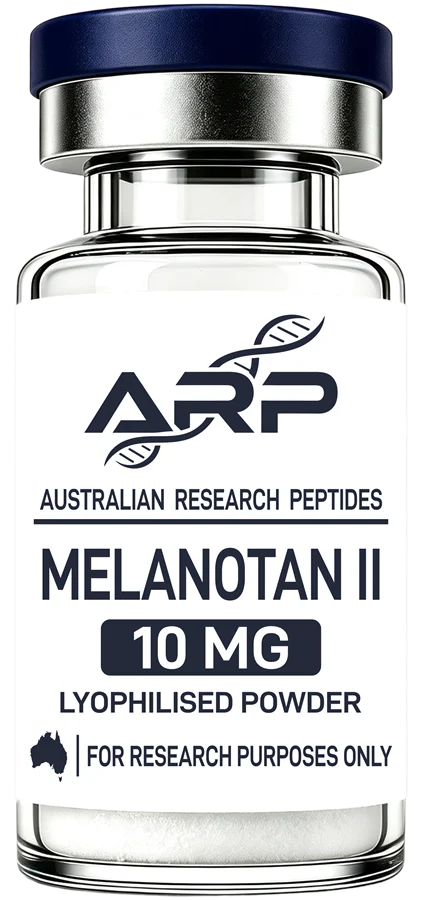
Melanotan II darkens skin, and it is stocked in Australia by Australian Research Peptides in one sealed 10 mg vial of freeze-dried powder, a cyclic ring of seven amino acids. It copies alpha-MSH, the hormone that tells melanocytes to make melanin, and switches on the MC1 receptor those pigment cells carry; the pathway that produces pigment in skin. The Guide to Pharmacology also logs it as a full agonist at MC3, MC4 and MC5, where animal work points to appetite suppression. For in vitro research purposes only.

Melanocortin Agonists · Lyophilised Powder · Batch-tested · SKU ARP-MT2-10
In stock·99.833%
$79.99
1

2+ vials: 5% off — applied automatically in the cart

Presentation
10 mg per vial
Grade
High-Purity Research Grade
Form
Lyophilised Powder
Category
Melanocortin Agonists
Same-day dispatch on business-day orders placed before 12pm AEST, Mon–Fri
Tracked shipping Australia-wide ·typically 1–2 business days to most areas by Express Post · free post over $199, free Express over $299
Batch certificates — published in the COA library
For in vitro research purposes only. Not for human consumption. Not for animal consumption. This product is not a drug, food, cosmetic, or dietary supplement. Any amounts shown are reported from published studies, with the species or trial population named. ARP gives no dosing, medical or therapeutic guidance of its own.
Melanotan II · 10 mg
$79.99

Frequently Bought Together

About Melanotan II

Melanotan II works through the melanocortin receptors. There are five of them, MC1R through MC5R, and they are docking points on the surface of cells. The IUPHAR/BPS Guide to Pharmacology records it as a full agonist at the human MC1, MC3, MC4 and MC5 receptors, and lists no interaction at MC2. Agonist means it turns those receptors on rather than blocking them. MC1R sits on the pigment cells of the skin, which is why most published work on this compound concerns pigmentation.

The evidence base is thin and almost entirely preclinical. Development of the compound as a medicine was halted on safety grounds. A 2022 experiment in mice found that Melanotan II delivered into the nucleus accumbens cut both food intake and the effort the animals spent getting food. A 2003 rat study reported better sensory recovery after sciatic nerve injury.

Melanotan II is a cyclic peptide of seven amino acids, built from residues 4 to 10 of alpha-MSH and closed into a ring by a lactam bridge. Its sequence is Ac-Nle-cyclo[Asp-His-D-Phe-Arg-Trp-Lys]-NH2. The free base is C50H69N15O9, molar mass 1,024.2, and its CAS number is 121062-08-6. ARP leaves those rows out of the spec table because the acetate salt that research peptides usually arrive as carries a different formula and a different mass.

Two neighbours in this catalogue get confused with it. Melanotan I is afamelanotide, a linear thirteen-residue peptide approved as a medicine by the EMA in 2014 and the FDA in 2019, and ARP does not stock it. PT-141 is bremelanotide, which differs only at the end of the ring, and ARP lists that one separately. The popular claim that Melanotan I acts at one receptor and Melanotan II at several is not what the Guide to Pharmacology shows — both are logged as full agonists at the same four subtypes.

Content reviewed

Melanotan II specifications, storage and shipping

  • Compound: Melanotan II
  • Also known as: Melanotan II
  • Class: Cyclic alpha-MSH analogue; non-selective melanocortin receptor agonist
  • Sequence: Ac-Nle-cyclo[Asp-His-D-Phe-Arg-Trp-Lys]-NH2
  • Appearance: White to off-white lyophilised powder
  • Sizes & SKUs: 10 mg (ARP-MT2-10)
  • Presentation: sealed glass vial
  • Form: Lyophilised Powder
  • Grade: High-purity research grade
  • Purity verification: HPLC-assayed on every batch to a minimum of 99% purity — the measured result for your batch is stated on its Certificate of Analysis
  • Identity confirmation: Mass spectrometry
  • Batch traceability: every batch is tested, with its certificate published in the COA library
  • Classification: In vitro research purposes only — laboratory reference material

Lyophilised — long term
−20 °C to −80 °C — long-term storage
Lyophilised — short term
2–8 °C — refrigerated, for a few months
Reconstituted
2–8 °C — use within 8–12 weeks
Protect from light and moisture. Handle in accordance with standard laboratory safety practice, including appropriate PPE. This information is provided for laboratory handling only and is not a usage instruction of any kind.

Every batch undergoes HPLC purity analysis and mass-spectrometry identity confirmation. The full laboratory report is published in the COA library.

Business-day orders before 12pm AEST are dispatched the same day with tracked, discreet shipping. Standard delivery within Australia typically takes 2–5 business days. See Shipping & Delivery for details, and follow your parcel on the Track Order page.

For in vitro research purposes only. Not for human consumption. Not for animal consumption. Not a drug, food, cosmetic, or dietary supplement. No therapeutic or medical claims are made.

Questions about Melanotan II

This question guide from Australian Research Peptides covers Melanotan II in Australia: what the listing contains, live buying and delivery questions, research context, handling, testing and comparisons. Start with the quick answers, then open the topic group that matches your search.

Buying, price and availability

Australian Research Peptides supplies Melanotan II within Australia, and a weekday request lodged before 12pm AEST is packed and dispatched that same afternoon. Melanotan 2, MT-2, MT2 and MT II all resolve to this one listing, catalogued under the code MT2. Tracked delivery runs to every state and territory, Express or standard, and the parcel starts its journey inside Australia.

Melanotan II is supplied by Australian Research Peptides — ARP — which HPLC-tests every batch. ARP shelves this vial beside PT-141 in Melanocortin Agonists and carries no Melanotan I. As an Australian business it posts domestically rather than across a border, and takes PayID or a direct bank transfer.

Melanotan II carries a single Australian-dollar price per vial, because it is listed in one size only — no strength ladder to compare and no per-milligram rate to work out. Australian Research Peptides draws both that figure and the vial's current availability from live catalogue data, never from hard-typed text. The HPLC Verified grade, rather than the product category, is what attaches the automatic multi-vial discount.

Melanotan II is supplied online by Australian Research Peptides, a domestic seller that posts within the country and sends nothing overseas. Payment is by PayID or bank transfer, which rules out cards, wallets and crypto altogether. Every order is issued its own payment reference and bank details by email, and the vials stay reserved until that transfer is matched. Nothing is taken by telephone.

Melanotan II is available from Australian Research Peptides and not from Chemist Warehouse or any other Australian pharmacy. It is not a registered medicine in this country and no approved formulation of it exists, so there is nothing a pharmacist could lawfully supply. ARP supplies it strictly as a research compound, sealed in a glass vial for laboratory use.

Identity, names and exact format

Melanotan II is a cyclic seven-amino-acid peptide and a non-selective melanocortin receptor agonist studied primarily in relation to skin pigmentation, because MC1R governs melanin production in pigment cells. Research has also examined appetite and nerve repair through other melanocortin receptors in cell culture, animal models and one small early human study. Australian Research Peptides supplies this material for laboratory work and draws no conclusion of its own from that literature.

A Melanotan II vial holds freeze-dried peptide powder and nothing else. The quantity is recorded against the vial in Australian Research Peptides' catalogue. No diluent, no solvent and no preservative is added, and nothing arrives pre-mixed. The glass vial is tamper-evident, so a broken seal is visible before you open it. Bacteriostatic water sits in Lab Supplies as its own line rather than inside the peptide vial.

Melanotan II has seven amino acids, which makes it a cyclic heptapeptide. It takes the 4-to-10 stretch of alpha-MSH, a natural hormone thirteen residues long. A lactam bridge ties the aspartic acid to the lysine and closes the chain into a ring. That bridge is the design change separating Melanotan II from the linear Melanotan I.

Melanotan II is commonly shortened to MT2. Australian Research Peptides also uses MT2 as its stock code. PubChem lists the free base under CAS 121062-08-6 and includes Melanotan II acetate among its synonyms. Melanotan I, also called afamelanotide, is a separate compound rather than another name for Melanotan II.

Melanotan II is supplied by Australian Research Peptides as a single 10 mg vial of freeze-dried powder, stock code ARP-MT2-10. It is not a spray, a solution, or a pre-mixed device of any kind, so it has to be reconstituted before laboratory work begins. Nasal preparations offered elsewhere carry the same peptide in a different presentation, and nothing in this listing supplies one. The figure on the label is the dry weight sealed inside the vial.

Research context and evidence

Melanotan II copies alpha-MSH, the hormone that switches on pigment production. It binds melanocortin receptors and activates them, which is what an agonist does. The Guide to Pharmacology gives it full agonist activity at four human subtypes: MC1, MC3, MC4 and MC5. MC1 is the receptor on skin melanocytes, the cells that hold pigment. MC3 and MC4 sit largely in the brain, which is where the appetite research points.

Dorr's 1996 pilot phase-I trial, published in Life Sciences, gave Melanotan II to three healthy men. Two showed increased pigmentation on the face, upper body and buttock, measured by reflectance a week later. Mild nausea appeared at most levels, and one of two men reached Grade II somnolence and fatigue at 0.03 mg/kg. Eliason 2022 later found reduced food intake in mice, and Ter Laak 2003 better nerve recovery in rats.

Dorr 1996 started three healthy men on 0.01 mg/kg of Melanotan II. Amounts rose in 0.005 mg/kg steps. Two men reached 0.03 mg/kg and one reached 0.025 mg/kg. Dorr and colleagues closed by recommending 0.025 mg/kg per day for future phase-I research. Those numbers describe that trial and nothing else. Australian Research Peptides states no amount for use by anyone.

Two published animal studies state an amount of Melanotan II. Ter Laak's 2003 rats got 20 micrograms per kilogram every 48 hours under the skin, and that level improved sensory recovery while 2 and 50 did not. Eliason's 2022 team put 0.1, 0.3 and 1 nanomole into the nucleus accumbens of male C57BL/6J mice. The 0.3 nanomole level held feeding down longest.

No human half-life for Melanotan II has been published. Dorr's 1996 pilot in Life Sciences followed pigmentation and adverse effects in three volunteers and measured no plasma concentrations at all; what kinetic work exists was done in rats. The sibling compound was measured in people, though: Ugwu's 1997 paper in Biopharmaceutics and Drug Disposition gives melanotan-I an elimination phase of 0.8 to 1.7 hours, while its tanning peaked a week later and lingered three weeks.

The 1996 human study of Melanotan II reported measurable pigmentation change after repeated administration over a period of days rather than after a single exposure. That was a small early trial with a defined protocol, not a consumer timeline, and nothing published since gives a reliable figure for what happens outside that setting.

What follows stopping Melanotan II has barely been examined in people. Dorr's early trial — three volunteers, the entire human dataset — measured raised facial and body pigmentation by quantitative reflectance one week after administration finished, and went no further. Whether that colour fades, and across what span, was never followed. Beyond that single reading, no observation of cessation exists.

Melanotan II's published record is case reports rather than controlled trials, and it is not a clean one. Nausea and facial flushing are commonly described; so is darkening and enlargement of existing moles, and the literature contains case reports of melanoma diagnosed in users. It has no regulatory approval anywhere and no safety monitoring behind it.

Both the human and the rat study of Melanotan II used subcutaneous injection, meaning under the skin. Dorr 1996 injected its volunteers on weekdays across two consecutive weeks, alternating with saline on the days between. Ter Laak's 2003 rats received one injection every 48 hours. Eliason 2022 took a different route and microinjected the peptide directly into a brain region.

Melanotan II does have human pigmentation data, and it is very small. Dorr's 1996 phase-I trial gave the peptide to three healthy men; two showed increased pigmentation across the face, upper body and buttock, measured by reflectance. Mild nausea appeared at most levels and one man reached Grade II somnolence and fatigue. Three volunteers in an early safety trial is where the published human record begins and ends, and no larger controlled trial has appeared since.

Handling, storage and measurements

Melanotan II is supplied as ten milligrams of dry ring-closed peptide, an amount resembling almost nothing once water has been sublimed away. Many vials show only a whitish rim around the base or a scattering of fine particles. Colour deserves more attention than volume with this compound: sound dry material is white to off-white, so a browned or yellowed deposit is the real warning sign.

Melanotan II carries a tryptophan, the amino acid most prone to oxidising, so keep the vial dark and dry. Bachem's figure for a dried peptide is anything below -15 °C, with colder better still. Open it only after a desiccator has brought the glass back to ambient, otherwise the powder pulls in moisture. Reseal tightly. Solutions go into aliquots and stay frozen.

Sealed Melanotan II powder kept cold and dry is the stable state; the fragile state is after reconstitution, where it is refrigerated and has a far shorter life. Visible signs that a mixed vial should not be used are cloudiness, particles, or powder that will not fully dissolve. Colour change in the dry cake is also a reason to stop.

Melanotan II is a ring-closed powder, and it goes into solution without much coaxing. Bring the vial up to room temperature while the seal is still on. Aim the diluent at the glass shoulder, never at the cake itself. Roll the vial between your fingers until the liquid clears, and do not shake. Bachem suggests a water bath sonicator for particles that hold out. Aliquot and freeze.

Divide the 10 mg in a Melanotan II vial by the millilitres you add. One millilitre of bacteriostatic water gives 10 mg/mL. Two millilitres give 5 mg/mL, and five millilitres give 2 mg/mL. The peptide mass never changes, so the volume alone sets the strength. Australian Research Peptides' reconstitution calculator guide runs the same sum for any pair of numbers.

Reconstituted Melanotan II is refrigerated at 2–8 °C and used inside eight to twelve weeks. Melanotan II closes its ring with an amide, and losing that amide yields the free acid catalogued separately as PT-141 — so it has a named chemical fate in water rather than a vague one. How quickly that runs in a chilled vial has never been published.

With Melanotan II, transient haze and lasting haze mean opposite things. Air folded in while the cake dissolves disperses within minutes, as does the slower clearing of contents used straight from cold. Material that stays clouded once warmed and rested, or leaves solid on the bottom refusing to shift, has either not dissolved properly or aggregated — and discolouration of the dry powder carries equal weight.

Yes — Melanotan II ships as a dry cake and must be dissolved before it is pipetted. Diluent means the liquid a powder goes into, nothing more technical than that. Melanotan II is usually paired with bacteriostatic water, and Australian Research Peptides lists that water in Lab Supplies as a separate consumable rather than packing it inside this box.

A 10 mg Melanotan II vial is 10,000 micrograms however it is prepared. What varies is how many syringe units each draw occupies: reconstitute with 1 mL and 250 mcg sits at 2.5 units, reconstitute with 2 mL and the same 250 mcg reads as 5 units. Same vial, same draws, different numbers on the barrel.

Testing and batch documents

Australian Research Peptides tests every batch of Melanotan II before it is sold. High-performance liquid chromatography measures how much of the sample is the peptide. Mass spectrometry then confirms the molecule really is Melanotan II and not a look-alike powder. Identity is the load-bearing half for Melanotan II, because it, Melanotan I and PT-141 sit close enough in name to be mixed up. A matching certificate is currently published for this product and strength. Open the 10 mg certificate.

Ordering, payment and Australian delivery

A Melanotan II order holds its stock for two business days while payment clears, with reminder emails along the way. If nothing arrives by the deadline the reservation lapses and the vials return to general stock — the order is not cancelled out of spite, the stock is simply released for someone else.

Melanotan II is among Australian Research Peptides’ lower-priced lines, so a pair of vials sits under the free Standard tracked post threshold and three clear it. Adding the consumables a dry vial cannot be used without takes a two-vial order most of the way there. Free Express Post is a different and higher threshold again. Both are read on the pre-discount subtotal.

Melanotan II normally arrives within a 2–5 business day window on standard tracked post, or as few as 1–2 by Express Post depending on the destination state. Those figures are capital-city routes. A regional or remote address generally adds days on top — the difference between Perth and a WA mining town, or Brisbane and far north Queensland, is real, and is the carrier's rather than ours.

There is an order of operations, and Melanotan II arrives at step zero of it: a sealed vial of dry powder. Bacteriostatic water goes in first, drawn with one syringe; the reconstituted solution comes out afterwards, drawn with another. So the vial alone is not usable, and both consumables are bought separately.

Access, approval and sport questions

No, Melanotan II has no approved product anywhere and no regulatory label. Afamelanotide is the only melanocortin agonist that does. Under the brand SCENESSE, its US label specifies a single 16 mg implant placed under the skin above the anterior supra-iliac crest every two months. It is approved for adults with erythropoietic protoporphyria, a light sensitivity disorder.

Melanotan II holds no TGA approval, is not a registered medicine in Australia, and has been the subject of public TGA warnings about products containing it. Australian Research Peptides supplies it as a laboratory research chemical, not for use in people or animals. Whatever obligations follow from holding it are yours to check, not the supplier's to resolve.

Melanotan II is not registered with the Therapeutic Goods Administration. That makes it an unapproved good rather than a medicine you can be prescribed off the shelf, and the TGA has publicly warned against tanning products containing melanotan. Australian Research Peptides sells Melanotan II strictly as a bench reagent for glassware and cultured cells, not as a therapeutic good, and gives no advice on use to anyone for any purpose.

Melanotan II is banned in sport throughout the year. No government health authority in any country has licensed it, placing it inside S0, the residual heading covering substances the list does not name individually. Tanning is not a performance purpose, and that changes nothing — the rule reads what a sample contains. Sport Integrity Australia handles queries from Australian athletes.

Melanotan II sent by an overseas seller can be detained on arrival, since unapproved goods are exactly what border screening targets, and once a package is held there is rarely any remedy against a foreign vendor. Ordering it from Australian Research Peptides avoids that entirely — ARP dispatches within Australia and never presents a parcel for clearance. Australian Border Force publishes what it detains and under whose authority.