
For laboratory research use only. Not for human or veterinary use.Lab research use only. Not for human or animal use.

Same-Day DispatchAustralian StockPremium Research GradePublished CoAsPayID · Clears in Seconds
Same-day dispatch on business-day orders before 12pm Sydney time.Same-day dispatch before 12pm Sydney timeFree standard post $199+Free std post $199+

Buy CJC-1295 (no DAC) + Ipamorelin 10 mg in Australia

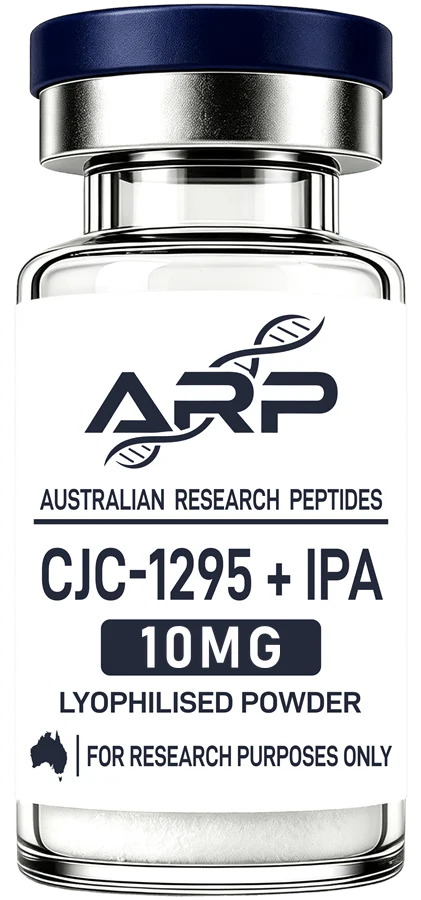
CJC-1295 (no DAC) + Ipamorelin 10 mg, often searched as CJC 1295 ipamorelin, is A$129.99 a vial in Australia from Australian Research Peptides, which supplies laboratories and researchers, though it is out of stock for now. Both peptides are freeze-dried together at a fixed ratio. The 29-amino-acid CJC-1295 half is a modified copy of growth-hormone-releasing hormone that binds the GHRH receptor, and the five-amino-acid ipamorelin half binds the ghrelin receptor. Both are studied in growth hormone research, and orders ship to every state and territory. In vitro research purposes only.

GHRH and Secretagogue Research · Lyophilised Powder · Independently lab-tested · SKU 45388
Out of stock·
$129.99

CJC-1295 (no DAC) + Ipamorelin 10 mg is sold out for now. Leave your email and ARP will send you one email the day it is back. Nothing else.

Presentation
10 mg per vial
Grade
Research Grade
Form
Lyophilised Powder
Category
GHRH and Secretagogue Research
This strength is not in stock — stocked lines dispatch same business day before 12pm Sydney time, Mon–Fri
Tracked shipping Australia-wide · typically 1–2 business days to most areas by Express Post · free post over $199, free Express over $299
Batch certificates — published in the COA library
For in vitro research purposes only. Not for human consumption. Not for animal consumption. This product is not a drug, food, cosmetic, or dietary supplement. No medical, therapeutic, or usage information is provided.
CJC-1295 (no DAC) + Ipamorelin 10 mg
$129.99
Notify Me

In stock at Australian Research Peptides

CJC-1295 (no DAC) + Ipamorelin is out of stock, and Australian Research Peptides has not put a substitute in its place. These are in stock on the shelf in Australia.

About CJC-1295 (no DAC) + Ipamorelin

This CJC-1295 (no DAC) + Ipamorelin vial holds two peptides that target two different receptors. CJC-1295 without DAC is a modified copy of the first 29 amino acids of growth-hormone-releasing hormone, the signal the hypothalamus sends to the pituitary gland, where its receptor sits on the growth-hormone cells. Ipamorelin is five amino acids long and binds a separate target, the growth hormone secretagogue receptor, which is the one ghrelin binds. An agonist is a molecule that binds a receptor and switches it on. Both molecules are studied in growth hormone research.

Australian Research Peptides supplies the no-DAC form, and the difference matters, because the two versions of CJC-1295 are often confused. The DAC version has an added Drug Affinity Complex, a lysine linked through maleimidopropionic acid, which binds serum albumin, a protein that circulates in the blood. That structural difference is why the two forms are not interchangeable. The no-DAC version has no such tail, and it is the same compound sold elsewhere as Modified GRF (1-29). Both peptides are dried together into one powder, so the strength shown covers the pair rather than either one alone.

Australian Research Peptides supplies the pair as a single freeze-dried solid, white to off-white, sealed in a tamper-evident glass vial. Once they are in the vial, the two peptides cannot be separated, so the amount of liquid added sets the concentration but can never change the ratio. The material is a laboratory reference compound, characterised for work in glassware and cell culture, not for any use in a living subject.

BAC water (bacteriostatic water) is also sold by Australian Research Peptides.

The peptide calculator works out the mg/mL concentration of a reconstituted vial.

What is in the vial

CJC-1295 (no DAC) + Ipamorelin composition per vial
ComponentAmount per vial
CJC-1295 (no DAC) — no DAC — not the DAC-modified analogue; also catalogued as Modified GRF (1-29)~5 mg
Ipamorelin~5 mg
Total10 mg per vial

CJC-1295 (no DAC) + Ipamorelin specifications, storage and shipping

  • Compound: CJC-1295 (no DAC) + Ipamorelin
  • Also known as: CJC-1295 without DAC (Modified GRF (1-29)) with ipamorelin
  • Class: Two-peptide blend: a growth-hormone-releasing-hormone analogue with a growth-hormone secretagogue-receptor ligand
  • Appearance: White to off-white lyophilised powder
  • Quantity: 10 mg
  • SKU: 45388
  • Sizes & SKUs: 10 mg (45388)
  • Presentation: sealed glass vial
  • Form: Lyophilised Powder
  • Grade: Research grade
  • Testing: Independently lab-tested for identity and amount before release — the laboratory's report for this blend gives a measured amount for each peptide and no purity figure
  • Identity confirmation: Mass spectrometry
  • Certificates: issued by Janoshik, an independent laboratory, and published in the COA library
  • Classification: In vitro research purposes only — laboratory reference material

Lyophilised — long term
−20 °C to −80 °C — long-term storage
Lyophilised — short term
2–8 °C — refrigerated, for a few months
Reconstituted
2–8 °C — use within 8–12 weeks
Protect from light and moisture. Handle in accordance with standard laboratory safety practice, including appropriate PPE. This information is provided for laboratory handling only and is not a usage instruction of any kind.

CJC-1295 (no DAC) + Ipamorelin is independently lab-tested for identity and amount. The full laboratory report is published in the COA library. CJC-1295 (no DAC) + Ipamorelin is tested by Janoshik, an independent laboratory, commissioned by the manufacturer rather than by Australian Research Peptides.
  • CJC-1295 (no DAC) + Ipamorelin 10 mg: measured content Ipamorelin 5.48 mg · CJC-1295 (mod GRF 1-29) 5.41 mg · CJC-1295 DAC not detected · laboratory batch 2026-06 · analysed 22 June 2026

This strength is not in stock today. Stocked lines ordered before 12pm Sydney time on a business day are dispatched the same day with tracked shipping. Standard delivery within Australia typically takes 2–5 business days. See Shipping & Delivery for details, and follow your parcel on the Track Order page.

For in vitro research purposes only. Not for human consumption. Not for animal consumption. Not a drug, food, cosmetic, or dietary supplement. No therapeutic or medical claims are made.

Questions about CJC-1295 (no DAC) + Ipamorelin

This question guide from Australian Research Peptides covers CJC-1295 (no DAC) + Ipamorelin in Australia: what the listing contains, live buying and delivery questions, research context, handling, testing and comparisons. Start with the quick answers, then open the topic group that matches your search.

Quick answers

Laboratories and researchers in Australia can buy CJC-1295 (no DAC) + Ipamorelin from Australian Research Peptides as a 10 mg vial at A$129.99, out of stock for now. It is one vial under the code CJCIPA, paid by PayID or bank transfer. Nothing can be sent out while the vial is unavailable, and the Monday-to-Friday 12pm Sydney time cut-off applies again when the next batch arrives. The vial holds the no-DAC form, not the DAC-modified peptide with almost the same name.

CJC-1295 (no DAC) + Ipamorelin is a blend of two peptides in one vial, one that binds the growth-hormone-releasing hormone receptor and one that binds the growth hormone secretagogue receptor. Having two different receptor targets is why the pair is studied together. The no DAC part matters: this is the unmodified form, not the DAC version, which carries an extra lysine that sticks to albumin, a blood protein.

Yes, CJC-1295 (no DAC) + Ipamorelin is tested before supply, and the report gives each peptide's measured content separately, with the DAC-modified form of CJC-1295 recorded as not detected. It lists Ipamorelin and CJC-1295 (mod GRF 1-29) in milligrams. The manufacturer hires an independent laboratory to run the tests for Australian Research Peptides. Mass spectrometry checks the measured mass against two expected values, one for each peptide, which is what tells the no-DAC compound apart from the DAC version with almost the same name. Both amounts are on its CJC-1295 + Ipamorelin COA. CJC-1295 (no DAC) + Ipamorelin is supplied for in vitro research purposes only.

Two CJC-1295 (no DAC) + Ipamorelin vials comfortably qualify for free Standard tracked post in Australia, but a single vial falls well short of the free shipping threshold. Free Express Post has a separate, higher threshold that two vials do not reach. The threshold is based on your goods subtotal before any discount code, so using a code never takes an order back below it.

CJC-1295 (no DAC) + Ipamorelin and tesamorelin are both built around a GHRH-receptor analogue, but their structures differ, and only the blend includes a second peptide. Tesamorelin is GHRH(1-44) with a trans-3-hexenoyl group on its N-terminus, while the CJC-1295 (no DAC) half of this blend is GHRH(1-29) with four amino acids swapped. That second peptide, ipamorelin, binds a second receptor that tesamorelin has no counterpart for. Australian Research Peptides lists both under GHRH and Secretagogue Research.

CJC-1295 (no DAC) + Ipamorelin pairs two peptides that each bind a different receptor, and both receptors are studied in growth hormone research. The CJC-1295 half is 29 amino acids long, a modified copy of growth-hormone-releasing hormone, and binds the GHRH receptor on the growth-hormone cells of the pituitary gland at the base of the brain. Ipamorelin is the five-amino-acid peptide Aib-His-D-2-Nal-D-Phe-Lys-NH2 and binds the growth hormone secretagogue receptor instead, the one ghrelin binds. These are laboratory binding measurements, not outcomes.

Buying, price and availability

Australian Research Peptides Pty Ltd, trading as ARP, supplies CJC-1295 (no DAC) + Ipamorelin in Australia, posting to every state and territory, including Western Australia and the Northern Territory, by Express or tracked post. The blend sits in the GHRH and Secretagogue Research category beside tesamorelin and standalone ipamorelin, and it is the only two-peptide product of the three.

CJC-1295 (no DAC) + Ipamorelin costs A$129.99 for the 10 mg vial (out of stock) at Australian Research Peptides, which sells the blend to laboratories and researchers in that one strength. A vial of this blend and a vial of standalone ipamorelin are separate items on an order, each with its own price, and postage is added by the service chosen. Dispatch resumes once the blend is restocked.

CJC-1295 (no DAC) + Ipamorelin is sold online by Australian Research Peptides through its website only, with no orders taken by phone or email. You can pay by PayID or a direct bank transfer, while digital wallets, buy-now-pay-later instalments and crypto are not accepted for any product. Stock is held and posted within Australia, and when the blend is unavailable you can sign up for an email alert.

No, you cannot buy CJC-1295 (no DAC) + Ipamorelin at Chemist Warehouse, or at any Australian pharmacy, because growth-hormone secretagogues like these have no Australian registration. That means no pharmacy can supply them. Australian Research Peptides sells the pair as a single 10 mg research vial under GHRH and Secretagogue Research.

CJC-1295 is not sold on its own by Australian Research Peptides, which offers it to laboratories and researchers in Australia only as a two-peptide vial with ipamorelin, freeze-dried together. A CJC 1295 listing on its own usually means the DAC-modified version, a structurally different molecule with an extra lysine that binds albumin, whereas the vial on this page is the no-DAC form, also known as Modified GRF (1-29). Ipamorelin is listed separately if only that half is wanted, and the two cannot be separated once dried into one cake.

When comparing CJC-1295 (no DAC) + Ipamorelin suppliers in Australia, check that the listing names the no-DAC form, not the DAC-modified version with almost the same name. Also check that the supplier publishes the laboratory's own certificate for the batch, with a measured amount of each peptide, rather than a retyped number. Australian Research Peptides publishes that certificate, holds stock in Australia and posts within the country, so a vial never crosses a border.

Identity, names and exact format

CJC-1295 (no DAC) + Ipamorelin contains two chains of very different lengths: the CJC-1295 half has 29 amino acids and the ipamorelin half has five. The CJC-1295 chain matches the first 29 amino acids of growth-hormone-releasing hormone, with four positions swapped. Two of ipamorelin's five are mirror-image D-forms that a plain sequence readout cannot tell apart from ordinary ones. Both chains are dried into one powder rather than kept separate.

A CJC-1295 (no DAC) + Ipamorelin vial from Australian Research Peptides holds 10 mg in total, blended at the standard 1:1 ratio, so it contains about 5 mg of each peptide. The two are dried into one cake, so the strength on the label is the total for the pair, not the amount of either one. These are the planned formulation figures. Blend labels are genuinely confusing across the industry, because the same number can mean a combined total or that amount of each peptide. When a batch document with exact strengths is published, its lab-measured amount for each peptide takes priority over the planned figures.

CJC-1295 (no DAC) + Ipamorelin has no single scientific synonym because it contains two peptides, each with its own set of names. CJC-1295 without DAC is also known as Modified GRF (1-29), often shortened to Mod GRF 1-29, and ipamorelin has the development code NNC 26-0161. Australian Research Peptides uses CJCIPA as the catalogue code for this two-peptide vial.

This CJC-1295 is without DAC: Australian Research Peptides supplies only the no-DAC form, also known as Modified GRF (1-29), in this listing. The DAC version carries an extra lysine bearing a Drug Affinity Complex, which binds serum albumin, a protein carried in the bloodstream. That makes it a structurally different molecule, and it is not listed here. Contact Australian Research Peptides support if the DAC form is what your work needs.

CJC-1295 (no DAC) + Ipamorelin is supplied as one vial, with both peptides freeze-dried together into a single powder and sealed in tamper-evident glass. It is not two vials boxed as a pair, and the two peptides cannot be separated once dried. If you need them apart, Australian Research Peptides also sells ipamorelin on its own as a standalone listing.

Yes, CJC1295 ipamorelin, cjc 1295 and ipamorelin, and cjc ipamorelin are all ways of typing the same product: the single Australian Research Peptides vial holding both peptides freeze-dried together. The hyphen and the space make no chemical difference: CJC-1295, CJC 1295 and CJC1295 all name the same 29-amino-acid chain. CPC 1295 also turns up, but that is a typing slip for CJC, not a different compound.

Research context and evidence

CJC-1295 (no DAC) + Ipamorelin belongs to growth hormone research, where each half is described by the receptor it binds rather than by any outcome. CJC-1295 without DAC is a 29-amino-acid version of growth-hormone-releasing hormone with four positions changed, and ipamorelin is the five-amino-acid peptide Aib-His-D-2-Nal-D-Phe-Lys-NH2, which binds the growth hormone secretagogue receptor. Australian Research Peptides supplies the pair for in vitro research purposes only.

CJC-1295 (no DAC) and ipamorelin are paired in one vial because each binds its own receptor, so the two do not compete for the same site. CJC-1295 binds the growth-hormone-releasing hormone receptor, and ipamorelin binds the growth hormone secretagogue receptor, which ghrelin also binds. No published study has tested this exact pairing; each peptide has been studied separately in laboratory and animal models. Australian Research Peptides supplies the pair for in vitro research purposes only.

Handling, storage and measurements

No, a sealed CJC-1295 (no DAC) + Ipamorelin vial holds dry, freeze-dried (lyophilised) powder that can travel and sit at room temperature without harm, which is why it is posted without a cold pack. It only needs the fridge once water is added. Dry and mixed are effectively two different products for storage, with very different shelf lives.

Yes, it is normal for a CJC-1295 (no DAC) + Ipamorelin vial to look empty, because the two peptides dry together into a deposit of just ten milligrams that shows up as a faint whitish film. Neither the five-amino-acid ipamorelin nor its twenty-nine-amino-acid CJC-1295 partner takes up visible space at these weights. A sealed, tamper-evident closure is better evidence of what is inside than anything you can see.

Store CJC-1295 (no DAC) + Ipamorelin frozen in its sealed vial, kept dry and away from light, following Bachem guidance to keep freeze-dried peptides below minus 15 degrees. Before opening, warm the vial in a desiccator, a sealed container that keeps moisture out. Its CJC-1295 chain has leucine at position 27 where growth-hormone-releasing hormone has methionine, an amino acid peptide handling guides flag as shortening shelf life. Once mixed, refrigerate the solution and use it promptly.

Reconstituting CJC-1295 (no DAC) + Ipamorelin takes a single preparation, because both peptides in the vial dissolve into the same liquid. Add the diluent slowly, letting it run down the inside wall of the glass rather than onto the powder. Swirl gently until the powder has dissolved, and never shake it. Keep the finished solution cold.

A reconstituted CJC-1295 (no DAC) + Ipamorelin vial should be kept at 2–8 °C, where Australian Research Peptides allows it 8 to 12 weeks. Its CJC-1295 chain differs from growth-hormone-releasing hormone at four positions, and one of those swaps the asparagine at position 8 for a glutamine. Bachem's shelf-life list names both amino acids, so that swap removed nothing from the list.

Australian Research Peptides publishes no set volume of diluent for a CJC-1295 (no DAC) + Ipamorelin vial, which holds 10 mg in total across both peptides. Whatever volume is added, the ratio between the two stays exactly as blended. The liquid cannot separate the two compounds; that is fixed in the vial, not at the bench.

CJC-1295 (no DAC) + Ipamorelin can look cloudy after mixing because its two peptides dissolve at different speeds, and the time while the slower one finishes can look like a fault. Tiny bubbles from swirling make it look worse. A few minutes at room temperature clears both. What is genuinely abnormal is a solution that stays hazy rather than turning clear, or one that forms particles when left alone.

CJC-1295 (no DAC) + Ipamorelin arrives dry and is dissolved in a water-based diluent chosen to suit the method, with one volume serving both peptides in the vial. A diluent is simply the liquid that dissolves a freeze-dried powder. No liquid is packed with the vial, and the volume added sets the concentration.

A CJC-1295 (no DAC) + Ipamorelin vial usually dissolves within a few minutes, once the diluent has been run down the inside of the glass and the vial gently swirled. Freeze-dried peptide can take longer, occasionally up to an hour, and the two chains do not dissolve at exactly the same speed. Never shake it.

A CJC-1295 (no DAC) + Ipamorelin vial is normally dissolved once, as a whole, because both peptides were dried together and cannot be separated in the lab. Splitting the finished solution into smaller portions on the day it is made avoids going back into the same vial again and again. The ratio between the two peptides stays as blended.

Testing and batch documents

The certificate that applies to a CJC-1295 (no DAC) + Ipamorelin vial is the one for the batch that vial came from, not a general document for the whole listing. Australian Research Peptides publishes the certificates it holds in its COA library, searchable by product name and stock code. Send Australian Research Peptides your order reference and the certificate will be matched to what you were sent.

Ordering, payment and Australian delivery

CJC-1295 (no DAC) + Ipamorelin takes 2–5 business days to arrive by standard tracked post, or 1–2 business days by Express Post to much of the country. Weekends and public holidays are what usually shift the date. Australian Research Peptides packs orders on business days only, so an order confirmed on a Saturday goes out on Monday, although carriers may still move a parcel already lodged over a weekend.

CJC-1295 (no DAC) + Ipamorelin orders can be paid by PayID or bank transfer, with a payment window counted in business days that pauses over weekends, because non-instant bank transfers are processed only on business days. So a transfer made on Friday evening that lands on Monday is not late. Without that rule, a weekend order could expire before any bank had a chance to move the money.

Access and regulatory questions

Australian Research Peptides supplies CJC-1295 (no DAC) + Ipamorelin in Australia for in vitro research purposes only, never as a medicine, and makes no claim that it is registered or approved for use in people or animals. Anyone unsure where their own work stands should get their own regulatory advice.

No, CJC-1295 (no DAC) + Ipamorelin is not FDA approved, because no authority has licensed either peptide in the blend, so the pairing has no approval in the United States or anywhere else. Neither compound ever reached a marketed product. Tesamorelin is the rare growth-hormone-related peptide that did gain approval, but neither of these two did. Both are supplied as unregistered research material with no approved label behind them.

Yes, CJC-1295 (no DAC) + Ipamorelin is banned in sport, because both peptides appear in section S2.2 of the World Anti-Doping Agency's prohibited list. CJC-1295 is named among the GHRH analogues and ipamorelin among the growth hormone secretagogues, and both are prohibited in and out of competition. In Australia, anti-doping rules are enforced by Sport Integrity Australia.

Neither peptide in CJC-1295 (no DAC) + Ipamorelin is registered as a medicine anywhere in the world, so there is no approved overseas product to legally import under a personal importation exemption. That scheme assumes a regulator somewhere has licensed the product. The TGA controls which unapproved goods may enter, and Border Force enforces that at the border. Australian Research Peptides posts this blend from Australian stock, so an order is not an import and waits on no clearance, which is why it reaches a lab faster than an overseas shipment. That removes a customs step, not the buyer's own responsibility for what they hold.

No, neither peptide in the CJC-1295 (no DAC) + Ipamorelin vial is approved by any medicines regulator, and Australian Research Peptides supplies it for in vitro research purposes only. Nothing on this website is medical, therapeutic or usage advice. What Australian Research Peptides does publish is chemical information: the measured amount of each peptide, a result showing the DAC-modified form was not detected, and the certificate for the batch.