
Beginner's Guide to Research Peptides
A peptide is a short chain of amino acids, and the order of that chain is its identity. Chains under about fifty are peptides; longer ones are proteins. Research peptides are synthetic, and most are signalling molecules that fit one receptor. They arrive as a freeze-dried powder in a sealed glass vial, which is how Australian Research Peptides supplies them to laboratories and researchers, for in vitro research purposes only.
6 minute read
What Is a Peptide?
A peptide is a short chain of amino acids — the same building blocks that make up every protein in every living thing. There are twenty standard amino acids, and like letters in an alphabet, the order they are joined in decides what the molecule is and how it behaves.
That order is called the peptide’s sequence, and it is the whole of its identity. Change one amino acid and you have a different peptide.
What Is the Difference Between a Peptide and a Protein?
The difference between a peptide and a protein is simply length. Both are chains of amino acids. The usual rule of thumb puts the line at around fifty: shorter chains are peptides, longer ones are proteins.
Most research peptides sit well under that line. BPC-157, for example, is fifteen amino acids long. Being short is also what makes them practical — short chains can be built reliably in a laboratory, and they keep well as a dry powder.
Are Synthetic Peptides Different?
A synthetic peptide is the same kind of molecule a living thing makes, built in a laboratory instead. It is assembled one amino acid at a time, in a set order. A synthetic copy of a natural sequence is chemically the same molecule.
Building them is what makes them practical to study. You get a known sequence in a known quantity, batch after batch, with nothing extracted from biological material — and because each batch is made rather than harvested, each batch can be tested and documented on its own.
Building them also allows deliberately altered sequences that nature does not produce, which peptide types, categories and blends covers.
Why Are Peptides Studied?
Most peptides of research interest are signalling molecules. They fit one specific receptor and trigger one specific response, rather like a key cut for one lock. That precision is the attraction.
A researcher studying a particular receptor can use a peptide known to act on it as an exact tool. Research runs across metabolic signalling, cell signalling, neurological models, copper-peptide biology, mitochondrial function and the growth-hormone system — the same fields the catalogue categories are built around.
What Is a Research Peptide?
A research peptide is a synthetic peptide supplied as a laboratory chemical, for work in glassware and instruments rather than in a living thing. It is qualified by testing that establishes two things: what the molecule is, and how pure the batch is.
That is narrower than most people expect, and the gap matters. A research chemical is not a medicine. It is not made, tested or approved for giving to people or animals, and nothing beyond its chemistry has been established. What “in vitro research purposes only” actually means sets out what that involves for a buyer.
How Do Research Peptides Arrive?
Research peptides arrive as a freeze-dried powder in a small sealed glass vial, with the amount stated in milligrams — 10 mg, 20 mg and so on. A few milligrams takes up almost no space, so a correctly filled vial can look close to empty.
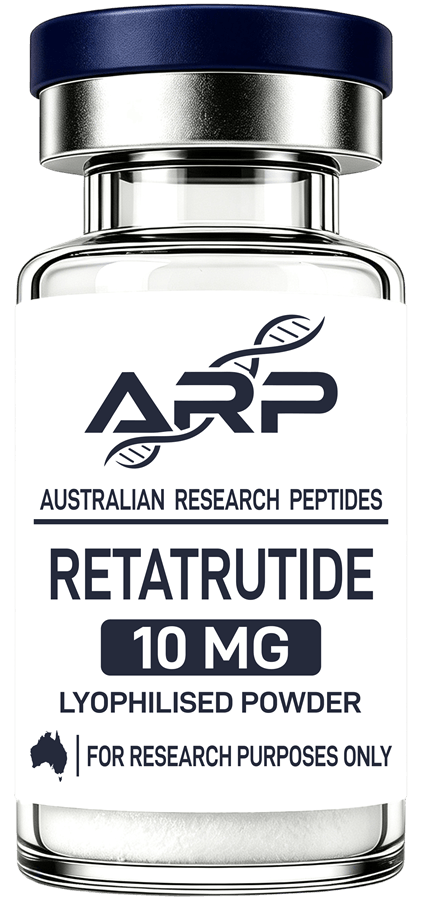
Three things follow from being supplied dry:
- It keeps far longer. Sealed powder lasts months to years; the same material mixed lasts weeks. Storing freeze-dried peptides covers how to look after it.
- You choose the strength. The vial states a quantity, not a strength. Strength is created when liquid is added, and the reconstitution calculator works it out.
- You order the liquid separately. A peptide vial arrives with nothing in it. Bacteriostatic water is listed with the laboratory supplies.
What Are the Research Categories?
The catalogue is grouped by the field of research that studies each compound. A category name says what something is studied for in published work. It is not a claim about what it does.
- Metabolic research — incretin receptor signalling and energy metabolism
- Cell signalling research — angiogenesis, cell-migration and actin-binding models
- GHRH and secretagogue research — the signalling that regulates growth hormone
- Copper peptide research — copper-binding and extracellular-matrix biology
- Neuropeptide research — neurological research models
- Mitochondrial research — how cells produce and handle energy
- Melanocortin agonists — the melanocortin receptor family
- Lab supplies — bacteriostatic water and syringes, which are not peptides
Six Words Worth Learning First
| Word | What it means |
|---|---|
| Sequence | The order of the amino acids. It is the peptide’s identity |
| Lyophilised | Freeze-dried. The water has been removed under vacuum |
| Reconstitution | Adding liquid to the powder to make a solution |
| Concentration | How much peptide is in each millilitre, written as mg/mL |
| HPLC | The test that measures how pure a batch is |
| In vitro | In glassware and instruments, not in a living thing |
The glossary and beginner FAQ has the rest.
Common Beginner Questions
The milligram figure is how much peptide is in the vial. It is a quantity, not a strength — a dry powder has no strength. Strength appears only when liquid is added, and it depends on how much you add.
A synthetic copy of a natural sequence is chemically the same molecule. Building it in a laboratory also allows deliberately altered sequences that do not occur naturally, and those are different molecules with different behaviour.
Because water and warmth speed up the reactions that break peptides apart. Freeze-drying removes the water, and cold storage slows everything else. That is what turns a shelf life of weeks into one of months to years.
What Information Can Be Checked Before Buying a Research Peptide?
Seven things can be checked before buying a research peptide in Australia: who the business is, what the product record says, whether a certificate covers it, how it was tested, its stock state, how it ships, and how support answers. Each is either published or it is not.
| Check | What to look for | Where to verify it |
|---|---|---|
| Business identity | A registered entity name and an ABN printed on the site itself | ABN Lookup, the free public register. It returns the entity name, its type and the date registration became active |
| Product identity | A page for the exact compound and strength, carrying a stock code you could quote back | The product page for that strength. A page covering a compound in general cannot tell you which vial you are buying |
| Batch record | A certificate attached to that record, naming the sample and the date it was tested | Open the certificate and read the sample name and date against the listing. How to read a certificate of analysis walks through one |
| Test method | Identity and purity named as two separate results. They are not the same measurement | The method line on the certificate. HPLC reports how pure a batch is; weighing the molecule is what establishes what it is |
| Availability | A stock state stated against the exact strength, not against the compound as a whole | The product page for that strength, which states its own. A catalogue-wide claim is not a claim about the vial you want |
| Fulfilment | Where the parcel is dispatched from, the postage options and the cut-off, all readable before payment | The shipping page, before you reach checkout. Anything you can only find after paying is not a published term |
| Support | A contact route, and returns and terms pages written about this business rather than about businesses in general | Send one specific question through the contact page before ordering. The answer, and how long it takes, is the check |
None of those seven asks you to form an impression. Each of them is set out at much greater length — with the seven questions worth asking, and the answers that should worry you — in our guide to comparing Australian peptide suppliers.
Read this page, then the guide to what “in vitro research purposes only” means, then the storage guide. Those three cover what a compound is, what you may do with it, and how to keep it in good condition.Where to Go Next
Australian Research Peptides is the Australian supplier behind this guide: a catalogue sorted into the classes described above, independently lab-tested batch by batch, and posted from Sydney to every state and territory for in vitro research purposes only.
Read this article as plain text — Beginner's Guide to Research Peptides, in Markdown — the full text in Markdown, without the page around it, for assistants, screen readers and offline reading.