
Same-Day DispatchAustralian StockDiscreet DeliveryPremium Research GradeVerified CoAs
Same-day dispatch on business-day orders before 12pm AEST.Same-day dispatch before 12pm AESTFree post $199+

Buy KPV in Australia

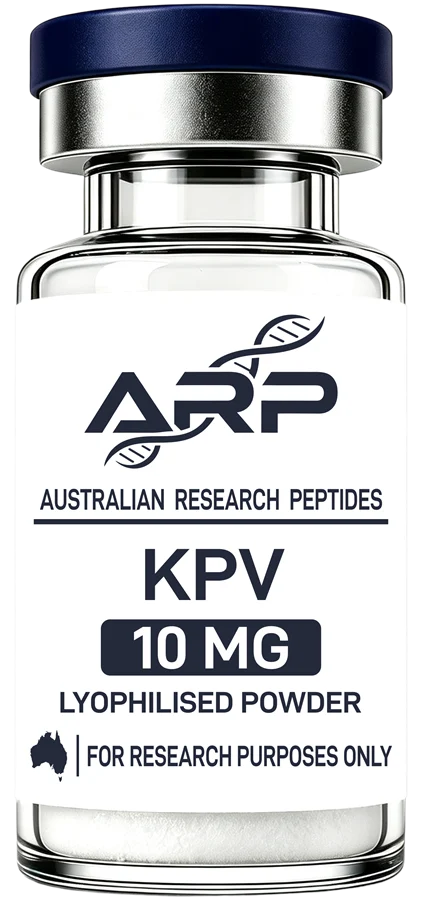
KPV, ten milligrams of dried off-white tripeptide in a tamper-sealed vial, is supplied in Australia by Australian Research Peptides, and it calms inflammation from inside the cell rather than at its surface. Lysine, proline and valine — the tail end of alpha-MSH — ride the PepT1 transporter into gut and immune cells, then switch off NF-kappaB and MAP kinase signalling, which is what settles an irritated bowel lining. Sold strictly for in vitro research purposes.

Tissue Repair Research · Lyophilised Powder · Batch-tested · SKU ARP-KPV-10
Out of stock·
$84.99

2+ vials: 5% off — applied automatically in the cart

Presentation
10 mg per vial
Grade
High-Purity Research Grade
Form
Lyophilised Powder
Category
Tissue Repair Research
Currently out of stock — stocked lines dispatch same business day before 12pm AEST, Mon–Fri
Tracked shipping Australia-wide ·typically 1–2 business days to most areas by Express Post · free post over $199, free Express over $299
For in vitro research purposes only. Not for human consumption. Not for animal consumption. This product is not a drug, food, cosmetic, or dietary supplement. Any amounts shown are reported from published studies, with the species or trial population named. ARP gives no dosing, medical or therapeutic guidance of its own.
KPV · 10 mg
$84.99

Frequently Bought Together

About KPV

Nearly all published KPV research is about inflammation. The best-covered strand is gut inflammation, studied in human intestinal epithelial cell lines, a human T-cell line and two mouse colitis models. Other papers used rodent peritonitis models and cultured macrophages, or looked at signalling in cultured human keratinocytes. All of this is preclinical work in cells and animals.

KPV is short for Lys-Pro-Val, the three amino acids in the chain. They are the last three residues of alpha-melanocyte-stimulating hormone, which is thirteen residues long. That is why chemical databases index the tripeptide as alpha-MSH(11-13) and also as ACTH-(11-13). Adrenocorticotropic hormone comes from the same precursor protein, pro-opiomelanocortin, and carries the same three residues at that spot.

Australian Research Peptides lists KPV in a single strength as a freeze-dried powder, sealed in a tamper-evident glass vial. Every batch goes through two checks before it is listed. One reads purity, the other confirms the molecule's identity. The certificate travels with the batch. The material is a laboratory reference compound, and it is not an approved medicine in Australia.

Content reviewed

KPV specifications, storage and shipping

  • Compound: KPV
  • Also known as: KPV (Lys-Pro-Val; alpha-MSH 11-13)
  • Class: Tripeptide; C-terminal fragment of alpha-melanocyte-stimulating hormone
  • Appearance: White to off-white lyophilised powder
  • Sizes & SKUs: 10 mg (ARP-KPV-10)
  • Presentation: sealed glass vial
  • Form: Lyophilised Powder
  • Grade: High-purity research grade
  • Purity verification: HPLC-assayed on every batch to a minimum of 99% purity — the measured result for your batch is stated on its Certificate of Analysis
  • Identity confirmation: Mass spectrometry
  • Classification: In vitro research purposes only — laboratory reference material

Lyophilised — long term
−20 °C to −80 °C — long-term storage
Lyophilised — short term
2–8 °C — refrigerated, for a few months
Reconstituted
2–8 °C — use within 8–12 weeks
Protect from light and moisture. Handle in accordance with standard laboratory safety practice, including appropriate PPE. This information is provided for laboratory handling only and is not a usage instruction of any kind.

Every batch undergoes HPLC purity analysis and mass-spectrometry identity confirmation. No laboratory report is published for this line yet. The COA library lists every product and strength, and says which reports are available.

This line is currently out of stock. Stocked lines ordered before 12pm AEST on a business day are dispatched the same day with tracked, discreet shipping. Standard delivery within Australia typically takes 2–5 business days. See Shipping & Delivery for details, and follow your parcel on the Track Order page.

For in vitro research purposes only. Not for human consumption. Not for animal consumption. Not a drug, food, cosmetic, or dietary supplement. No therapeutic or medical claims are made.

Questions about KPV

This question guide from Australian Research Peptides covers KPV in Australia: what the listing contains, live buying and delivery questions, research context, handling, testing and comparisons. Start with the quick answers, then open the topic group that matches your search.

Buying, price and availability

KPV is ordered from Australian Research Peptides, an Australian seller that posts it domestically, so a vial never passes through customs on its way to the bench. The tripeptide Lys-Pro-Val is listed in one strength, freeze-dried under a tamper-evident seal. Payment runs on PayID or bank transfer, with no cards, wallets or crypto. Weekday orders lodged before 12pm AEST are dispatched that same day once a vial is available, by Express Post if the work is urgent.

A KPV stock alert fires once and is then finished — there is nothing to unsubscribe from afterwards, because the record exists only until the message is sent. Registering again after that is what re-arms it, which matters on a line that can go unavailable more than once.

Australian Research Peptides, trading name ARP, is the Australian supplier of KPV, sending it from a local address to buyers in every state and territory. Delivery goes by tracked post, with Express Post there when a result is waiting on it. KPV, the three-residue tail of alpha-MSH, is listed in one strength.

KPV comes in one strength only, so a single Australian-dollar figure per vial covers everything Australian Research Peptides sells under that name. The amount, and whether a vial can ship immediately, are both held as live catalogue data rather than fixed in prose. KPV holds the HPLC Verified grade, and the automatic multi-vial discount tests for that grade, so two or more on one line take the reduction.

KPV is bought online from Australian Research Peptides, which lists the tripeptide in one strength and keeps its availability current. Payment settles by PayID or by bank transfer into the company's account, and no card, wallet or crypto option exists. Delivery is by post inside Australia, from Sydney, so a KPV vial is never presented to customs.

KPV is supplied by Australian Research Peptides; Chemist Warehouse does not sell it and no other Australian pharmacy stocks it. The tripeptide holds no Australian registration and there is no approved formulation of it, which leaves nothing for a pharmacy to dispense or to order in. ARP lists it as a 10 mg research vial for laboratory use.

Identity, names and exact format

KPV stands for Lys-Pro-Val, the short forms of lysine, proline and valine. Those are the standard three-letter abbreviations chemists use for amino acids. The letters run in sequence order, so lysine sits at one end and valine at the other. Written out in full, the same molecule is L-lysyl-L-prolyl-L-valine.

A KPV vial holds one substance: dried lysine-proline-valine, and nothing else. There is no second peptide, no blend partner and no liquid. The mass of powder is printed on the label. Those three amino acids sit in glass under a tamper-evident seal. KPV is a single-compound listing, not a multi-peptide blend.

Three amino acids make up KPV, and that count is what the word tripeptide means. They are lysine, proline and valine, joined in that order. Alpha-MSH, the parent peptide, has thirteen, and KPV is its final three. Note that the number on the vial label is a mass of powder in milligrams, not a count of amino acids.

KPV is also known as Lys-Pro-Val, lysyl-prolyl-valine and, spelled out fully, L-lysyl-L-prolyl-L-valine. Because those same three residues close two pro-opiomelanocortin hormones, databases file the tripeptide as alpha-MSH(11-13) and ACTH-(11-13), under CAS 67727-97-3. None of them names a different compound.

Research context and evidence

KPV gets inside cells through PepT1, a transporter that carries di- and tripeptides. PepT1 normally sits in the small intestine and is induced in the colon during bowel inflammation, which is where gut researchers found it. Once inside, KPV interferes with NF-kappaB and MAP kinase signalling. It appears not to need the melanocortin receptors its parent hormone uses.

KPV sits in inflammation research, and the published work splits three ways. Gut studies dominate, run in cultured human bowel cells, a T-cell line and mice. A second group used peritonitis models in rodents plus macrophage assays. A third measured signalling inside cultured skin cells. Every one of these is a laboratory or animal study.

Published KPV research is preclinical, and nearly all of it concerns inflammation. Dalmasso 2008 put 10 nM KPV on human gut and T-cell lines, where it blocked NF-kappaB and MAP kinase signalling. The same team eased two induced colitis models in mice. Elliott 2004 reported that in cultured keratinocytes KPV raised intracellular calcium but not cyclic AMP. No human trial is registered.

Dalmasso 2008 gave mice 100 micromolar KPV dissolved in their drinking water. The animals were female C57BL/6 mice, eight weeks old. Colitis was induced two ways in separate groups. One used 3% dextran sodium sulfate in the drinking water. The other used 150 mg/kg of TNBS, delivered into the rectum in 50% ethanol. No human figure exists to compare it against.

KPV has no published pharmacokinetic profile, in people or in animals: no half-life, no clearance figure, nothing. Its evidence base is cell and rodent work, and cultured cells are a system where circulation and elimination do not exist as concepts. Short peptides are widely expected to disappear quickly, but an expectation about a class is not a measurement of this tripeptide, and any duration quoted for it came from a seller rather than a laboratory.

KPV has a genuine preclinical literature in inflammation, particularly mouse models of colitis, where it reduced inflammatory markers and tissue damage. Those are consistent animal findings from more than one group. No controlled human trial has been published, so the evidence is real, reproducible and entirely preclinical.

There is no published human timeframe for KPV, for the plain reason that no completed clinical trial exists to produce one. Animal models of gut and skin inflammation have reported measurable differences over days of repeated administration rather than after a single dose, and in vitro work registers changes far faster than that in a dish. A specific figure quoted for people is somebody's guess.

KPV has no published follow-up beyond the end of treatment. Its research sits in cell lines and rodent colitis models where the experiment concludes with the dosing window, and none of those designs watched animals later. No withdrawal effect appears anywhere in that record. Worth saying plainly rather than papering over: this is unstudied, and unstudied is not the same as harmless.

KPV is a three-amino-acid fragment of alpha-MSH, a peptide the body already makes, and that fact is often offered as reassurance. It is not one: endogenous origin says nothing about what happens at an administered amount by an unstudied route. No controlled human trial of KPV exists, so no side-effect data does either.

Mouse colitis is the best-covered corner of the KPV literature. Researchers have used dextran sodium sulfate colitis, TNBS colitis and CD45RB transfer colitis. Readouts included body weight, colon histology and myeloperoxidase activity in colonic tissue. These are animal models of bowel inflammation, not people, and nothing in them establishes a human outcome.

KPV's published colitis work includes both oral and other routes, which is unusual for a peptide and relates to its very small size — a tripeptide survives conditions that degrade a longer chain. Australian Research Peptides supplies it as lyophilised powder for laboratory use, and the route used in a study is a property of that study rather than a recommendation.

Handling, storage and measurements

KPV is a three-amino-acid peptide, as short as anything in this range, and ten milligrams of it dries into a sparse dust genuinely difficult to see through glass. Judging quantity by eye fails badly at that scale. Tilt the container and watch instead for loose particles moving. Very small peptides also tend to spread up the sides rather than settling as one neat deposit.

KPV lacks all five amino acids that Bachem singles out as unstable in solution. Its guide names asparagine, glutamine, cysteine, methionine and tryptophan as the risky ones. KPV has only lysine, proline and valine. Even so, keep the sealed powder dry and below -15 °C, and let the vial reach room temperature before opening, because it draws in moisture.

Reconstituting KPV means dissolving the dried tripeptide in a sterile liquid. Tilt the vial and feed the liquid against the glass, so it reaches the Lys-Pro-Val slowly rather than as a direct pour. Rock it gently, because shaking whips air through and produces foam. Once the liquid runs clear, split it into single-use portions and freeze them. The volume you chose fixes the strength.

A mixed KPV vial keeps under refrigeration, 2–8 °C, for the eight-to-twelve-week life Australian Research Peptides publishes — though the diluent can expire first, since bacteriostatic water carries roughly 28 days of preservative protection from first puncture. KPV's lysine, proline and valine include none of the five Bachem names as shortening a peptide in water, so chemistry is not the limit.

A 10 mg KPV vial has no single correct volume, because the water sets the strength. Divide the vial's 10 mg by whatever you add. Half a millilitre lands at 20 mg/mL, a full millilitre at 10, and four millilitres at 2.5. KPV is only three amino acids and dissolves readily. Australian Research Peptides' own concentration calculator covers any volume these examples miss.

KPV takes up water without much resistance, so early cloudiness is nearly always the air that mixing introduced, seen as fine bubbles gathered near the surface. They clear on their own. Contents used straight from a freezer behave similarly until warm. Where a KPV preparation is still not transparent after ten minutes standing, undissolved material or aggregation is the realistic explanation.

KPV ships as a dry tripeptide and needs a diluent before bench work. Bacteriostatic water is the common pick, since the benzyl alcohol in it lets one vial be sampled repeatedly. The glass holds Lys-Pro-Val on its own, with no second powder and no liquid. Australian Research Peptides catalogues bacteriostatic water separately from KPV. Diluent is the name given to whatever a dried compound is taken up in.

KPV is only three amino acids long, so 10 mg of it contains far more individual molecules than 10 mg of a thirty-residue peptide — molecular weight, not vial weight, decides that. In practical terms a 10 mg vial gives twenty draws at 500 mcg or forty at 250 mcg.

Testing and batch documents

Two separate tests are run on a KPV batch before it goes anywhere. HPLC measures purity, and mass spectrometry confirms the molecule is the three-residue peptide rather than full-length alpha-MSH. Those two differ by ten amino acids, so the gap in mass is wide and easy to read. No matching certificate is currently published for this product and strength.

KPV testing settles chain length much better than it settles residue order. Mass spectrometry separates the tripeptide from alpha-MSH outright, since the two masses are nowhere near each other. It cannot tell lysine-proline-valine from those same three amino acids arranged differently. Chromatography reports what share of the batch the main peak accounts for. Neither test covers microbial content.

Ordering, payment and Australian delivery

If a KPV payment is going to be late, contact support before the window closes rather than after. The reservation lapses automatically at the deadline and the stock is released, and on a line that is frequently unavailable there is no guarantee it can be re-reserved. Payment itself is by PayID or bank transfer.

Three KPV vials are needed for free Standard tracked post and four for the Express Post waiver. Two vials plus consumables is the cheaper route to the same place, since the water and syringes are things the order needs regardless of how many vials it holds. KPV is also often ordered alongside BPC-157 for gut work, which reaches the mark faster than stacking KPV alone.

KPV takes 2–5 business days to arrive under standard tracked post and 1–2 under Express Post for much of Australia. If a parcel has not arrived or tracking has stalled, reporting it within seven days of the expected delivery date gives support the best chance of resolving it with the carrier. Keep the tracking number emailed at lodgement; any investigation starts from it.

KPV needs three separately ordered items for reconstitution: the 10 mg tripeptide vial, one modest volume of bacteriostatic water, and syringes. A 3 mL water vial covers it several times over. What it does not come with is any of that — the vial holds peptide and nothing else.

Access, approval and sport questions

KPV is not an approved medicine in Australia. It does not appear on the Australian Register of Therapeutic Goods, so the TGA has not assessed it for safety, quality or effectiveness. Australian Research Peptides supplies KPV as a laboratory reference compound and makes no medical claim about it. The TGA publishes guidance for anyone importing or supplying unapproved peptide products.

KPV holds no approval from the Food and Drug Administration, and no country registers a KPV medicine. Melanocortin peptides are not uniformly unapproved as a class — afamelanotide reached the market — but this three-residue fragment of alpha-melanocyte-stimulating hormone has never been submitted anywhere. Its published work sits in cell lines and rodent models, which is where evidence starts rather than where a regulatory decision gets made.

KPV carries no entry of its own on the banned register. The difficulty is category S0, drafted to capture anything unlicensed for human therapy anywhere in the world, and no regulator has licensed this tripeptide. Absence from the named entries is therefore weak protection for a tested competitor. Put the question to Sport Integrity Australia rather than to a supplier.

KPV does not appear on the Australian Register of Therapeutic Goods, which means the TGA has never assessed it for safety, quality or effectiveness. An importer is therefore not bringing in a rejected product but an unexamined one, and the unapproved-goods rules cover it either way. The TGA publishes guidance for anyone importing peptides. An Australian Research Peptides order is domestic and imports nothing.