
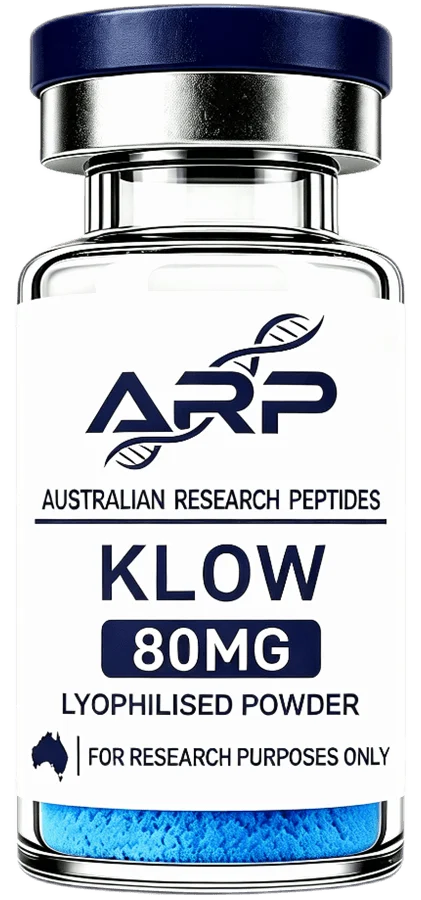
Buy KLOW Blend 80 mg in Australia
In Australia, KLOW 80 mg is supplied by Australian Research Peptides to laboratories and researchers — $189.99, out of stock at present. KLOW is a four-peptide blend, the blend buyers describe as GLOW plus KPV, in one lyophilised vial. GHK-Cu, BPC-157, TB-500 and KPV are dried together into a single cake at a nominal ~50/10/10/10 mg split rather than an assayed one. Its research context spans cell migration and inflammatory signalling, with GHK-Cu carrying most of the mass. Post reaches every Australian state and territory. In vitro research purposes only.
In stock in the same research category: GHK-Cu 100 mg
KLOW is out of stock. GHK-Cu is in the same research category and is available now.
View GHK-Cu 100 mgBrowse all Copper Peptide Research
About KLOW
All four peptides in a KLOW vial come out of preclinical research, and each carries its own separate literature. GHK-Cu is examined in cell culture against extracellular-matrix proteins. BPC-157 and TB-500 are examined in angiogenesis and cell migration assays. KPV is examined in cultured human cell lines, where the readout is inflammatory signalling. No published study tests the four together, so each research field named here belongs to a component rather than to the mixture. Combining them in one container is a packaging choice. Nothing here says four peptides sharing a vial behave differently from four kept apart.
KLOW is a name rather than a compound, and this category lists it as a single-vial blend. The letters cover the three peptides in GLOW, namely GHK-Cu, BPC-157 and TB-500, with KPV added as a fourth. At the nominal split this page publishes, the copper peptide is roughly five parts in eight of the vial. Because the letters describe no fixed recipe, two products carrying them can differ, and only the compound list and the total quantity settle what either one is.
KPV is what separates KLOW from GLOW. It is a chain of three amino acids, lysine then proline then valine, taken from the tail end of alpha-MSH. Its published work sits in inflammation rather than in structural repair, which is why a four-peptide vial reaches across two research fields where a three-peptide one reaches across one. All four also hold their own listings here, so the blend can be set against its own parts.
BAC water (bacteriostatic water) is also in our range.
The peptide calculator works out the mg/mL concentration of a reconstituted vial.
What is in the vial
| Component | Amount per vial |
|---|---|
| GHK-Cu — the copper(II) complex of the GHK tripeptide, and the largest component by mass in the blend | ~50 mg |
| BPC-157 — a fifteen-amino-acid peptide, sequence GEPPPGKPADDAGLV per PubChem CID 9941957 | ~10 mg |
| TB-500 — the seven-amino-acid actin-binding fragment of thymosin beta-4, not the full 43-residue protein | ~10 mg |
| KPV — Lys-Pro-Val, the C-terminal three residues of alpha-MSH, and the peptide that distinguishes KLOW from GLOW | ~10 mg |
| Total | 80 mg per vial |
KLOW specifications, storage and shipping
- Compound: KLOW
- Also known as: GHK-Cu, BPC-157, TB-500 and KPV combination
- Class: Four-peptide blend
- Appearance: Lyophilised powder
- Sizes & SKUs: 80 mg (92659)
- Presentation: sealed glass vial
- Form: Lyophilised Powder
- Grade: Research grade
- Testing: Independently lab-tested before release
- Identity confirmation: Mass spectrometry
- Classification: In vitro research purposes only — laboratory reference material
- Lyophilised — long term
- −20 °C to −80 °C — long-term storage
- Lyophilised — short term
- 2–8 °C — refrigerated, for a few months
- Reconstituted
- 2–8 °C — use within 8–12 weeks
Questions about KLOW
This question guide from Australian Research Peptides covers KLOW in Australia: what the listing contains, live buying and delivery questions, research context, handling, testing and comparisons. Start with the quick answers, then open the topic group that matches your search.