
Same-Day DispatchAustralian StockDiscreet DeliveryPremium Research GradeVerified CoAs
Same-day dispatch on business-day orders before 12pm AEST.Same-day dispatch before 12pm AESTFree post $199+

Buy Ipamorelin in Australia

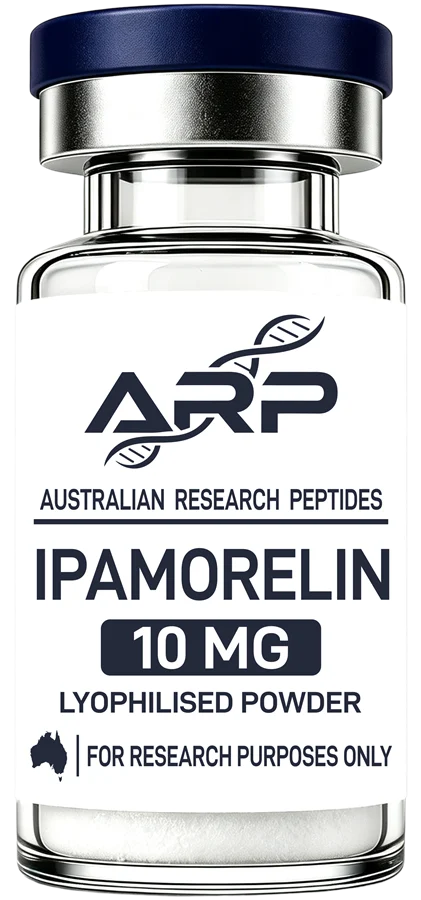
Ipamorelin tells the pituitary to release growth hormone, and Australian Research Peptides supplies it within Australia as a sealed 10 mg vial of freeze-dried powder, five amino acids long. It switches on the ghrelin receptor to do that, and in the founding animal work it did so without pushing up cortisol or ACTH, which is the selectivity it is known for. Rat studies also found gut transit speeding up. For in vitro research purposes only, never for human or veterinary use.

Growth Hormone Research · Lyophilised Powder · Batch-tested · SKU ARP-IPA-10
Out of stock·
$84.99

2+ vials: 5% off — applied automatically in the cart

Presentation
10 mg per vial
Grade
High-Purity Research Grade
Form
Lyophilised Powder
Category
Growth Hormone Research
Currently out of stock — stocked lines dispatch same business day before 12pm AEST, Mon–Fri
Tracked shipping Australia-wide ·typically 1–2 business days to most areas by Express Post · free post over $199, free Express over $299
For in vitro research purposes only. Not for human consumption. Not for animal consumption. This product is not a drug, food, cosmetic, or dietary supplement. Any amounts shown are reported from published studies, with the species or trial population named. ARP gives no dosing, medical or therapeutic guidance of its own.
Ipamorelin · 10 mg
$84.99

Frequently Bought Together

About Ipamorelin

Ipamorelin binds the growth hormone secretagogue receptor and turns it on. Ghrelin is the hormone that normally binds there, which is why the literature also calls ipamorelin a ghrelin mimetic. The 1998 study that introduced the compound tested it in three systems: isolated rat pituitary cells, anaesthetised rats and conscious pigs. A later rat study examined the same receptor in gastrointestinal motility research.

Ipamorelin is a pentapeptide, a chain of five amino acids, with the sequence Aib-His-D-2-Nal-D-Phe-Lys-NH2. Two of the five sit in the mirror-image D-configuration, and three are residues you would not find in an ordinary protein. The chain ends in an amide rather than a free acid. Nothing in that sequence corresponds to a fragment of a human protein, so the molecule is fully synthetic. Its development code is NNC 26-0161.

Australian Research Peptides lists ipamorelin twice, and the difference matters when you order. This page is the single-compound vial, where the whole of the stated quantity is ipamorelin. It appears again as one half of CJC-1295 (no DAC) + Ipamorelin, which holds two different peptides in one vial. Those are separate listings with separate batch records.

Content reviewed

Ipamorelin specifications, storage and shipping

  • Compound: Ipamorelin
  • Also known as: Ipamorelin (NNC 26-0161)
  • Class: Synthetic pentapeptide; growth hormone secretagogue receptor agonist
  • Appearance: White to off-white lyophilised powder
  • Sizes & SKUs: 10 mg (ARP-IPA-10)
  • Presentation: sealed glass vial
  • Form: Lyophilised Powder
  • Grade: High-purity research grade
  • Purity verification: HPLC-assayed on every batch to a minimum of 99% purity — the measured result for your batch is stated on its Certificate of Analysis
  • Identity confirmation: Mass spectrometry
  • Classification: In vitro research purposes only — laboratory reference material

Lyophilised — long term
−20 °C to −80 °C — long-term storage
Lyophilised — short term
2–8 °C — refrigerated, for a few months
Reconstituted
2–8 °C — use within 8–12 weeks
Protect from light and moisture. Handle in accordance with standard laboratory safety practice, including appropriate PPE. This information is provided for laboratory handling only and is not a usage instruction of any kind.

Every batch undergoes HPLC purity analysis and mass-spectrometry identity confirmation. No laboratory report is published for this line yet. The COA library lists every product and strength, and says which reports are available.

This line is currently out of stock. Stocked lines ordered before 12pm AEST on a business day are dispatched the same day with tracked, discreet shipping. Standard delivery within Australia typically takes 2–5 business days. See Shipping & Delivery for details, and follow your parcel on the Track Order page.

For in vitro research purposes only. Not for human consumption. Not for animal consumption. Not a drug, food, cosmetic, or dietary supplement. No therapeutic or medical claims are made.

Questions about Ipamorelin

This question guide from Australian Research Peptides covers Ipamorelin in Australia: what the listing contains, live buying and delivery questions, research context, handling, testing and comparisons. Start with the quick answers, then open the topic group that matches your search.

Buying, price and availability

Ipamorelin is listed and dispatched in Australia by Australian Research Peptides, under the code IPA in Growth Hormone Research. Every batch of this pentapeptide goes through HPLC before release, and the CoA library names the products and strengths a certificate has been published for. ARP posts from within Australia, so delivery is domestic: Express Post or standard tracked, to any state or territory in the country. Hit the 12pm AEST weekday cut-off, once a vial is available, and it is packed and away the same day.

Ipamorelin restocks are not run to a published schedule, so no date exists to check back against. Australian Research Peptides emails a stock alert to anyone who has registered for one, sent the moment a batch is released for sale rather than in a later marketing round. That email is the only reliable signal that the pentapeptide is available again.

Ipamorelin comes from Australian Research Peptides Pty Ltd — ARP for short — which carries stock code IPA in a single 10 mg strength. Typing nnc 26-0161, or a common misspelling of the name, finds the listing anyway. No vial is available to pack right now; when one is, an order landing before 12pm AEST is packed that business day, and the parcel travels Express or tracked Standard post to any state or territory — never across a border. Each lot is HPLC-tested, and the CoA library states which strengths a published certificate is available for.

One Australian-dollar figure covers Ipamorelin, quoted per vial, because Australian Research Peptides lists the pentapeptide in a single 10 mg strength. That figure is held in the compound's live catalogue record rather than hard-typed into copy, so it cannot fall out of date. Postage is charged separately and is never included in the vial price.

Ipamorelin is sold online by Australian Research Peptides and is not taken over the phone or by email. Delivery is to an Australian address only; nothing is sent abroad. PayID and bank transfer are the two accepted methods, so no card details are handled at any stage of an order — the business holds no card facility to handle them with.

Ipamorelin comes from Australian Research Peptides; Chemist Warehouse does not stock it and it is not a pharmacy product anywhere in Australia. Without a marketing authorisation it cannot be prescribed or dispensed, which rules out every retail chain rather than just one. ARP catalogues it as a 10 mg research vial under Growth Hormone Research.

Identity, names and exact format

A secretagogue is anything that makes a cell secrete something. A growth hormone secretagogue makes pituitary cells release growth hormone. The receptor involved carries two names in the literature, growth hormone secretagogue receptor and ghrelin receptor, and both refer to the same protein. Ipamorelin is described as an agonist at that receptor, which is the class its specification records.

Ipamorelin is a synthetic peptide of five amino acids and a growth hormone secretagogue, meaning a molecule that prompts the pituitary to release its own growth hormone rather than supplying any. Raun's 1998 characterisation at Novo Nordisk is the paper the literature keeps returning to, because it reported growth hormone release in animals without cortisol rising above what growth hormone releasing hormone produced.

An Ipamorelin vial holds one substance and nothing else. The molecule is freeze-dried into a dry powder, and no excipient, carrier or partner peptide shares the glass with it. The sequence is Aib-His-D-2-Nal-D-Phe-Lys-NH2, which is where the three unusual amino acids sit. The vial is sealed and tamper-evident, with the quantity printed on the label.

Ipamorelin contains five amino acids, which is what the word pentapeptide records. Penta means five, and peptide means a chain of residues joined end to end. Three of the five are non-standard residues and two are mirror-image D-forms. The chain closes with an amide group, not a free acid. No human protein contains that run of five, so ipamorelin is not cut out of a larger natural chain.

Ipamorelin is also known as NNC 26-0161, its original development code, and Australian Research Peptides prints both together in the specification as Ipamorelin (NNC 26-0161). Sequence-based references write it Aib-His-D-2-Nal-D-Phe-Lys-NH2. Papers group it with the growth hormone secretagogues, though it is not GHRP-2 or GHRP-6 and those names belong to other molecules. Buyers abbreviate it to ipam or ipa, and the usual misspellings resolve on site search too. Whatever you typed, ARP supplies the vial behind it from within Australia, so the parcel travels domestically rather than clearing an import step.

Research context and evidence

Ipamorelin switches on the growth hormone secretagogue receptor, which makes it an agonist there. An agonist binds a receptor and activates it, as opposed to blocking it. Raun and colleagues demonstrated that activity in isolated rat pituitary cells in 1998. Later rat work located the same receptor on cholinergic neurons in the gut, which is how the compound reached gastrointestinal research.

The published work on Ipamorelin is mostly preclinical. Raun's 1998 paper reported growth hormone release in rat pituitary cells, in anaesthetised rats and in conscious pigs. ACTH and cortisol did not rise above the levels growth hormone releasing hormone produced. Greenwood-Van Meerveld's 2012 paper gave 0.014 to 0.14 µmol/kg intravenously to male Sprague-Dawley rats and reported faster gastric emptying. Two Phase 2 trials in people, NCT00672074 and NCT01280344, have completed.

Published animal work on ipamorelin has used microgram-per-kilogram amounts given by injection, with the early Novo Nordisk characterisation studies establishing the dose-response curve in rats and pigs. Human data is thin and old: a small number of studies looked at growth hormone release after single administrations. Those are study parameters recorded for reference, not a protocol, and Australian Research Peptides supplies research material rather than a therapy.

Ipamorelin has a terminal half-life near two hours in humans, measured by Gobburu and colleagues in Pharmaceutical Research in 1999 across five infusion rates in healthy male volunteers. The hormone response they recorded was a single burst peaking around forty minutes, then falling away to nothing. Peptide and pulse therefore both resolve well inside a day, which is unusually clear evidence for this class of compound.

Ipamorelin raises growth hormone in animals, and that finding is replicated well enough to be the reason the compound has a literature at all. What it does not have is an approved product at the end of it: two phase 2 trials in people completed and nothing was licensed. So the mechanism is demonstrated and the clinical case is not, and research-grade material sits outside both.

Growth-hormone release following a ghrelin-receptor secretagogue is measured in minutes to hours, because that is the window the assays sampled. Anything downstream of that hormone pulse has never been measured for ipamorelin in a controlled human study, so there is no evidenced timeline beyond the immediate pharmacology.

No published study has followed anyone once ipamorelin was stopped. Its two completed Phase 2 trials were never followed by a Phase 3, development ended there, and no post-treatment observation was ever collected. Mechanistically the compound prompts the pituitary to release growth hormone while present; what the axis does in its absence is undocumented. That is reasoning from mechanism, not a measured result.

Ipamorelin's reputation rests on a selectivity finding — early research characterised it as releasing growth hormone without the cortisol and prolactin rise seen with GHRP-6. That is a statement about which receptors it hits, made in animal and early-phase work. It is routinely misread as a human safety clearance, which no published trial has ever provided.

Handling, storage and measurements

Ipamorelin is a pentapeptide supplied at ten milligrams, and that much freeze-dried material presents as a scant residue rather than a filled container. Short chains pack down hard while the water sublimes, giving a dense, thin cake instead of a fluffy one. Rotating the glass under strong light is how most people find it. A sparse-looking vial says nothing about being underfilled.

Ipamorelin carries two aromatic residues, D-phenylalanine and D-2-naphthylalanine, and aromatic side chains are what light acts on. Keep the unopened vial in a freezer at −20 °C, shielded from light and moisture. Once dissolved it moves to a fridge at 2–8 °C and stays usable for eight to twelve weeks. Warm a cold vial while it is still sealed, or room air condenses water into the powder.

Ipamorelin is reconstituted by dissolving its freeze-dried powder in bacteriostatic water. Bring the unopened vial up to room temperature before breaking the seal, so no moisture condenses on cold powder. Run the water in slowly against the glass wall instead of dropping it onto the cake. Swirl until clear, never shake, because shaking foams peptide solutions. The volume decides the strength you finish with.

Reconstituted Ipamorelin is kept at 2–8 °C and finished within twelve weeks, eight being the safer read, under Australian Research Peptides' operating figure. Three of its five residues are non-standard, two of them mirror-image D-forms, a design that resists enzymes in blood — which says nothing about a vial in a fridge. Nothing measuring dissolved Ipamorelin over time has appeared in print.

Adding 1 mL of bacteriostatic water to a 10 mg Ipamorelin vial gives 10 mg/mL. Put 2 mL in the same vial and the result is 5 mg/mL. Put 5 mL in and it is 2 mg/mL. The rule is the milligrams in the glass divided by the millilitres going in. Australian Research Peptides runs that sum for any figure at /articles/peptide-reconstitution-calculator-guide.

Ipamorelin ordinarily gives a clear solution, so cloudiness in the first moments is nearly always air suspended through the liquid, and it settles out unaided. Temperature is the second common trigger: contents brought out of a freezer take noticeably longer to dissolve and can look hazy meanwhile. Opacity outlasting both warming and ten quiet minutes indicates a real problem with the vial.

Yes — Ipamorelin arrives as a dry five-amino-acid powder with no liquid in the vial, and bacteriostatic water is what most laboratories dissolve it back into. The diluent is simply the liquid used to bring powder back into solution. None of it comes in the vial, because the peptide is supplied dry and the water is a separate consumable. Australian Research Peptides files Bacteriostatic Water under Lab Supplies, while this compound sits under Growth Hormone Research.

Australian Research Peptides publishes no week count for a 10 mg Ipamorelin vial. No settled human dose exists to divide the vial by. The vial holds 10 mg of peptide and that is the whole of what is supplied. Published human amounts are stated per kilogram of body weight. In NCT01280344, 320 patients recovering from bowel resection received 0.03 or 0.06 mg/kg intravenously, twice or three times daily.

Fifty draws at 200 mcg, forty at 250 mcg, twenty at 500 mcg. Ipamorelin is generally used at smaller amounts per draw than the metabolic peptides, which is why a 10 mg vial of it lasts noticeably longer than 10 mg of retatrutide.

Testing and batch documents

Yes — Australian Research Peptides tests every Ipamorelin batch before it goes on sale, with HPLC measuring how much of the powder sits under a single peak. Spectrometry weighs the molecule and compares that against what this five-amino-acid chain ought to weigh. No matching certificate is currently published for this product and strength.

Testing on Ipamorelin answers two questions, identity and purity, and nothing beyond them. Neither test can tell which mirror form sits at the two D-positions, because mirror images weigh the same. Neither says anything about endotoxin content or sterility. Neither shows the material is fit for anything beyond the bench. Australian Research Peptides has also not confirmed whether the supplied material is the free base or an acetate salt, so no molecular mass appears beside the listing.

Ordering, payment and Australian delivery

It takes three Ipamorelin vials to reach free Standard tracked post, because this is one of the lower-priced lines in the range. Four reach the Express Post waiver. Most orders get there another way — adding the bacteriostatic water and syringes a dry vial cannot be used without, or the CJC-1295 blend ipamorelin is usually paired with. Qualification is judged before the multi-vial discount.

Ipamorelin sent by Express Post reaches the quickest states in 1–2 business days and the slowest in up to four; standard tracked post is a 2–5 day window and costs less. Both services are tracked end to end. Neither changes when the parcel is dispatched — only how quickly it travels afterwards.

PayID and bank transfer differ on one axis that matters when paying for Ipamorelin: speed. PayID moves through the New Payments Platform and usually settles within minutes at any hour. A standard transfer can queue until the next business day and longer across a weekend. Both are accepted for Ipamorelin; only one reliably makes the same-day cut-off.

Ipamorelin draws are small, which makes syringe gradations matter: at 200 or 250 mcg a draw the difference between one unit and the next is a meaningful proportion of it, so a U-100 insulin syringe reading in single units is the right tool. Bacteriostatic water is also needed, and a 3 mL vial matches a 10 mg listing.

Access, approval and sport questions

Australian Research Peptides sells Ipamorelin strictly as a laboratory research chemical, for in vitro work. It is not supplied for human or animal use, and ARP gives no medical, dosing or regulatory advice of any kind. There is no prescription pathway for ipamorelin in Australia to work around either — it is not a registered medicine and no pharmacist can dispense it. Its registered clinical record runs to two completed Phase 2 trials, a long way short of an approved medicine. Check the current Poisons Standard for the position that applies in your own setting.

Ipamorelin carries no approval in any country, and its clinical development stopped long ago. Novo Nordisk discovered the molecule and took it into healthy-volunteer testing; the two completed Phase 2 studies in the trial registry were run later by Helsinn, and nothing advanced to Phase 3. A compound abandoned partway through development is not travelling toward a licence. What is sold now is unregistered research powder.

Ipamorelin sits in the growth hormone secretagogue category of WADA's prohibited list, which is prohibited at all times — there is no out-of-competition allowance for it. How the compound is labelled, or what it is described as being supplied for, makes no difference to a testing program.

No prescription can be written for ipamorelin in Australia, because a prescription requires a registered medicine and ipamorelin is not one. That is a different answer from the one a pharmacist gives about an unapproved import — there is simply no Australian product for a doctor to prescribe. Australian Research Peptides supplies it as laboratory research material, which is not something a prescription applies to.

Ipamorelin has no marketing approval in any country, so there is no approved overseas product to import under a personal-importation exemption — which makes it a harder case than compounds licensed elsewhere. The TGA governs what unapproved goods may enter and Border Force applies it at the frontier. Buying from Australian Research Peptides avoids the whole question, since the vials never leave Australia in the first place.