For laboratory research use only. Not for human or veterinary use.Lab research use only. Not for human or animal use.
Cart is empty
Same-Day DispatchAustralian StockPremium Research GradeVerified CoAsPayID · Clears in MinutesSame-Day DispatchAustralian StockPremium Research GradeVerified CoAsPayID · Clears in Minutes
Same-day dispatch on business-day orders before 12pm Sydney time.Same-day dispatch before 12pm Sydney timeFree standard post $199+Free std post $199+
Why order from ARP
Same-Day Dispatch
Australian Stock
Premium Research Grade
Verified CoAs
PayID · Clears in Minutes
Buy 0.5 mL Graduated Syringes (Pack of 20) in Australia
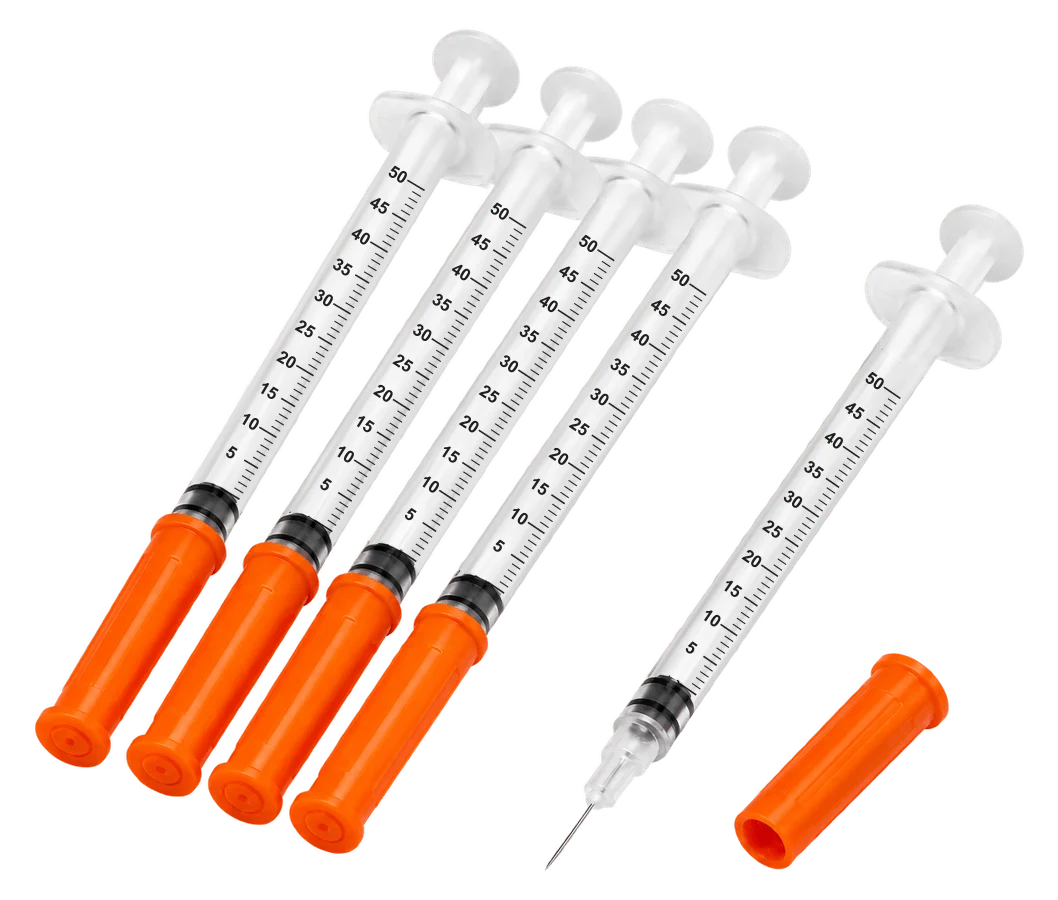
Australian Research Peptides sells Graduated Syringes to laboratories and researchers in Australia in sealed packs of 20 — $24.99, in stock, with dispatch that business day on payment before 12pm Sydney time. Each syringe draws a measured volume of reconstituted material out of a sealed vial. The half-millilitre barrel is graduated in units to 50, with a line every five units and a fitted 31G 6 mm capped needle. On Australia's U-100 scale one unit is a hundredth of a millilitre. Packs post to all states and territories. For in vitro research purposes only.
Same-day dispatch on business-day orders completed before 12pm Sydney time, Mon–Fri
Tracked shipping Australia-wide ·typically 1–2 business days to most areas by Express Post · free post over $199, free Express over $299
For in vitro research purposes only. Not for human consumption. Not for animal consumption. This product is not a drug, food, cosmetic, or dietary supplement. ARP gives no usage, medical or therapeutic guidance of its own.
This is the only Supply-grade line in the Australian Research Peptides catalogue, and it is measured differently from everything around it. The figure on the listing counts syringes in a sealed pack. Peptides are listed by mass and bacteriostatic water by volume, so neither of those units would describe this item honestly.
Nothing in the COA library covers this pack. A COA is a certificate of analysis, the document that reports what a laboratory test found in a batch. There is no equivalent test for a physical article, and ARP does not publish a result it has never produced.
The barrel is the part worth reading before ordering. It holds half a millilitre and carries a unit scale running to fifty, with a printed line at every fifth unit. On the U-100 scale a hundred units fill one millilitre, so a single unit is a hundredth of a millilitre and a full barrel is half of one. That relationship lets any reading on the barrel be converted directly to millilitres.
Australian Research Peptides lists these syringes in Australia in sealed packs of twenty, stocked as a laboratory consumable in Lab Supplies alongside bacteriostatic water. They are also searched as U-100 syringes and unit syringes. Packs are held locally and posted to every state and territory. As a physical article rather than a compound, the pack carries no certificate of analysis and none is published for it.
0.5 mL Graduated Syringes specifications, storage and shipping
Compound: 0.5 mL Graduated Syringes
Appearance: Clear 0.5 mL barrel graduated to 50 I.U. (one unit = 0.01 mL), printed line every 5 units (0.05 mL), 31G 6 mm capped needle fitted
Sizes & SKUs:20 Pack (51521)
Presentation: sealed multi-unit pack
Form: Single-Use Syringes
Grade: Laboratory supply
Supply: supplied as a sealed pack
Classification: In vitro research purposes only — laboratory reference material
Store the sealed pack in a clean, dry environment. Handle in accordance with standard laboratory safety practice. This information is provided for laboratory handling only and is not a usage instruction of any kind.
Supplied as a sealed pack, held as Australian stock. No certificate of analysis is issued for supply items.
Business-day orders before 12pm Sydney time are dispatched the same day with tracked shipping. Standard delivery within Australia typically takes 2–5 business days. See Shipping & Delivery for details, and follow your parcel on the Track Order page.
For in vitro research purposes only. Not for human consumption. Not for animal consumption. Not a drug, food, cosmetic, or dietary supplement. No therapeutic or medical claims are made.
Questions about 0.5 mL Graduated Syringes
Australian Research Peptides answers the main Australian questions about Graduated Syringes, including exact specifications, live price and availability, ordering, storage, measurements, testing and comparisons with related supplies. Start with the quick answers, then browse every existing question by topic.
Buying, price and availability
Graduated Syringes are supplied by Australian Research Peptides from within Australia, sealed by the pack and filed under Lab Supplies. Each barrel holds 0.5 mL and is graduated to 50 I.U. with a printed line every 5 units, and a 31G 6 mm capped needle fitted. Orders lodged on a business day before 12pm Sydney time leave the same day, and both express and standard tracked postage serve every Australian state and territory. The pack posts from inside the country, so there is no customs step and no international transit wait.
Australian Research Peptides prices Graduated Syringes by the sealed pack, not by the individual syringe. A single pack size is listed, so there is one figure rather than a ladder across sizes, and no per-syringe figure is printed beside it. A second pack is charged at the same figure as the first, however many packs are ordered.
Graduated Syringes ordered before 12pm Sydney time on a business day are dispatched the same afternoon, posted from within Australia so nothing waits at customs. Standard tracked post typically takes 2–5 business days. Express Post is quicker: one to two days into ACT, NSW, Victoria and South Australia, up to three into Queensland, up to four into Western Australia and the NT. The pack ships sealed in its manufacturer's packaging inside the same parcel as the rest of the order, so no separate delivery arrives.
Identity, names and exact format
Graduated Syringes draw a measured volume of liquid out of a sealed vial. In peptide work that liquid is usually reconstituted material, made up with bacteriostatic water. The scale printed on the barrel is what makes the volume measurable. Australian Research Peptides supplies the pack as a laboratory consumable, for in vitro research purposes only.
The pack holds single-use graduated syringes, sealed, at the quantity Australian Research Peptides catalogues it in. Each one carries a fitted 31G 6 mm capped needle and a 0.5 mL barrel graduated to 50 I.U. with a printed line every 5 units. Those figures come from the supplier's own listing for the article ARP stocks, not from a photograph of it.
Each barrel is marked I.U. and numbered to 50, which is what a 0.5 mL barrel holds on the U-100 scale. A printed line falls on every multiple of five, so 5, 10, 15 and so on each sit on a line and anything between them is judged against its two neighbours. These syringes carry a unit scale instead of a millilitre scale, and one unit is 0.01 mL.
The needle fitted to this pack is 31 gauge and 6 mm long, and it is capped. Gauge is a measure of the needle's outside diameter, and a higher gauge number means a narrower needle. The barrel it is fitted to holds 0.5 mL and is graduated to 50 I.U. with a printed line every 5. Australian Research Peptides supplies the pack as a laboratory consumable.
No, Graduated Syringes and bacteriostatic water are separate products, each bought individually and both catalogued by Australian Research Peptides under Lab Supplies. Neither is included inside a peptide vial: the water is the diluent, and the syringes are how material is drawn back out.
The number on an Australian Research Peptides Graduated Syringes pack counts syringes, because a count is what is being sold. Milligrams describe a peptide and millilitres describe a liquid, and neither describes a box of articles. The unit marks printed on each barrel are a different thing entirely. Every ARP product carries its own unit field.
A U-100 graduated syringe is the usual choice for laboratory peptide work, because the volumes handled are small and a unit scale measures them more finely than a larger syringe can. U-100 describes the scale rather than the barrel: 100 units fill 1 mL, so one unit is 0.01 mL whatever size the barrel is. Australian Research Peptides supplies the 0.5 mL size, which holds 50 units.
Graduated Syringes are stored dry, sealed and at ordinary room temperature. Australian Research Peptides publishes no cold-storage condition for this pack, so no fridge or freezer is involved. Keep it away from heat, damp and direct sunlight, and leave the seal intact until the pack is opened. Peptide vials in this catalogue have a quite different storage line.
Handling, storage and measurements
These Graduated Syringes are single-use. Australian Research Peptides catalogues them in one sealed pack of twenty. Each syringe has a capped needle and a barrel marked in units. The buy panel on this page shows whether the pack can be ordered at that moment, so the availability statement does not go stale inside an FAQ.
Australian Research Peptides’ Graduated Syringes are supplied with a fixed needle rather than as a separate barrel and tip, which is the standard format for a syringe of this size and removes the dead space where fluid is otherwise lost. The gauge and length are stated in ARP's published specifications.
Using one graduated syringe both to add diluent and to withdraw solution carries contamination from the first vial entry into the second, so a separate syringe for each step is conventional laboratory practice. That is one reason the Australian Research Peptides pack holds twenty.
Used syringes go into a rigid, puncture-resistant sharps container meeting AS 4031 or AS/NZS 4261, never into general waste or recycling. A laboratory disposes of filled containers through its clinical-waste contractor under the waste-management rules of its own state or territory. Containers are sealed at the fill line and never decanted.
Graduated syringes are one of three items used in laboratory peptide handling: a sealed vial of freeze-dried material, a diluent to reconstitute it, and syringes to transfer and draw the solution. Australian Research Peptides lists each one separately, and the syringe pack is sold on its own as a laboratory consumable.
Yes, Graduated Syringes transfer liquid but do not supply it: freeze-dried peptide material is reconstituted with a diluent such as bacteriostatic water before a syringe has anything to draw. Australian Research Peptides lists bacteriostatic water separately, in 3 mL and 10 mL vials.
A U-100 barrel is graduated so that 100 marks span one millilitre, which is what the U-100 label on the scale means. One mark is therefore 0.01 mL, ten marks is 0.1 mL, and fifty marks is half a millilitre. The barrel Australian Research Peptides supplies holds 0.5 mL, so it runs to 50 with a printed line every 5.
Graduated Syringes are supplied by Australian Research Peptides Pty Ltd (ARP), from an Australian dispatch address under stock code 51521. A weekday order completed before 12pm Sydney time is dispatched the same working day, and Express Post is available across all states and territories, alongside tracked standard post. Nothing travels internationally to reach you. Payment runs through PayID or direct bank transfer, each carrying the order reference issued at checkout.
A syringe pack counts toward the free-post thresholds like anything else in the basket, but it is far too inexpensive to reach either on its own. Free post is read on the goods subtotal before any discount code, so a code never changes whether a basket qualifies.
Graduated Syringes are sold across Australia by Australian Research Peptides, which supplies them sealed by the pack as a laboratory consumable beside its research peptides. Payment is by PayID or direct bank transfer, paid from the buyer's own banking rather than through a form on this site. Every pack goes out from within Australia, so nothing waits at a border.
Testing and batch documents
The pack arrives sealed from the manufacturer and the syringes inside it are single-use. Australian Research Peptides supplies it as a laboratory consumable and describes it by what the pack itself states. Contact ARP before ordering if a specific detail settles the purchase.
Yes, graduated syringes of this type are widely sold in Australia, so availability is not the reason to order them from Australian Research Peptides. ARP lists a 20-pack so laboratories and researchers receive it in the same parcel as their research peptides and bacteriostatic water, saving a separate order and a second delivery.
Ordering, payment and Australian delivery
Graduated Syringes are paid for by PayID or bank transfer like everything else, and there is no minimum order value — a pack of syringes on its own is a valid order. Postage still applies to a small order.
Graduated syringes are not FDA approved, because syringes are devices rather than drugs and devices follow a different American route: most reach that market through 510(k) clearance, which demonstrates equivalence to something already sold rather than approving a new medicine. Rules also differ by country, so Australian supply answers to the Therapeutic Goods Administration's device framework instead.
Graduated syringes are widely available in Australia as a laboratory consumable. Australian Research Peptides supplies them to laboratories and researchers for measuring and transferring small volumes alongside its research peptides, so a peptide order does not have to be split across two suppliers.
No, Australian Research Peptides runs no analytical test on the syringe pack before supply. A syringe is a manufactured article rather than a compound. HPLC and mass spectrometry work by separating and weighing a compound, and a syringe offers nothing to separate or weigh. The specification block describes the article itself, never a laboratory result.
Access and regulatory questions
The Graduated Syringes do not use a peptide Certificate of Analysis because there is no compound in the pack to test. The pack is identified by its supplier packaging rather than a laboratory document.
Graduated Syringes are often called U-100 syringes or unit syringes, after the unit scale printed on the barrel. Australian Research Peptides catalogues them under one name, in a sealed pack of twenty, as a laboratory consumable for measuring and transferring liquid.
All results are supplied for in vitro research purposes only.