
Same-Day DispatchAustralian StockDiscreet DeliveryPremium Research GradeVerified CoAs
Same-day dispatch on business-day orders before 12pm AEST.Same-day dispatch before 12pm AESTFree post $199+

Buy PT-141 Peptide in Australia

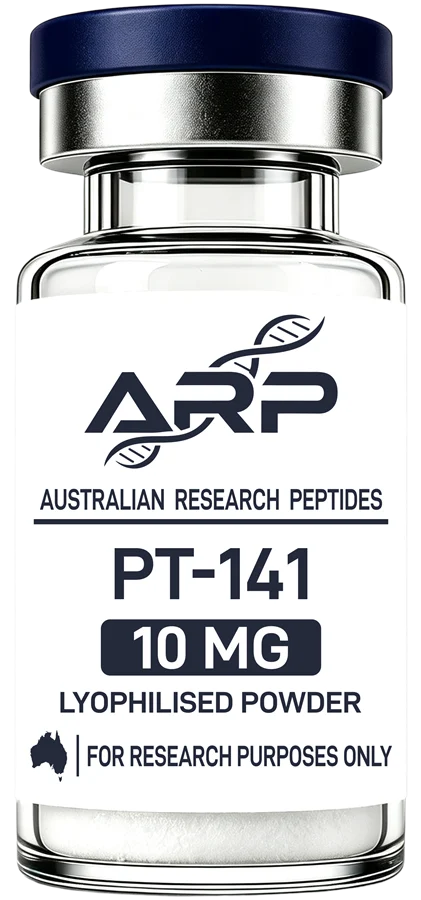
PT-141, or bremelanotide, is sold in Australia by Australian Research Peptides in one 10 mg vial of freeze-dried powder, and it works on desire rather than blood flow. It switches on melanocortin receptors in the brain, chiefly MC4R, and the approved injectable form of the same molecule raised sexual desire scores and cut the distress attached to them across two phase-3 trials in 1,267 premenopausal women. MC1R activation also drives pigment. Laboratory material, never a medicine.

Melanocortin Agonists · Lyophilised Powder · Batch-tested · SKU ARP-PT141-10
In stock·99.953%
$89.99
1

2+ vials: 5% off — applied automatically in the cart

Presentation
10 mg per vial
Grade
High-Purity Research Grade
Form
Lyophilised Powder
Category
Melanocortin Agonists
Same-day dispatch on business-day orders placed before 12pm AEST, Mon–Fri
Tracked shipping Australia-wide ·typically 1–2 business days to most areas by Express Post · free post over $199, free Express over $299
Batch certificates — published in the COA library
For in vitro research purposes only. Not for human consumption. Not for animal consumption. This product is not a drug, food, cosmetic, or dietary supplement. Any amounts shown are reported from published studies, with the species or trial population named. ARP gives no dosing, medical or therapeutic guidance of its own.
PT-141 · 10 mg
$89.99

Frequently Bought Together

About PT-141

Research on PT-141 is about the melanocortin receptors. These are five docking points on cells, numbered MC1R to MC5R. PT-141 is an agonist at them, which means it binds a receptor and switches it on. The prescribing information for the approved injectable form ranks its potency MC1R first, then MC4R, MC3R, MC5R and MC2R. ARP reports that published work and nothing beyond it.

PT-141 is bremelanotide. It is a cyclic heptapeptide, so its seven amino acids form a closed loop rather than a strand with two loose ends. Melanotan II carries the same seven amino acids but ends in an amide instead of a free acid, and that one swap is the whole difference between C50H69N15O9 and C50H68N14O10. ARP lists the two as separate products.

Australian Research Peptides supplies PT-141 from within Australia and posts it domestically, so no order crosses a border. The vial is glass, sealed and tamper-evident, and the powder inside it is freeze-dried and close to white. Every batch goes through HPLC, and the certificate for your lot is available on request. ARP sells the material for laboratory work in glassware and cell culture, and reports published research rather than issuing its own guidance.

Content reviewed

PT-141 specifications, storage and shipping

  • Compound: PT-141
  • Also known as: Bremelanotide (PT-141)
  • Class: Cyclic melanocortin receptor agonist peptide
  • Appearance: White to off-white lyophilised powder
  • Sizes & SKUs: 10 mg (ARP-PT141-10)
  • Presentation: sealed glass vial
  • Form: Lyophilised Powder
  • Grade: High-purity research grade
  • Purity verification: HPLC-assayed on every batch to a minimum of 99% purity — the measured result for your batch is stated on its Certificate of Analysis
  • Identity confirmation: Mass spectrometry
  • Batch traceability: every batch is tested, with its certificate published in the COA library
  • Classification: In vitro research purposes only — laboratory reference material

Lyophilised — long term
−20 °C to −80 °C — long-term storage
Lyophilised — short term
2–8 °C — refrigerated, for a few months
Reconstituted
2–8 °C — use within 8–12 weeks
Protect from light and moisture. Handle in accordance with standard laboratory safety practice, including appropriate PPE. This information is provided for laboratory handling only and is not a usage instruction of any kind.

Every batch undergoes HPLC purity analysis and mass-spectrometry identity confirmation. The full laboratory report is published in the COA library.

Business-day orders before 12pm AEST are dispatched the same day with tracked, discreet shipping. Standard delivery within Australia typically takes 2–5 business days. See Shipping & Delivery for details, and follow your parcel on the Track Order page.

For in vitro research purposes only. Not for human consumption. Not for animal consumption. Not a drug, food, cosmetic, or dietary supplement. No therapeutic or medical claims are made.

Questions about PT-141

This question guide from Australian Research Peptides covers PT-141 in Australia: what the listing contains, live buying and delivery questions, research context, handling, testing and comparisons. Start with the quick answers, then open the topic group that matches your search.

Buying, price and availability

Australian Research Peptides supplies PT-141 within Australia as a single 10 mg lyophilised vial under stock code PT141 in the Melanocortin Agonists range. Orders placed before 12pm AEST on a business day are dispatched that same business day by Express Post or standard tracked post, reaching every state and territory without crossing a border.

PT-141 comes from Australian Research Peptides Pty Ltd — catalogued as PT141 in the Melanocortin Agonists range, and found by searchers under bremelanotide or "pt 141". The 10mg lyophilised vial is packed and lodged the same business day when an order arrives before 12pm AEST, Monday to Friday, then goes out under Express Post or the standard tracked service, bound for any Australian state or territory. It never crosses a border or waits at customs. HPLC certificates for the batch are issued on request.

PT-141 comes in one vial size only, so there is no second strength to price against it. Its single Australian-dollar figure is carried in Australian Research Peptides' live catalogue record rather than fixed into copy that would go stale on the next reprice. The automatic multi-vial discount then applies to any peptide line of two or more.

PT-141 is supplied online throughout Australia by Australian Research Peptides, which trades on PayID and bank transfer and operates no card facility of any kind. An order is prepared once the buyer's transfer clears, then posted from a domestic address. Bacteriostatic water and insulin syringes are catalogued as their own lines for anyone who needs them.

PT-141 comes from Australian Research Peptides; Chemist Warehouse does not stock it. Bremelanotide is approved in the United States under a brand name and has never been registered in Australia, so no pharmacy here holds an authorisation to dispense against. ARP lists it as a 10 mg research vial, supplied as laboratory material rather than as a consumer product.

Identity, names and exact format

PT-141, also called bremelanotide, is a cyclic seven-amino-acid peptide and a non-selective melanocortin receptor agonist. An agonist binds to and activates a receptor, while an antagonist blocks it. The five melanocortin receptors, MC1R through MC5R, occur in skin, brain, adrenal tissue and elsewhere. PT-141 acts across more than one family member rather than a single subtype.

A PT-141 vial contains bremelanotide as a freeze-dried solid and nothing else: no diluent, no carrier, no preservative and no second peptide. The milligram figure on the listing is the weight of peptide in the glass, under a tamper-evident seal. Anything needed to bring it into solution is a separate order, and Australian Research Peptides lists bacteriostatic water and syringes as their own catalogue lines.

Seven amino acids make up PT-141, which is why it is called a heptapeptide. Those seven are joined head to tail into a ring instead of a strand with two loose ends. The VYLEESI prescribing information writes the sequence as Ac-Nle-cyclo(Asp-His-D-Phe-Arg-Trp-Lys)-OH. Seven is a fact about the molecule, not about the vial. How many milligrams of powder the vial holds is a separate figure entirely.

PT-141 is the development code for bremelanotide, the international non-proprietary name used in the literature; both identify the same molecule. Registry entries may use bremelanotide acetate, while the free base is indexed under CAS 189691-06-3.

Research context and evidence

PT-141 switches on melanocortin receptors sitting on the outside of cells. The label for the approved injectable ranks its potency MC1R, then MC4R, MC3R, MC5R and MC2R, so it is called non-selective. MC4R is carried by nerve cells throughout the central nervous system. MC1R is carried by melanocytes, the cells that make pigment, and turning it on raises pigment production.

Bremelanotide, the compound in PT-141, has been through phase 3 human trials. Kingsberg and colleagues reported the two RECONNECT studies, which randomised 1,267 premenopausal women with hypoactive sexual desire disorder across 24 weeks. Pooled against placebo, the desire score rose 0.35 and the matching distress score fell 0.33, both at P below .001. The United States regulator approved the injectable form in 2019. Australian Research Peptides sells research material, not that medicine.

PT-141 has a mean terminal half-life around 2.7 hours, spanning 1.9 to 4.0, according to VYLEESI prescribing information for the approved bremelanotide product. Roughly a fifth of it binds to serum protein, and radiolabelled material was recovered mainly in urine. Being a seven-residue chain, it is taken apart by ordinary hydrolysis rather than by liver enzyme metabolism.

PT-141 is one of the few compounds on this site whose active molecule reached a regulator and passed: bremelanotide holds a US licence, which means placebo-controlled trials met their endpoints. The size of the measured effect was modest rather than dramatic, and the trials studied a defined patient group under supervision. None of that transfers to research-grade powder, which nobody has evaluated at all.

Bremelanotide's approved product is designed to be given around 45 minutes ahead of when it is wanted, which is the timescale its trials sampled. That is a pharmacological onset window from a registered medicine, not a claim about Australian Research Peptides' research compound, and it says nothing about anything cumulative over weeks.

Bremelanotide was studied as an as-needed compound rather than a continuous one, so there is no withdrawal arm in its trial record for the simple reason that there was nothing continuous to withdraw from. No dependence or rebound has been reported in the published work. That is an absence of findings rather than a finding of absence, and nothing has been measured on research-grade PT-141 either way.

Bremelanotide's approved-product trials reported nausea as the most common side effect by a wide margin, followed by flushing, injection-site reactions and headache. Transient rises in blood pressure with a fall in heart rate were also recorded, which is why the registered product carries cardiovascular cautions. That is trial data from a supervised 1.75 mg product.

Handling, storage and measurements

Yes — PT-141 is dried at ten milligrams as a ring-closed peptide, and cyclic molecules of that weight settle into a compact pale wafer which hides against clear glass. Overhead light washes the deposit out completely, while light angled from the side brings it back. Quantity is established by weighing at fill, never by how full a container looks to a buyer opening it.

Store PT-141 in its sealed, tamper-evident vial, kept cold, dark and dry. Bachem's handling guidance puts freeze-dried peptide below -15 C for long storage, and colder again is better. Let the vial reach room temperature before you open it, so moisture does not settle onto the powder. A PT-141 solution is short-lived once made, and peptide solutions are not meant for long keeping.

Add bacteriostatic water to the PT-141 vial slowly, running it down the inside of the glass. Do not aim the stream straight at the powder. Swirl the vial gently and let the solid dissolve on its own. Shaking whips air through it and helps nothing. Wait until the liquid runs clear before use. The volume chosen fixes the concentration, and Australian Research Peptides publishes that arithmetic for the 10 mg vial.

A mixed PT-141 vial sits at 2–8 °C for a maximum of twelve weeks under Australian Research Peptides' published condition, and anything held past that belongs frozen in single-use portions. PT-141 is a ring closed by a lactam bridge and ending in a free acid, and the tryptophan inside that ring is what light acts on, so darkness matters.

One PT-141 vial contains 10 milligrams of dry peptide, and that mass never changes. Dividing it by the volume of water gives the concentration. Add 1 mL and the result is 10 mg/mL. Use 2.5 mL and it is 4 mg/mL. Use 5 mL and it is 2 mg/mL. That same division is what Australian Research Peptides' reconstitution calculator automates.

Freshly reconstituted PT-141 often looks hazy for a minute or two while air introduced during mixing rises out, and that resolves by itself. Cold contents dissolve sluggishly and can appear the same. What matters is the state roughly ten minutes later at room temperature: a sound bremelanotide preparation is clear, with nothing floating in it. Sustained opacity is reason to stop.

Yes, PT-141 ships as a dry cake of cyclic peptide sealed in glass. The word diluent covers any liquid used to dissolve a dried compound. Bremelanotide powder normally goes into bacteriostatic water. Australian Research Peptides lists that water separately under Lab Supplies, well away from the Melanocortin Agonists shelf PT-141 sits on, so it goes on your order as a second line.

Measured against the approved bremelanotide product's 1.75 mg strength, a 10 mg PT-141 vial is a little over five of those. Read at rounder amounts it is ten at 1 mg or twenty at 500 mcg. Adding more or less water changes the syringe units per draw but never the number of draws available.

Testing and batch documents

Every lot of PT-141 goes through HPLC before supply. HPLC pushes the sample through a column and measures what share of it is bremelanotide. The figure describes one batch rather than the listing as a whole. A matching certificate is currently published for this product and strength. Open the 10 mg certificate.

Ordering, payment and Australian delivery

Three PT-141 vials reach the standard free-post threshold; two do not. Two vials plus the water and syringes needed to use them is the cheaper way to the same place, since those are consumables the order needs regardless. Express free post begins higher still. Australian Research Peptides reads qualification on the goods value before the multi-vial reduction is deducted.

PT-141 typically takes 2–5 business days to land by standard tracked post, or 1–2 in the quicker states if Express Post is chosen. It travels in plain outer packaging with nothing on the label naming the contents or the compound, and the sender shown is the registered business name. Anyone handling the parcel sees a small satchel from an Australian business.

What appears on your bank statement for a PT-141 order is the registered company name and nothing describing the goods. Neither PayID nor a bank transfer carries a product description through to a statement line. Payment is by those two methods only; no card is taken at any point.

One 3 mL bacteriostatic water vial is more than a single 10 mg PT-141 vial needs, so expect a surplus — and note the surplus has a clock on it. Diluent keeps for roughly 28 days from first puncture, so leftovers are only useful if a second reconstitution falls inside that window. Syringes are also required.

Access, approval and sport questions

The approved injectable form of PT-141 is dosed at 1.75 mg. Its label, VYLEESI, sets that as one subcutaneous injection in the abdomen or thigh, for premenopausal women with hypoactive sexual desire disorder. It allows no more than one dose in 24 hours, and no more than eight a month. Australian Research Peptides does not sell Vyleesi, and supplies PT-141 as research powder only.

Australian Research Peptides gives no protocol for PT-141, because the material is a bench reagent. What ARP reports is what other people published, with the population named every time. The 1.75 mg figure belongs to an approved medicine ARP does not sell. Turning a published number into an instruction is a step the reader takes, not ARP.

Australian Research Peptides sells PT-141 in Australia for laboratory research, and does not supply it as a medicine. The TGA regulates peptide products as therapeutic goods under the Therapeutic Goods Act 1989. Any peptide missing from the Australian Register of Therapeutic Goods is what the TGA calls an unapproved peptide product. Whether a particular use is lawful is a question for the TGA or a doctor, not for a supplier.

PT-141 is approved in America under its generic name bremelanotide, marketed as Vyleesi since 2019 for premenopausal women with hypoactive sexual desire disorder. Approval was granted to that particular autoinjector, manufactured and tested against a set standard. Research powder carrying the same molecule falls wholly outside it, unassessed by any agency, and the Australian register is a separate matter again.

PT-141 is not named anywhere on the anti-doping list. Its approval in the United States as a prescription injectable, marketed as Vyleesi, also lifts it clear of S0, which reaches only compounds no regulator anywhere has licensed. That is narrower than a clearance, so an athlete should confirm the current position with Sport Integrity Australia before assuming it.

No Australian prescriber can write for Australian Research Peptides’ PT-141 listing, because it is a research chemical rather than a registered medicine. Whether any bremelanotide product is registered in Australia is a question for the ARTG rather than for a supplier. What ARP supplies is powder in a vial, not a dispensed medicine.

PT-141 sits in an awkward class for importing, because bremelanotide is an approved medicine in the United States and is not registered here at all. That combination is what the TGA's Personal Importation Scheme was written for, and it attaches conditions rather than granting a free pass. An Australian Research Peptides order does not engage any of it: the vials are held and posted inside Australia, so no parcel meets Border Force.